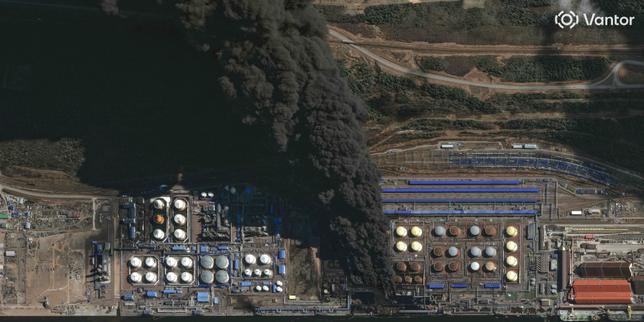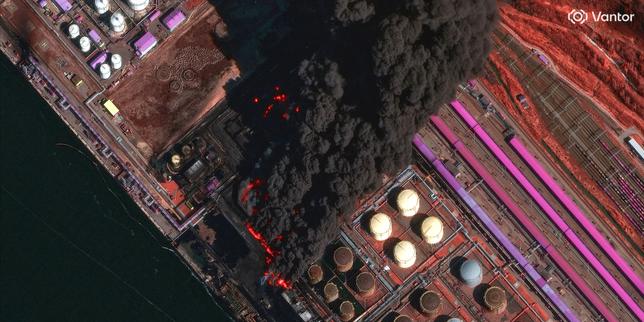
The reach of Ukrainian drone technology has officially outpaced the geographical safety net long enjoyed by the Russian energy sector. By striking the Ust-Luga terminal on the Gulf of Finland, Kyiv has not just hit a port; it has punctured the primary artery through which Russia pumps its economic lifeblood to the global market. This isn't a localized skirmish. It is a calculated expansion of the front line that places 700 miles of previously "safe" Russian territory under the constant threat of asymmetric warfare.
The shift in the war’s geometry is staggering. For nearly two years, the Baltic Sea was considered the rear guard of the Russian Federation. It was the quiet, cold waterway where tankers loaded fuel destined for Asia and South America, far from the HIMARS and Storm Shadows haunting the Donbas. That sense of security has evaporated. The drones used in the Ust-Luga strike traveled over 1,000 kilometers from the Ukrainian border, bypassing some of the most sophisticated air defense networks on the planet.
The Myth of Russian Air Superiority in the Rear
Military analysts have spent decades dissecting the S-400 and S-300 missile systems, often labeling them as impenetrable "bubbles." The reality on the ground—or rather, in the air—suggests a different story. These systems are designed to detect and intercept high-speed fighter jets and ballistic missiles. They are not particularly good at spotting a slow-moving, low-altitude drone made of composite materials that mimics the radar cross-section of a large bird.
Russia faces a math problem it cannot solve. The federation is the largest country on earth, and its critical infrastructure is scattered across nine time zones. To protect every oil terminal, refinery, and pumping station with point-defense systems like the Pantsir-S1 would require tens of thousands of units that simply do not exist. Ukraine knows this. By hitting a high-value target in the Baltic, they force Moscow into a defensive dilemma: do they pull air defenses from the front lines to protect the oligarchs' refineries, or do they leave the economy's engine exposed?
The Economics of Fire and Steel
Ust-Luga is more than just a collection of docks and cranes. It is a massive industrial complex where gas condensate is processed into jet fuel and heating oil for export. When a drone strikes a fractionation unit, it doesn't just cause a fire; it causes a specialized industrial catastrophe. These units are not off-the-shelf items. They require western-made turbines, pumps, and sensors that are currently under heavy sanctions.
Replacing this equipment isn't a matter of weeks. It’s a matter of months, if not years. Russia has become adept at "shadow fleet" logistics to move its oil, but it cannot shadow-fleet a 50-ton distillation column. Every day the terminal is offline, millions of dollars in hard currency vanish. More importantly, the global insurance market is watching. When the "war risk" premium for a Baltic port jumps, the cost of doing business for Russian energy giants like Novatek spikes, further eroding the margins that fund the Kremlin’s war chest.
Domestic Pressure and the Invisible War
Until now, the average citizen in St. Petersburg or Vyborg could pretend the "Special Military Operation" was something happening to other people in a distant land. The plumes of smoke rising over the Gulf of Finland change that perception. It brings the reality of the conflict to the doorstep of Russia’s second-largest city.
Ukraine's strategy is transparently psychological. They are demonstrating that no part of Russia is beyond their grasp. This isn't about capturing territory in the Baltic; it's about making the cost of the war felt by the elites who have remained insulated. If the gas can't be refined and the ships can't sail, the social contract between the Kremlin and the oligarchic class begins to fray.
The Technical Evolution of the Long Range Drone
The hardware used in these strikes is often a mix of hobbyist technology and high-end military engineering. We are seeing drones powered by simple internal combustion engines, similar to those found in lawnmowers, yet guided by sophisticated AI-driven terminal homing systems. These machines use GPS-independent navigation, such as terrain contour matching, to avoid electronic jamming.
When a drone can fly for eight hours, navigate by "seeing" the ground, and hit a specific valve on a storage tank, the traditional rules of engagement are dead. Ukraine is currently out-innovating the Russian military-industrial complex by staying small, cheap, and agile. They are producing these long-range "suicide" drones in makeshift factories, sometimes in the basements of residential buildings, making the production line as difficult to target as the drones themselves.
Logistics of the Baltic Corridor
The Baltic Sea is a crowded, narrow space. It is also now a NATO lake, following the accession of Finland and Sweden. While Ukraine is acting independently, the intelligence required to navigate through Russian airspace to reach Ust-Luga is immense. The Russians are quick to blame Western satellite data, but the truth is likely more grounded. Ukraine has developed its own robust intelligence network, utilizing human assets within Russia and sophisticated signals intelligence to map out the holes in Russian radar coverage.
The strategic significance of the Baltic cannot be overstated. It is Russia's primary window to Europe and the Atlantic. If Ukraine can sustain a campaign of atmospheric pressure against these ports, they effectively blockade Russia without ever needing a navy. It is a blockade by attrition, where the risk of docking becomes higher than the reward of the cargo.
The Vulnerability of Global Energy Markets
The world's energy markets are a delicate ecosystem. Any disruption in the Baltic ripples through to prices in Rotterdam and Singapore. While the US and its allies want to see Russia's war-making capability diminished, they are also terrified of a massive price spike that could trigger global inflation. Ukraine is walking a razor's edge. They must hit Russia hard enough to hurt, but not so hard that they alienate the Western partners who provide their financial and military support.
This is why we see targets like gas condensate plants rather than crude oil pipelines. The former hurts the Russian military's fuel supply and specific export revenues, while the latter could trigger a global economic shock. It is surgical, high-stakes economic warfare conducted from the air.
Hardware vs Intent
The West has spent billions on high-tech weaponry, but the most effective tool in the Ukrainian arsenal right now is a $30,000 drone with a 50-pound explosive charge. The disparity in cost-to-damage ratio is unprecedented in modern history. A single successful strike can destroy equipment worth $100 million and halt production worth $1 billion.
Russia’s response has been to increase the frequency of its own drone and missile barrages, but these are often directed at civilian infrastructure with the intent to terrorize. Ukraine's strikes, conversely, are becoming increasingly focused on the technical nodes of the Russian economy. This isn't just revenge; it's a systematic dismantling of the opponent's ability to maintain a long-term industrial war.
The Geography of Fear
As the snow melts and the weather clears, the frequency of these long-range attacks will likely increase. The Russian military is now forced to defend a perimeter that is thousands of miles long. Every radar unit moved to the Baltic is one less unit guarding the approach to Moscow or the bridges to Crimea.
The logistical nightmare for the Kremlin is only beginning. They are fighting a ghost in the machine—an enemy that can appear from any direction, at any time, with almost no warning. The Baltic was supposed to be a sanctuary. Instead, it has become a target gallery.
For the international community, the lesson is clear. The era of the "safe rear" is over. In a world of cheap, long-range precision strikes, industrial concentration is a liability. Every chimney, every tank, and every dock is a potential point of failure. The war in Ukraine has moved past the trenches and into the heart of the industrial age's most vital infrastructure.
The smoke over Ust-Luga is a signal. It tells the world that the geography of this conflict is no longer bounded by the borders of Ukraine. The front line is now wherever a drone can reach, and in the 21st century, that is everywhere.