You didn't have this on your 2026 bingo card, but a sitting US President is officially getting his face stamped onto legal tender.
On July 15, 2026, Treasury Secretary Scott Bessent announced that the US Mint has begun striking a new, gold-colored $1 coin featuring Donald Trump. It is timed to mark America’s 250th birthday.
If you think this is just another standard commemorative release, you’re missing the massive political and legal storm brewing behind the scenes. This coin is not just a collector's item. It is a highly controversial piece of metal that pushes the absolute limits of federal law, completely bypasses standard design committees, and has numismatists and politicians screaming foul.
Here is what is actually going on with the Trump dollar coin, why it's legal (kinda), and what it means for your wallet.
The Portrait and the Pivot to Manganese Brass
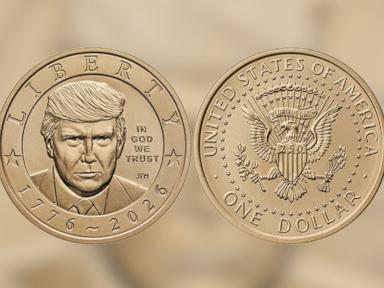
Let’s look at the coin itself. The final design, minted in Philadelphia, features Trump looking directly forward with a stern expression, flanked by "LIBERTY," "IN GOD WE TRUST," and the dual dates "1776-2026". On the back, you get the classic bald eagle with the shield from the Great Seal.
But the finished product represents a massive downgrade from earlier, much loftier plans.
If you look back at the original proposals from late last year and early 2026, the Trump administration was originally pushing for two vastly different concepts:
- The "Fight" Design: An early draft of the dollar coin featured Trump standing with a clenched fist in front of an American flag, displaying the words "FIGHT FIGHT FIGHT" — a direct nod to the 2024 Butler, Pennsylvania assassination attempt. This aggressive campaign-style imagery was ultimately scrapped.
- The Solid Gold Giant: The administration was also pushing for a giant, 24-karat solid gold coin that could have been up to 3 inches in diameter. This idea sparked massive backlash, with Senate Democrats raising red flags about where the Mint’s gold was sourced and demanding the project be halted.
Instead of solid gold, the Treasury pivoted. The new $1 coin is made of manganese brass — the exact same golden-hued alloy used for the Sacagawea dollar. It is slightly larger than a quarter, containing absolutely zero actual gold.
How Did They Bypass the "No Living Presidents" Law?
This is the question everyone is asking. Since the foundation of the republic, we’ve had a pretty strict rule: you don't put living people on US currency.
Specifically, federal law (dating back to the Civil War era) and the Presidential $1 Coin Act of 2005 explicitly state that a president must be deceased for at least two years before they can appear on a coin.
So how did Treasury Secretary Scott Bessent pull this off?
It all comes down to a clever bit of statutory gymnastics involving the Circulating Collectible Coin Redesign Act of 2020. This bipartisan bill, signed during Trump’s first term, authorized the Treasury to design and mint special commemorative coins for the 2026 Semiquincentennial (the 250th anniversary).
The 2020 law states:
"No head and shoulders portrait or bust of any person, living or dead, and no portrait of a living person may be included in the design on the reverse of any coin..."
Notice that very specific word: reverse.
The Treasury’s legal team realized that while the law explicitly banned putting a living person on the back (reverse) of the coin, it didn’t technically mention the front (obverse). Under this legal loophole, the Mint determined that slapping Trump's face on the front of the coin was perfectly legal.
Bessent also pointed to historical precedent. During the US Sesquicentennial (150th anniversary) in 1926, the US Mint released a coin featuring Calvin Coolidge, who was the sitting president at the time. If Coolidge could do it, the Treasury argued, so could Trump.
The Secretive Battle Inside the Mint
The legal loophole is one thing, but the process of getting this coin approved was downright dirty.
Normally, when a new US coin is designed, two key bodies must review and approve it: the Commission of Fine Arts (CFA) and the Citizens Coinage Advisory Committee (CCAC).
Because the CFA is currently composed entirely of Trump appointees, they happily rubber-stamped the design. But the CCAC — a separate advisory group of coin experts — was completely bypassed.
Donald Scarinci, a prominent numismatist who has served on the CCAC for over two decades, didn’t hold back his frustration. He revealed that the Mint tried to force a last-minute emergency meeting in December to get the design approved, but couldn't get a quorum. Instead of rescheduling, the Treasury just plowed ahead anyway, completely ignoring the committee's legal mandate to review the design.
"The concept that the secretary of the Treasury can create his own coin — it's illegal," Scarinci said, warning that the move could prompt Congress to step in and demonetize the coins entirely.
Can You Actually Spend This Dollar?
Technically, yes. It is legal tender with a face value of $1.
But don't expect to get one back in your change at the grocery store. The Treasury Department has confirmed that these coins will not enter general circulation.
Instead, the US Mint will sell them directly to the public in rolls, bags, and presentation boxes starting this fall. They are marketing them strictly as collectibles.
Because of the massive political polarization surrounding Trump, these coins are guaranteed to behave weirdly on the secondary market. Supporters will likely hoard them, while critics will avoid them entirely. If you want to get your hands on one, your best bet is to monitor the US Mint's official catalog as the fall release approaches. Keep your expectations realistic—because they are being minted in large quantities from basic manganese brass, they are highly unlikely to appreciate in value like actual gold bullion.