The sea does not care about ink.
For Leonardo, a fifty-two-year-old fisherman from the shores of Pangasinan, the water is not a geopolitical chessboard. It is a living, breathing engine of survival. He knows the contours of the Scarborough Shoal not by coordinates on a naval chart, but by the specific, vibrating hum of his wooden boat’s engine as it fights the swell, and by the taste of the salt spray that coats his lips. For generations, his family cast their nets into these shallow, turquoise waters, pulling up grouper and snapper to feed families on the mainland.
Then came the steel hulls.
In the dark of a humid Tuesday morning, Leonardo’s small vessel was dwarfed by a wall of gray steel. A Chinese coast guard ship, towering like an apartment building, blocked his path. The air split with the deafening roar of a high-pressure water cannon, a liquid battering ram that shattered his wooden outriggers and sent his crew scrambling for their lives. This is not an abstract debate about treaty clauses. It is a terrifying, wet, freezing reality played out on the high seas.
Behind the dry, bureaucratic language of international diplomacy lies a quiet tragedy of lost livelihoods, shrinking borders, and the slow, relentless strangulation of a region's sovereignty.
The Paper Shield of The Hague
To understand how a fisherman’s daily routine became a flashpoint for global conflict, one must look back to a quiet room in the Netherlands. On July 12, 2016, an arbitral tribunal in The Hague issued a unanimous, sweeping decision. The ruling was clear: Beijing’s self-proclaimed "nine-dash line"—a cartographic loop-the-loop claiming roughly eighty percent of the South China Sea—had absolutely no basis in international law.
The court ruled under the United Nations Convention on the Law of the Sea (UNCLOS), a treaty both China and the Philippines signed. It stated that "historic rights" could not override the legal maritime zones established by modern global consensus.
But international law is only as strong as the will to enforce it.
Beijing’s response was swift, simple, and defiant. They dismissed the landmark ruling as a "worthless piece of paper". They refused to participate in the hearings, refused to recognize the outcome, and instead doubled down on their physical presence. They built artificial islands, paved runways over fragile coral reefs, and deployed a shadowy "maritime militia"—hundreds of heavily reinforced fishing trawlers designed to ram, harass, and squeeze out local fishers.
For a decade, the ruling sat like a monument in an empty field. Admired by lawyers, ignored by the empire next door.
A Gathering of Fourteen
The landscape changed on the tenth anniversary of that ignored verdict. In a highly coordinated move, fourteen nations—including the United States, the United Kingdom, Japan, Australia, Germany, and the Philippines—released a joint, blistering statement. Alongside them, the 27-member European Union issued its own firm backing.
This was not just another routine press release. It was a diplomatic wall.
By banding together, these nations sought to internationalize what Beijing desperately tries to keep as a series of isolated, bilateral brawls. The coalition didn’t mince words. They explicitly condemned the use of military-grade lasers, water cannons, and dangerous blocking maneuvers designed to intimidate lawful operations.
But the real struggle isn’t happening in press rooms in Washington or Tokyo. It’s happening in the minds of the people who live along the edge of this contested water.
Consider the northernmost tip of the Philippines: the Batanes Islands. This emerald archipelago of windswept hills and stone houses has suddenly found itself on the front lines. Here, locals look out at the Luzon Strait and wonder if the horizon will soon be filled with gray hulls. To counter the international pressure of the 14-nation statement, Beijing has turned its eyes toward these very islands, introducing new diplomatic counter-claims and warning the Philippines that they are playing a dangerous game.
The message is clear: if you push us with paper, we will push you with steel.
The Invisible Stakes
It is easy to look at a map of the South China Sea and see only empty blue space dotted with tiny, uninhabited reefs. But this water is the throat of global commerce.
More than three trillion dollars in trade passes through this corridor annually—nearly one-third of all global maritime shipping. The smartphone in your pocket, the grain feeding livestock in Europe, the oil powering factories in Japan—they all float through these contested waters.
If one nation successfully colonizes this sea, they control the switch to the global economy.
More intimately, the South China Sea is a biological miracle. Its reefs are the spawning grounds for fish populations that feed hundreds of millions of people across Southeast Asia. Yet, the environmental destruction of building military bases on live coral, combined with unchecked industrial overfishing by state-backed fleets, is pushing this vital ecosystem to the brink of a total collapse.
For the people of the coastlines, this is not a theoretical chess match. It is a slow-motion eviction from their own homes.
The Horizon Ahead
The 14-nation statement is a necessary, albeit fragile, shield. It reminds the world that might does not make right, that a signed treaty actually means something, and that the ocean belongs to the global community, not to whoever has the biggest cannons.
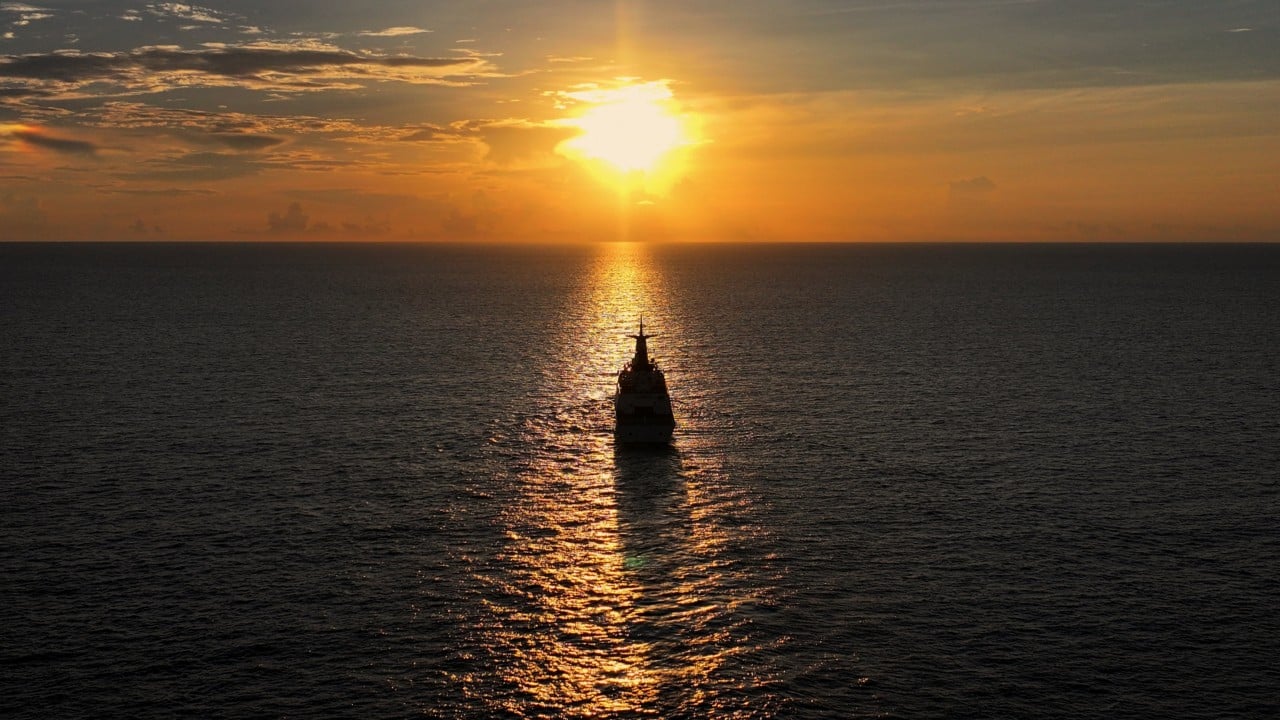
But as the sun sets over the West Philippine Sea, painting the sky in bruises of purple and gold, Leonardo prepares his mended boat for another run. He knows the 14-nation coalition will not be sitting in his wooden hull when the gray ships appear again. He knows the law is a distant comfort when cold water is rushing over his deck.
The real test of international law is not whether fourteen countries can sign a piece of paper. It is whether they can ensure that a single, quiet fisherman can cast his net into the sea of his ancestors, look at the horizon, and feel safe.
Until then, the maps will remain contested, the water will remain hot, and the small wooden boats will keep sailing directly into the path of the giants.