The air in a modern marriage is rarely still. It is filled with the hum of the refrigerator, the pitter-patter of a toddler’s feet, and, increasingly, the sharp, jagged edges of a divided nation. We have been told for a decade that the world is splitting in two. We are led to believe that if you share a bed with someone, you must also share a soul, a voting record, and a singular vision for the tax code.
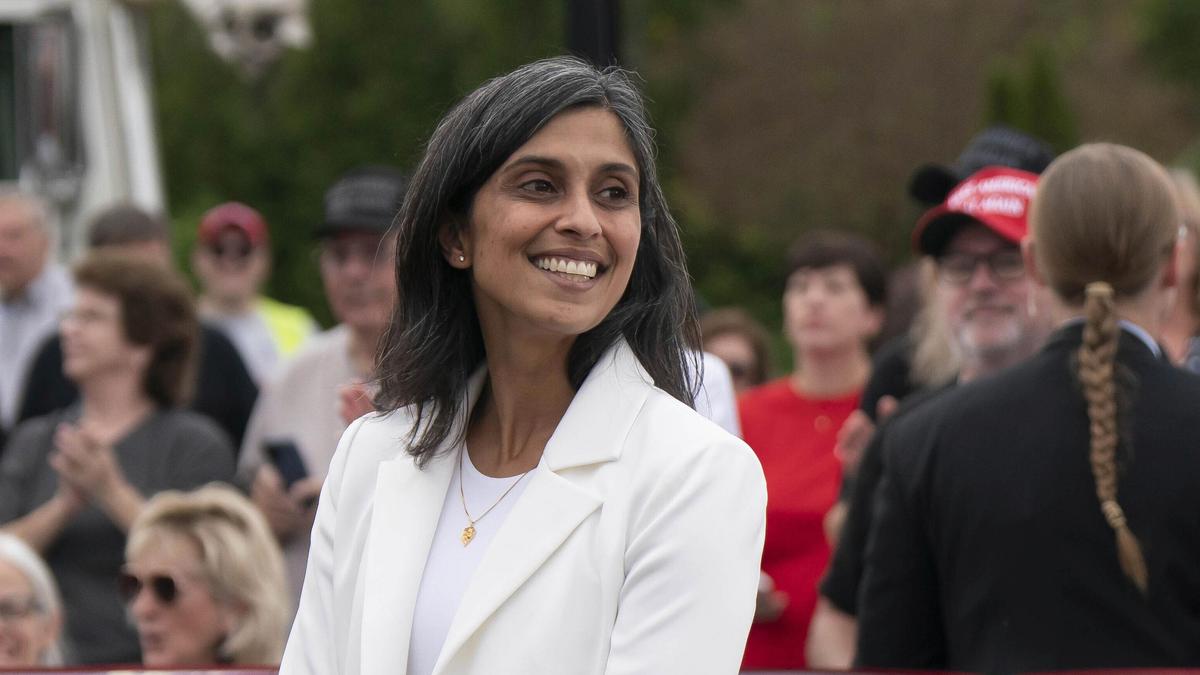
Then there is Usha Vance.
She sits in the bright glare of the national spotlight, not as a carbon copy of her husband, but as a reminder of a forgotten art. Her recent public reflections on her marriage to JD Vance aren't just political damage control. They are a window into a quiet, radical domesticity where two people can look at the same sunset and see entirely different colors—and still eat dinner together at the same table.
The headlines tried to flatten her. They took her admission—that she and her husband don't agree on every issue—and treated it like a glitch in the software. In a world of tribalism, total ideological alignment is expected. Anything less is seen as a betrayal or a weakness. but Usha’s stance suggests something far more complex. It suggests that the strongest bonds are not built on the absence of conflict, but on the presence of a shared language that exists beneath the noise of policy.
The Myth of the Monolith
Think about the last time you sat across from someone you loved and felt that sudden, cold prickle of realization: They don't see this the way I do.
It might have been about something trivial, like how to raise a child or where to spend the holidays. Or it might have been about the fundamental direction of the country. In that moment, the temptation is to pull away. To categorize. To judge. We have been conditioned to believe that disagreement is a precursor to divorce—either literal or emotional.
Usha Vance, a litigator with a background that screams intellectual rigour, defies this. She is a woman of South Asian descent, a daughter of immigrants, a Yale Law graduate, and a former clerk for Supreme Court justices. Her resume is a map of high-level deliberation. She knows better than most that two brilliant minds can look at the same set of facts and arrive at different conclusions.
When she speaks about her husband, she isn’t describing a political project. She is describing a man.
The core of her message is a rejection of the monolith. By publicly stating that they have "plenty of disagreements," she is reclaiming her own agency. She is refusing to be the silent, nodding spouse that political consultants dream of. She is essentially saying that her husband’s platform is his, and her mind is hers.
The Invisible Stakes of Agreement
There is a hidden cost to the demand for total agreement. When we require our partners to mirror our every thought, we aren't seeking a relationship. We are seeking an echo.
Imagine a kitchen in Cincinnati. The kids are finally asleep. The television is off. The world outside is shouting about the latest poll, the latest gaffe, the latest cultural firestorm. Inside, there are two people. One is a Vice Presidential candidate carrying the weight of a movement that many find polarizing. The other is a woman who has spent her life navigating elite spaces where that movement is often viewed with hostility.
If they were required to agree on everything, the conversation would die. Silence would become a survival mechanism.
Instead, Usha describes a marriage where the friction is the point. It is the "iron sharpening iron" philosophy applied to the dinner table. If JD Vance proposes a policy, and Usha—with her legal mind and distinct life experience—challenges it, the policy might change. Or, more importantly, the man might change.
This isn't just about the Vances. It’s about the millions of American families who have stopped talking to each other because of a ballot box. We have elevated political identity to a religious status, forgetting that the most important "identity" we hold is often the one we share with the person across the hall.
A Different Kind of Loyalty
We often confuse loyalty with compliance.
In the political arena, a "loyal" spouse is one who defends every word, justifies every mistake, and adopts every stance of their partner. But that isn't loyalty. That’s branding.
True loyalty is what Usha Vance is practicing. It is the loyalty that says: I don't agree with your conclusion, but I believe in your character. I don't like that policy, but I know the heart of the man who wrote it.
This is an uncomfortable concept for a modern audience. We want our villains to be entirely villainous and our heroes to be perfectly heroic. We want the spouses of people we dislike to be either victims or villains themselves. Usha refuses to play the part. She presents a reality where a person can be "okay" with disagreement because they value the human being more than the talking point.
She spoke of their different backgrounds—the cultural gap between a girl from a suburban San Diego academic family and a boy from the hollows of Kentucky. Those gaps don't just vanish because you get married. They become the texture of the life you build.
The Art of the Civilized Disagreement
Let’s look at the mechanics of how this works. It’s easy to say "we disagree," but how do you live it?
It requires a high degree of intellectual humility. It requires the ability to say, "I might be wrong," or at least, "I see how you could be right."
Usha Vance’s background in the law is no small detail here. In a courtroom, two sides argue vehemently. They use every tool at their disposal to win. But when the gavel drops, the lawyers often go out for a drink. They understand that the argument is a process, not a personal attack.
If we apply that to a marriage, the stakes change. The argument over a specific policy becomes a debate, not a declaration of war. By normalizing this, Usha is offering a lifeline to a country that is currently suffocating under the pressure of "purity tests."
She is signaling that you can love someone whose politics make you cringe. You can support a person’s journey without endorsing every single stop along the way.
The Weight of the Public Eye
It is one thing to disagree in the privacy of a home. It is another to do it when the entire world is watching, waiting for a crack in the armor.
Every time Usha Vance admits to a difference in opinion, she hands a weapon to her husband's critics. They can use her words to say, "See? Even his wife doesn't like his ideas." But she does it anyway.
There is a quiet bravery in that. It is the bravery of honesty.
She isn't just defending her husband; she is defending the complexity of the human experience. She is reminding us that JD Vance is a father who helps with the kids and a husband who listens to his wife’s critiques. She is humanizing a figure who has been flattened into a caricature by both his fans and his detractors.
The media often portrays political wives as either the "Power Behind the Throne" or the "Silent Sufferer." Usha is carving out a third path: the "Independent Participant." She is there by choice, not by obligation. She supports the man, not necessarily the manifesto.
The Quiet Radicalism of Nuance
We live in an era of loud certainties. Everyone has an opinion, and everyone is 100% sure they are right.
Usha Vance’s approach is a radical departure from this. It is a soft-spoken insistence on nuance. It is an admission that life is messy, that relationships are complicated, and that no one person—not even a spouse—can represent the totality of another person’s beliefs.
Think of the hypothetical "undecided voter" sitting in a living room in Pennsylvania. They look at the screen and see a woman who looks like them, who went to schools like theirs, who speaks with a measured, calm authority. They hear her say she doesn't agree with everything her husband says.
That voter doesn't feel lied to. They feel seen.
Because they, too, have a brother they love but can't talk politics with. They have a mother who voted for the "other side." They have a partner who drives them crazy with their worldviews.
By acknowledging the space between her chair and JD’s, Usha Vance isn't creating distance. She is creating a bridge. She is suggesting that the bridge is made of something stronger than political consensus. It is made of history, of shared struggle, and of a fundamental respect that transcends the current news cycle.
The Texture of a Shared Life
Ultimately, a marriage is not a political caucus. It is a series of small, mundane moments that accumulate over time.
It’s the way he makes the coffee. It’s the way she handles a crisis. It’s the shared jokes that no one else understands. When Usha Vance looks at her husband, she isn't seeing a set of bullet points on a campaign website. She is seeing the man who was with her in the law library at Yale. She is seeing the father of her children.
The "invisible stakes" of their public life are not about winning an election. They are about preserving the integrity of their private world while the public one tries to tear it apart.
Her refusal to be a carbon copy is her way of protecting that world. It’s her way of saying that their home is a sanctuary where ideas can be tested, rejected, or refined without fear of excommunication.
In a time when we are encouraged to "unfriend" anyone who disagrees with us, Usha Vance is choosing to stay in the room. She is choosing to engage. She is choosing to love through the disagreement.
It isn't a glitch. It isn't a sign of trouble. It is the very definition of a robust, healthy, and deeply human partnership.
The space between their chairs isn't a void. It’s a room. And in that room, there is enough space for two different people to exist, to argue, and to remain whole.
She stands on the stage, the lights reflecting in her eyes, a woman who knows her own mind and loves a man who sometimes loses his. She doesn't need to agree with him to be his greatest ally. She only needs to be herself.
The lesson she offers us is simple, yet incredibly difficult to follow in the heat of a political summer. You don't have to win the argument to win at life. Sometimes, the most powerful thing you can do is hold someone’s hand while you tell them they’re wrong.