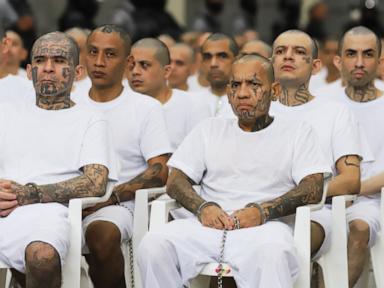
The light inside the Terrorism Confinement Center, known simply as CECOT, is flat and sterile. It does not so much illuminate as expose. In this colossal concrete fortress rising out of the volcanic soil of Tecoluca, hundreds of men sit perfectly still. Their heads are shaved. Their bodies, mapped with the dense, blue-black calligraphy of the Mara Salvatrucha, are hunched forward.
They are shackled at the wrists and ankles. They do not speak. Read more on a similar topic: this related article.
Instead, they stare at giant television screens mounted on the high, bare walls. On those screens, hundreds of miles away in San Salvador, sits a judge whose face they cannot see. This is the new face of justice in El Salvador. It is a trial by pixels, where the fates of 486 accused MS-13 leaders are decided in a single, sweeping gesture of state power.
To understand the weight of this moment, you have to look past the cold arithmetic of the courtroom. The prosecutors speak in numbers that stagger the mind: 47,000 crimes committed over a decade. Among them are 29,000 homicides. These are not just statistics; they are a decade of empty chairs at dinner tables, of whispered extortions paid in fear at dusty corner stores, of families fleeing northward in the dead of night. Additional analysis by Al Jazeera delves into comparable views on this issue.
But as the gavel falls in these unprecedented mass trials, a quieter, more haunting question echoes through the country. What happens to a society when it trades the slow, painstaking search for individual guilt for the swift, heavy hammer of collective retribution?
Consider a hypothetical Salvadoran woman named Maria. For fifteen years, Maria ran a pupuseria in a neighborhood once controlled by the gang. Every month, a teenager with a quiet voice and a gun tucked into his waistband would collect the renta—the extortion fee that kept her business open and her children alive. She knew the names of the boys who died on her street. She knew the terror of the weekends when the "valves" were opened and the streets ran red.
When President Nayib Bukele declared a state of exception in March 2022 after a single weekend left 87 people dead, Maria, like millions of others, felt a profound, exhausting sense of relief. For the first time in her life, she could walk to the market after dark. Her children could play soccer in the street.
The peace is real. It is tangible. It is paid for by the silence on the screens of CECOT.
Yet, there is another side to the ledger. Under the state of emergency, more than 91,000 people have been swept into the prison system. The constitutional guarantees we take for granted—the right to know why you are being arrested, the right to speak to a lawyer, the presumption of innocence—have been suspended.
Among those thousands are men who were simply in the wrong place at the wrong time. Young men with no tattoos, whose only crime was living in a neighborhood where MS-13 ruled. The government itself has acknowledged that at least 8,000 innocent people have been arrested and later released. But for many still inside, their names are now swallowed by mass indictments where individual defense is practically impossible.
In the courtroom, prosecutors argue that these men operated as a unified, parallel state. They call it rebellion. Under this legal theory, the leadership of the gang is collectively responsible for every drop of blood spilled by their command chain. It is a legal shortcut, a massive dragnet designed to settle what prosecutors call "a historic debt."
But a trial without faces, where a single judge decides the fate of hundreds of men via a video link, risks turning the scales of justice into a rubber stamp. When we stop looking at the individual, we stop looking at the truth.
The courtrooms of El Salvador are no longer places of quiet deliberation. They are theaters of a new era. As the trial wraps up, the world watches a nation that has decided that the only way to cure a plague is to lock the entire city in a room and throw away the key.
The silence in Maria's neighborhood is beautiful. But as she looks at the empty streets, she wonders if the quiet is the sound of peace, or simply the sound of a country holding its breath.