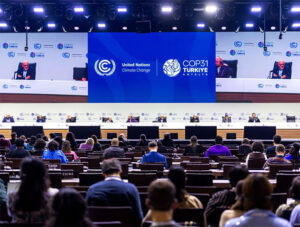
Picture walking into an emergency room with chest pain, and the hospital board votes to unplug the heart monitor because the beeping ruins the mood. That's basically what happens when international climate summits treat peer-reviewed physics like a negotiable opinion. At COP31, Earth system scientist Johan Rockström drew a hard line in the sand, warning world leaders that pushing scientific evidence to the margins isn't just bad diplomacy—it's a direct path toward irreversible planetary tipping points.
You've probably heard the phrase "tipping point" thrown around so much it's lost its punch. Let's fix that. In climate science, a tipping point isn't a gradual slope where things get a little warmer every summer. It's a threshold. Cross it, and a massive Earth system—like the Greenland ice sheet or the Amazon rainforest—locks into a self-reinforcing loop of collapse that continues even if humans suddenly cut emissions to zero the next morning. You might also find this related story interesting: Twenty-Four Ghosts in the Rearview Mirror.
Rockström, who directs the Potsdam Institute for Climate Impact Research (PIK) and co-developed the Planetary Boundaries framework, has spent decades mapping these exact thresholds. His message around COP31 cuts through the usual diplomatic polite-speak. While negotiators haggle over phrasing and fossil fuel lobbyists crowd the hallways, the physical climate system doesn't care about political compromise.
What Johan Rockström Actually Warned About at COP31
If you follow UN climate conferences closely, you know the pattern. Every November, tens of thousands of delegates gather, speeches get made about "ambition" and "solidarity," and the final text gets watered down until every petro-state can sign it without flinching. Rockström's intervention at COP31 targets the core flaw in that process: the deliberate sidelining of hard scientific boundaries in favor of politically convenient half-measures. As reported in recent articles by Reuters, the implications are significant.
Here's the problem he's pointing at. When science gets treated as just another stakeholder group sitting alongside industry trade associations, truth gets averaged out with wishful thinking. You can't negotiate a middle ground with thermodynamics. If the physics says keeping global heating below 1.5°C requires immediate, deep cuts in fossil fuel combustion, a compromise that delays action by a decade doesn't meet the physics halfway. It fails completely.
Rockström's warning centers on two interlocking threats. First, the Earth's major life-support systems are losing their resilience faster than older climate models predicted. Second, geopolitical pushback and economic short-termism are actively squeezing scientific consensus out of the decision-making room at COP summits.
The Physics of Climate Tipping Points Explained Simply
Most people still picture climate change as a linear thermostat. Turn up the carbon dioxide, turn up the temperature by a predictable notch, and deal with slightly worse weather. Honestly, if that were true, our jobs would be way easier.
Earth systems don't work like a dimmer switch. They work like a canoe. You can lean a little to the left, and the boat tilts, then rocks back upright. Lean a little further, and it still recovers. Lean one inch past a specific center of gravity, and the entire thing flips upside down in half a second.
Scientists have identified more than a dozen major climate tipping elements across the globe. Research led by Tim Lenton, Johan Rockström, and colleagues in Science and Nature shows that several of these systems are already dangerously close to their critical thresholds at current warming levels—roughly 1.3°C to 1.5°C above pre-industrial averages.
The Big Four Systems Keeping Scientists Up at Night
- The Greenland and West Antarctic Ice Sheets: Once melting lowers the elevation of these massive ice domes into warmer air layers, the melt accelerates on its own. Together, they hold enough water to raise global sea levels by roughly 10 meters over centuries.
- The Atlantic Meridional Overturning Circulation (AMOC): Think of this as the ocean's giant conveyor belt bringing warm tropical water north toward Europe. Fresh meltwater pouring off Greenland dilutes the salty, dense water that drives this current, risking a severe slowdown or collapse that would wreck global rainfall patterns and plunge Northern Europe into brutal winters.
- The Amazon Rainforest: Deforestation combined with rising heat and drought threatens to flip parts of the Amazon from a wet tropical forest that absorbs carbon into a dry savanna that pumps carbon back into the atmosphere.
- Boreal Permafrost: Frozen soils across Siberia, Alaska, and Canada lock away roughly twice as much carbon as currently sits in the entire atmosphere. As permafrost thaws, microbes wake up and release both carbon dioxide and methane, turbocharging warming from the ground up.
Notice how none of these operate in isolation. When Greenland melts faster, it dumps freshwater into the North Atlantic, which weakens the AMOC, which shifts tropical rain belts south, which dries out the Amazon. One domino knocks into the next. That's what Rockström means by cascading risk—and why treating 1.5°C as an arbitrary political slogan rather than a physical guardrail is so reckless.
How Science Gets Sidelined at UN Climate Summits
You might assume that a UN climate conference runs directly on the findings of the Intergovernmental Panel on Climate Change (IPCC). On paper, yes. In practice, the gap between what the IPCC reports say and what makes it into final COP cover decisions is massive.
I've watched how this plays out across multiple COP cycles, and the mechanics are surprisingly predictable. It rarely looks like someone standing up and shouting that climate change is a hoax. Instead, it happens through subtle procedural friction.
First, there's the battle over language. Negotiators spend days fighting over whether a text should say "phase out" or "phase down" fossil fuels, or whether to include loopholes like "unabated" emissions—a word that lets producers keep pumping oil and gas on the promise of future carbon capture technologies that barely exist at scale. When scientists point out that the math doesn't work, their warnings get softened into "welcoming the contributions of science" in a preamble paragraph while the binding operational clauses ignore the carbon budget entirely.
Second, look at who gets into the room. Over recent COP summits, fossil fuel lobbyists have outnumbered official delegates from almost every individual country, and often outnumbered the entire contingent of frontline Indigenous representatives and academic researchers combined. When your conference halls are packed with people paid to protect trillion-dollar stranded assets, scientific urgency gets drowned out by talk of "energy security" and "gradual transitions."
Third, consensus rules give a tiny handful of obstructive nations an effective veto. Because UNFCCC decisions require consensus among nearly 200 parties, any single oil-producing state can stall text that explicitly cites the latest IPCC warning on fossil fuel phase-outs. The result? The science gets watered down to the lowest common denominator.
The Planetary Boundaries Framework and Why It Matters Now
To understand why Rockström sounds the alarm so forcefully, you have to look at the broader framework he pioneered back in 2009 with a team of 28 internationally renowned scientists. Instead of looking only at carbon emissions and global average temperature, the Planetary Boundaries model tracks nine interconnected processes that regulate the stability of the entire Earth system.
Think of it as a comprehensive blood panel for the planet rather than just checking its temperature. Those nine boundaries cover:
- Climate change
- Biosphere integrity (biodiversity loss and extinction rates)
- Land-system change (deforestation and habitat conversion)
- Freshwater change (both surface water and soil moisture)
- Biogeochemical flows (nitrogen and phosphorus runoff from industrial agriculture)
- Ocean acidification
- Atmospheric aerosol loading
- Stratospheric ozone depletion
- Novel entities (synthetic chemicals, plastics, and microplastics)
According to the landmark update published in Science Advances by Katherine Richardson, Johan Rockström, and their team, humanity has already transgressed six of these nine planetary boundaries. Climate change and biosphere integrity sit deep in the high-risk zone.
Here's why that matters for COP31: you can't solve climate change while destroying the ecosystems that absorb half of our carbon emissions. Right now, oceans and land forests soak up roughly 50% of the carbon dioxide humans pump into the air every year. They're doing half the cleanup work for free. Push biodiversity loss, deforestation, and ocean warming past their tipping points, and Earth's natural carbon sinks start failing right when we need them most.
What Most People Get Wrong About the 1.5°C Target
A dangerous myth has crept into mainstream policy circles over the last couple of years. You hear it from executives, politicians, and even some commentators: "Well, we're basically hitting 1.5°C anyway, so let's just accept 2°C or 2.5°C as the new realistic goal."
That's a complete misunderstanding of how temperature thresholds work.
1.5°C isn't a pass-fail cliff where 1.49°C is paradise and 1.51°C is instant apocalypse. It's a risk dial. Every tenth of a degree above 1.5°C dramatically increases the probability of triggering multiple tipping points simultaneously. Going from 1.5°C to 2°C doesn't just make heatwaves 33% worse—it wipes out virtually all tropical coral reefs, exposes hundreds of millions more people to lethal wet-bulb heat stress, and pushes the Greenland and West Antarctic ice sheets far past their recovery zones.
Even more importantly, Rockström has repeatedly emphasized the danger of "overshoot" scenarios. Many economic models assume we can blow past 1.5°C for a few decades and then suck carbon back out of the atmosphere later this century using massive carbon dioxide removal technologies. The physics disagrees. If you trigger an ice sheet collapse or thaw deep permafrost during a 40-year overshoot, cooling the air back down later won't refreeze the ice or put the methane back underground. Some doors only swing one way.
What Needs to Change Before Science Loses the Room Completely
If COP31 and future climate summits are going to stay anchored to reality instead of turning into expensive trade shows, governments, institutions, and engaged citizens need to force a structural shift in how science feeds into policy.
- Bind negotiations directly to remaining carbon budgets: Every COP cover decision should open with the exact gigatons of CO2 remaining for a 50% or 67% chance of limiting warming, updated annually by the IPCC and Global Carbon Project, rather than vague multi-decade pledges.
- Enforce strict conflict-of-interest rules for delegates: Just as the World Health Organization bars tobacco lobbyists from shaping public health treaties under the Framework Convention on Tobacco Control, the UNFCCC must require full disclosure and restrict fossil fuel industry representatives from sitting on national negotiating teams.
- Integrate nature and climate targets into single legal mandates: Stop treating biodiversity summits (COP16/COP17) and climate summits as separate tracks. Protecting intact forests, peatlands, and coastal mangroves must be financed as core climate infrastructure.
- Shift domestic accountability from 2050 pledges to five-year rolling cuts: Politicians love promising net-zero by 2050 because they'll be retired by then. Demand legally binding five-year carbon budgets with automatic policy triggers when a country falls off track.
- Support independent climate science communication: When researchers like Johan Rockström face political blowback for stating uncomfortable physical realities, universities, media outlets, and voters need to back scientific independence over corporate greenwashing.
Physics doesn't sign compromises, wait for election cycles, or read press releases—and the longer world leaders treat scientific boundaries as optional, the fewer choices the rest of us will have left.