The coffee in the room is cold, the kind of bitterness that comes from sitting in a thermal carafe for six hours while men in tailored suits stare at maps of a coastline they rarely visit. In London and Paris, the clocks are ticking toward a midnight that carries more weight than a simple change of date. On the table lies a document—a renewal of a deal, a pact of cooperation, a shared burden. To the bureaucrats, it is a matter of budget allocations and "interoperability." To the people waiting on the frost-covered dunes of northern France, it is the difference between a life and a ghost story.
The English Channel is twenty-one miles wide at its narrowest point. On a clear day, you can see the white cliffs of Dover standing like sentinels against the horizon. They look close enough to touch. They look like a promise. But for those standing in the mud of the Pas-de-Calais, that stretch of water is an abyss. It is a graveyard of dreams and a theater of political desperation.
As the UK and France enter these eleventh-hour negotiations to renew their "small boats" security agreement, the air is thick with the scent of high-stakes theater. The UK wants more boots on French beaches. France wants more money for the drones, the thermal imaging cameras, and the hundreds of officers who patrol the shoreline in the dead of night. They are haggling over the price of a border that refuses to stay put.
The Geography of Desperation
Imagine a woman named Amira. She is not a statistic in a Home Office spreadsheet. She is a former schoolteacher from a city that no longer exists in any functional sense. She is sitting in a tent made of heavy-duty bin liners and discarded tarpaulin. Her shoes are caked in a grey, chalky silt that never seems to dry. For Amira, the news of a "renewed bilateral agreement" means very little until it manifests as a searchlight sweeping across the sand or a siren wailing in the distance.
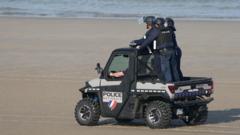
The current deal involves the UK paying hundreds of millions of pounds to France to beef up security. It pays for high-tech surveillance. It pays for the "beach buggies" that tear across the dunes to intercept groups before they can launch. But the sea has a way of mocking the best-laid plans of governments. When one section of the coast is locked down, the human tide simply shifts. It moves five miles down the coast. It moves ten. It moves into more dangerous waters where the currents are unpredictable and the chance of being spotted by a rescue vessel dwindles to near zero.
Consider the physics of a dinghy built for six people carrying twenty-five. The rubberized fabric groans under the weight. The outboard motor, often a cheap imitation bought in bulk, coughs and sputters in the salt air. Water begins to seep over the side. It is cold—a bone-deep chill that steals the breath from your lungs. This is the reality that the "small boats deal" attempts to manage from a distance of hundreds of miles.
The Cost of the Fence
The tension in these talks stems from a fundamental disagreement about responsibility. The UK argues that as a sovereign nation, it must control its borders to maintain public trust and national security. The argument is that by funding French enforcement, they are breaking the "business model" of the smuggling gangs who profit from this misery. It is a logic of deterrence. If the journey is too difficult, the logic goes, people will stop trying.
France, meanwhile, views the situation through a lens of exhaustion. They point out that they are effectively acting as Britain’s border guard on European soil. Their officers are tired. Their coastal towns are under immense pressure. They argue that the money provided by the UK, while significant, barely scratches the surface of the long-term social and logistical costs.
The numbers are staggering. We are talking about half a billion pounds over several years. We are talking about thousands of interceptions. Yet, the boats keep coming. The "success" of the deal is measured in the number of launches prevented, but the failure is measured in the number of bodies recovered from the surf. It is a grim accounting system where the currency is human life.
The Smuggler’s Shadow
Behind every high-level diplomatic meeting is the shadow of the organized crime syndicates. These are not the Robin Hood figures of folklore. They are predators. They operate in the shadows of encrypted messaging apps, moving people like cargo. They watch the news, too. They know when a new deal is signed. They know when the patrols are likely to increase.
When the UK and France tighten the screws, the smugglers increase their prices. They find more remote launch sites. They use flimsier boats to maximize profit margins. The diplomacy in London and Paris inadvertently creates a market where the risk is passed entirely to the buyer. The "customer"—the person in the tent—pays more for a higher chance of drowning.
The complexity of the problem is that both governments are right and both are wrong. The UK is right that the current situation is unsustainable and dangerous. France is right that they cannot be expected to solve a global migration crisis through local policing alone. They are stuck in a cycle of reactive policy, trying to plug leaks in a dam that was never built to hold this much pressure.
The Weight of the Water
There is a specific kind of silence that happens on the Channel at three in the morning. It is the silence of a small boat when the engine finally dies. In that moment, the politics of the European Union, the rhetoric of "taking back control," and the intricacies of international maritime law vanish. There is only the sound of the waves and the realization that the shore is nowhere to be seen.
The negotiators in their warm rooms are trying to find a middle ground. They are looking for a figure that satisfies the Treasury and a set of operational goals that satisfies the Ministry of the Interior. They are looking for a way to tell their respective voters that the problem is under control.
But can a border ever truly be under control when the drivers of migration—war, climate collapse, and economic ruin—remain unaddressed? The small boats deal is a bandage on a wound that requires surgery. It is a necessary bandage, perhaps, to prevent the patient from bleeding out, but it is not a cure.
The Human Ledger
We must look at what happens when the deal "works." A group is stopped on the beach. They are processed, their details taken, and they are often released back into the same cycle of displacement. They return to the camps. They wait for the next moonless night. They wait for the next gap in the patrol schedule. The deal creates a holding pattern, a Limbo on the edge of the continent.
For the people of Dover and the people of Calais, the deal is a daily reality. It is the sight of lifejackets washed up like orange rinds on the shingle. It is the sound of helicopters overhead. It is the feeling of being at the center of a storm that neither side seems able to calm.
The talks will likely end with a handshake and a joint statement. There will be talk of "renewed commitment" and "strengthened cooperation." More money will change hands. More cameras will be installed on the dunes. The headlines will move on to the next crisis, the next scandal, the next election.
Yet, the water remains. The twenty-one miles do not shrink.
Amira is still there. She is watching the horizon. She is not waiting for a policy update or a press release from the Home Office. She is waiting for the wind to drop. She is waiting for the moment when the fear of staying becomes greater than the fear of the crossing.
The invisible line in the sea is not made of ink on a treaty. It is made of salt, steel, and the desperate hope of those who have nothing left to lose. Until the world finds a way to address why people are fleeing, the UK and France will continue to meet in cold rooms, drinking cold coffee, trying to bargain with the tide.
The tide, however, does not negotiate. It only pulls.