The mainstream media is stuck in a decade-old time loop. Whenever analysts look at the northern border of Côte d’Ivoire, they dust off the same tired playbook: count the number of cross-border skirmishes, sound the alarm about an imminent "southward expansion" of Sahelian terror networks, and advise Western governments to pour more millions into military hardware.
This lazy consensus is not just wrong; it is actively dangerous.
Ten years after the Grand-Bassam shootings and a few years removed from the Kafolo outpost attacks, the standard narrative insists that Côte d’Ivoire is a fragile domino waiting to fall to Al-Qaeda affiliate JNIM (Jama'at Nusrat al-Islam wal-Muslimin). This assessment fundamentally misunderstands both the nature of modern insurgency and the specific socio-economic reality of the Ivorian north. Côte d’Ivoire is not Mali. It is not Burkina Faso. Treating it as the next inevitable theater in the Sahelian war ignores the real levers of stability and instability on the ground.
Security cannot be measured by the number of drones patrolling the Tchologo region. If you want to understand why the north hasn't collapsed—and why the standard counter-terrorism manual is useless here—you have to look at what the alarmists are completely ignoring.
The Myth of the Contagion Model
The foundational flaw in Western analysis of West African security is the "contagion model." Analysts view jihadism like a biological virus, creeping across borders on a map, infecting territory indiscriminately. Under this logic, because Burkina Faso’s eastern and southern provinces are highly unstable, northern Côte d’Ivoire must inevitably succumb.
This is intellectual laziness. Insurgencies do not expand through geographic proximity; they expand through local opportunities. They exploit governance vacuums, ethnic marginalization, and economic despair.
Where the contagion model falls flat is in its failure to recognize that the Ivorian state actually exists in its northern borderlands. Unlike the central government in Ouagadougou, which effectively abandoned its rural peripheries years ago, Yamoussoukro has spent the last half-decade aggressively asserting its presence in regions like Bounkani and Tchologo.
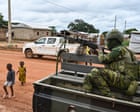
I have watched international donors pour massive funding into heavy border militarization, convinced an invasion force was coming. They prepared for a conventional cross-border assault that was never in the cards. JNIM is a network of syndicates, not a conventional army. They do not want to conquer Korhogo; they want to use the border zone as a logistics, fund-raising, and rest-and-relaxation sanctuary.
By treating a complex cross-border smuggling ecosystem as a purely military invasion, Western-backed strategies risk provoking the exact local hostilities they are trying to prevent.
The Real Economy of the Borderland: Smuggling as Stasis
To understand why the northern frontier remains relatively quiet, you have to follow the money. And the money in northern Côte d’Ivoire does not run on jihadist ideology. It runs on cattle, gold, and fuel.
The standard counter-terrorism expert looks at illicit trafficking networks across the Comoé National Park and sees a security failure. They demand crackdowns, border closures, and aggressive policing. They do not realize that these informal economic networks are precisely what keeps the region stable.
Let’s look at the mechanics of the cattle trade. The northern Ivorian economy relies heavily on transhumance—the seasonal movement of livestock from the landlocked Sahel down to the coastal markets. Because of the conflict in Burkina Faso, traditional trade routes are broken. Northern Côte d’Ivoire has become a vital economic lung for pastoralists.
JNIM finances itself by taxing these trade routes on the Burkinabé side. But here is the nuance the analysts miss: the insurgents understand that if they destabilize northern Côte d’Ivoire through mass casualty attacks, they kill the golden goose. They shut down the very markets where their taxed cattle are sold and where their operatives buy supplies, medical goods, and fuel.
The Reality Check: The relative peace in northern Côte d’Ivoire is not a sign of total military deterrence; it is a product of a cold, transactional equilibrium. The militants need the Ivorian market functioning. The local population needs the trade flowing.
When the state steps in with heavy-handed military crackdowns that disrupt these informal economies—confiscating livestock or shutting down artisanal gold mining sites without providing alternatives—it does the insurgents' recruiting work for them. You do not counter violent extremism by bankrupting the border population.
Dismantling the "People Also Ask" Delusions
When people search for information on the Ivorian security situation, the questions asked reflect a deep misunderstanding of West African dynamics. Let’s address the most prominent misconceptions directly.
Is Côte d’Ivoire the next Mali or Burkina Faso?
Absolutely not. The structural conditions are entirely different. Mali and Burkina Faso suffered from profound institutional decay, multiple military coups, and a total collapse of trust between rural populations and urban elites. Côte d’Ivoire, despite its history of civil conflict in the 2000s, possesses a highly centralized, economically vibrant state apparatus. The Ivorian military (FACI) has undergone significant professionalization since 2011. More importantly, the state has the financial capacity to invest in northern infrastructure—something its northern neighbors simply cannot do.
Are northern Ivorian Muslims prone to radicalization?
This question is based on a flawed premise that conflates religious identity with political violence. The Muslim population in northern Côte d’Ivoire has deep-rooted, centuries-old traditions of Sufi Islam and Maliki jurisprudence that are highly resistant to the rigid, foreign ideologies peddled by Sahelian jihadist groups. Radicalization in this region is almost never theological. When individuals cooperate with armed groups, it is driven by local grievances: land disputes between farmers and herders, heavy-handed behavior by security forces, or a simple lack of employment options for youth.
Has Western military aid saved Côte d’Ivoire from terror?
If anything, heavy reliance on external Western military doctrines has created blind spots. Millions have been spent on tactical training and intelligence-sharing mechanisms that treat the symptoms rather than the disease. The successes Côte d’Ivoire has achieved are overwhelmingly domestic: localized socio-economic programs, targeted infrastructure investments, and intelligence operations run by Ivorians who actually understand the local language and lineage structures.
The Danger of the "Social Programme" Success Narrative
In fairness to the Ivorian government, they realized earlier than most that guns alone would not solve the problem. The launch of the Programme Social du Gouvernement (PSGouv) injected billions of CFA francs into northern regions for youth employment, electricity, clean water, and road construction.
Mainstream analysts love this. They point to it as a gold standard of "holistic" counter-insurgency. But if you look closer at how these funds are distributed on the ground, the cracks in the strategy become obvious.
The administration of these development funds often routes through traditional chieftaincies and local political elites aligned with the ruling party in Abidjan. In the north, society is highly stratified. For generations, the Dioula trading class and traditional chieftains have held political sway, while pastoralist communities, particularly the Fulani (Peul), have been marginalized.
When development money flows strictly through existing elite structures, it exacerbates local inequality. A young Fulani herder who cannot get access to grazing land or who is extorted by local gendarmerie does not care that a new school was built three villages over. He sees the state apparatus getting richer while his community remains marginalized.
If the state’s development push inadvertently widens the gap between favored ethnic groups and marginalized minorities, it creates the exact social friction points that JNIM exploits to present itself as an alternative adjudicator of justice.
Redefining Security on the Frontier
If the goal is long-term stability along the northern border, the current approach needs a radical overhaul. Stop measuring success by the number of battalions deployed or the amount of foreign aid secured.
Instead, execution must pivot toward three unconventional priorities:
- Legalize and Regulate, Don't Prohibit: Stop trying to shut down informal cross-border trade and artisanal gold mining. When the state bans these activities, it pushes them entirely into the underground economy, making them easy targets for insurgent taxation and control. Create clear, low-barrier regulatory frameworks that allow local actors to operate legally.
- De-escalate Border Militarization: Shift the primary security burden away from heavy infantry units toward community-oriented policing. The presence of elite special forces in rural villages often alienates locals. Trust is built through consistent, accountable local policing, not masked soldiers in technicals.
- Prioritize Local Dispute Resolution Over National Courts: The vast majority of entry points for armed groups stem from land use conflicts. The formal judicial system in Abidjan is slow, expensive, and viewed with suspicion. Empowering local, mixed commissions—comprising both agriculturalists and pastoralists—to resolve land disputes on the spot strips insurgents of their role as alternative judges.
The obsession with a conventional military threat from the north has blinded observers to the real dynamics of the borderlands. Côte d’Ivoire is winning its quiet war against instability not because of Western counter-terrorism doctrines, but in spite of them. Maintaining that edge requires ditching the alarmist rhetoric and accepting a messy, pragmatic reality where border economies matter far more than border defenses.
Stop looking for an invasion that isn't coming, and start paying attention to the fragile economic truce that is already there.