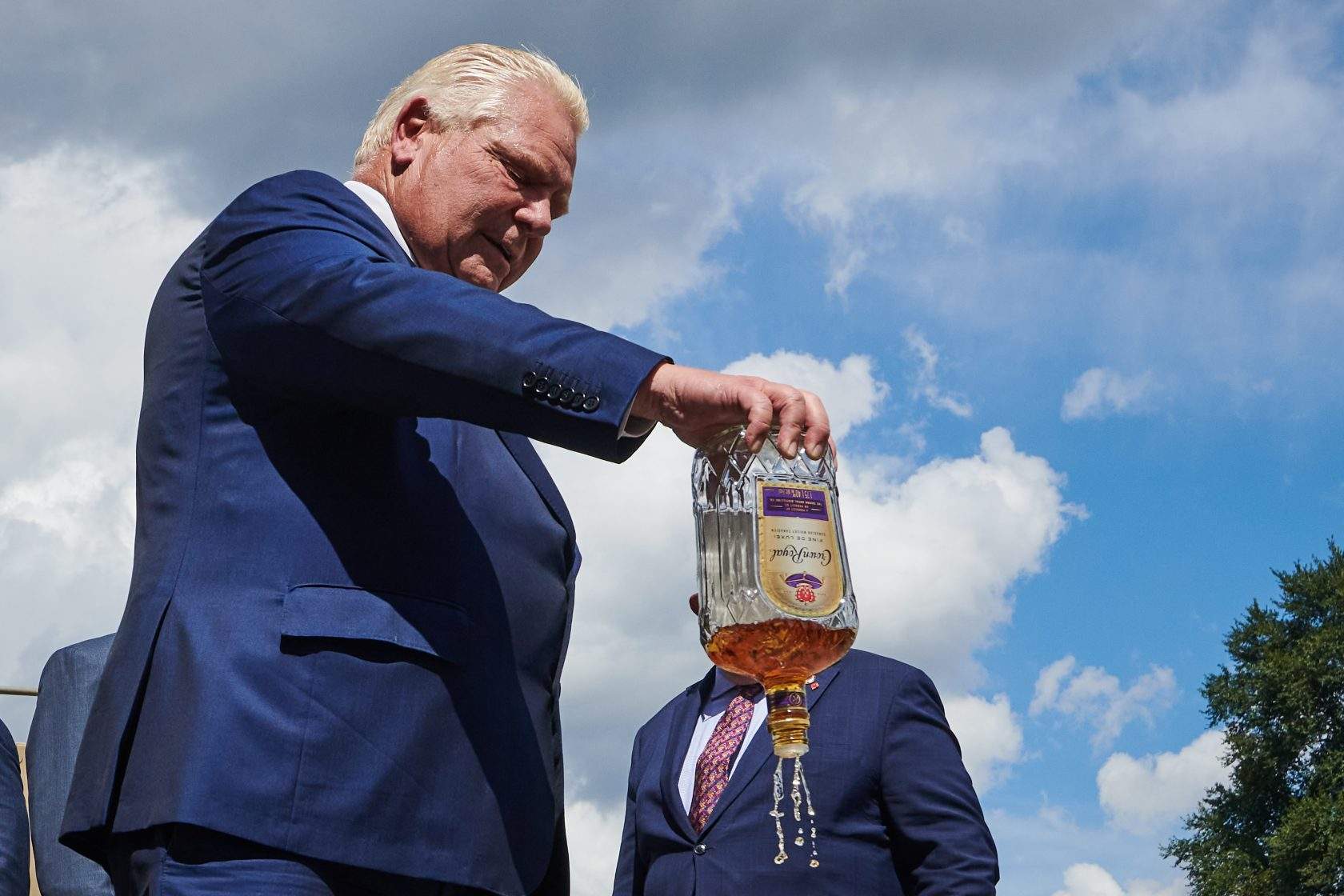
Sub-national retail monopolies wield asymmetric economic leverage when deployed as instruments of geopolitical retaliation. When the state controls the entire distribution and retail apparatus of a consumer market, market access ceases to be a function of private commercial demand and becomes a direct lever of state statecraft. This mechanism is currently defining the trade friction between Canada and the United States, crystallized by Ontario Premier Doug Ford’s absolute refusal to restore American alcohol to provincial shelves until broader federal tariff disputes are resolved.
The introduction of the Combating Attacks on our National Alcoholic Drinks by Allies (CANADA) Act by U.S. Representative Claudia Tenney marks an escalation from localized retail friction to formal international trade adjudication. By seeking a Section 301 investigation under the Trade Act of 1974, Washington is attempting to counter provincial procurement boycotts by threatening targeted federal counter-tariffs. This cross-border stand-off exposes a structural vulnerability in integrated supply chains: the vulnerability of private foreign producers to centralized, state-run monopsonies.
The Monopsony Lever and Market Distortions
The Liquor Control Board of Ontario (LCBO) and the Société des alcools du Québec (SAQ) do not operate as typical commercial retailers. They function as state-sanctioned monopsonies. In economics, a monopsony occurs when a market features many sellers but only one major buyer. When a provincial government decides to cease purchasing from a specific nation, it does not merely reduce market share; it completely closes the geographic market.
Before the enforcement of the procurement ban in March 2025, Ontario imported approximately $965 million worth of beverage alcohol from the United States annually. Quebec represented a parallel $434 million market for American wine producers. By halting all procurement, these two provinces instantly removed roughly $1.4 billion in annual demand from the balance sheets of U.S. wineries, breweries, and distilleries.
The structural impact on U.S. producers is non-linear. According to data from the Distilled Spirits Council of the United States, retaliatory provincial purchasing bans caused a 63 percent decline in total U.S. spirits exports to Canada over the course of 2025. This contraction highlights how sub-national state entities can execute highly targeted economic damage without relying on traditional federal tariff structures.
The internal cost function of this strategy falls on inventory depreciation and consumer welfare. When the LCBO implemented the sudden freeze on American products, approximately $2 million worth of U.S. inventory within provincial distribution hubs was left to expire. Because beer and ready-to-drink (RTD) mixed beverages possess finite shelf lives compared to distilled spirits, the immediate financial loss fell on distributors and the state enterprise itself, which had already committed capital to procurement or storage logistics.
The Section 301 Transmission Mechanism
The American legislative counter-strategy relies on the deployment of Section 301 of the Trade Act of 1974. This statutory provision grants the Office of the United States Trade Representative (USTR) broad authority to investigate and respond to foreign government practices that are deemed unfair, discriminatory, or restrictive to U.S. commerce.
The proposed CANADA Act directs USTR Jamieson Greer to initiate a formal investigation into provincial liquor board procurement policies. The strategic intent behind this legislative maneuver involves a multi-stage escalation framework:
[Congressional Enactment of CANADA Act]
                 │
                 ▼
[USTR Section 301 Investigation Initiated]
                 │
                 ▼
[Determination of Discriminatory Trade Practices]
                 │
                 ▼
[Authorized Federal Retaliation / Tariffs on Canadian Exports]
If the USTR investigation concludes that the provincial procurement halts constitute an unjustifiable restriction on commerce, the executive branch gains the legal mandate to impose compensatory tariffs on Canadian goods entering the United States. This transfers the economic pain away from U.S. beverage producers and onto core Canadian export sectors such as automotive components, steel, aluminum, or softwood lumber.
The U.S. position views the provincial bans as an artificial trade barrier that violates the core spirit of the Canada-United States-Mexico Agreement (CUSMA). From Washington's analytical perspective, Canada is utilizing provincial administrative bodies to bypass federal trade commitments, establishing a dangerous precedent where sub-national governments can nullify international treaties through procurement mandates.
Game Theory and the CUSMA Renegotiation Timeline
The refusal of Ontario and Quebec to back down reflects a calculated gambit rooted in game-theoretic bargaining. Premier Doug Ford's position is explicit: American alcohol serves as a hostage asset. It will not be returned to store shelves until the United States removes its broader, foundational tariffs on Canadian industrial sectors.
This strategy treats the retail ban not as an isolated commercial policy, but as a defensive counterweight against a much larger economic threat. The broader context is the ongoing, turbulent renegotiation of CUSMA. The United States recently declined to extend the continental trade pact for a fixed 16-year term, triggering a rolling annual review process that could last up to a decade. This rolling review injects severe structural uncertainty into the Canadian economy, as any member nation can signal an intent to terminate the agreement during the annual evaluation cycle.
Within this framework of persistent trade friction, Canada’s provincial leaders view unilateral concessions as strategic errors. Ford’s rhetoric regarding previous negotiations with U.S. officials reveals a deep institutional distrust. For example, during prior tariff disputes, Canadian regional leaders agreed to dismantle retaliatory measures, such as specific electricity surcharges on U.S. states, based on verbal assurances from U.S. officials that steel tariffs would be lifted. When the United States subsequently maintained or doubled down on those industrial tariffs, it demonstrated the risk of asymmetric compliance.
Therefore, the current Canadian strategy relies on maintaining the alcohol ban to preserve bargaining chips for the comprehensive CUSMA review. Eliminating the ban in exchange for mere goodwill, without securing binding exemptions from industrial tariffs, would deplete Canada's limited leverage.
Structural Vulnerabilities of Sub-National Trade Polices
While the weaponization of a state monopoly offers immediate retaliatory capabilities, it introduces severe long-term distortions and risks for the domestic economy. These vulnerabilities can be categorized into three distinct operational bottlenecks:
- Supply Chain Inelasticity: Retail monopolies rely on highly optimized, long-term procurement contracts to manage inventory and pricing structures. Abruptly severing ties with U.S. suppliers forces these monopolies to rapidly shift supply chains toward domestic or European alternatives. This rapid reallocation increases administrative costs and often results in higher consumer prices due to increased shipping distances and less favorable bulk-purchasing terms.
- Retail Substitution Inefficiencies: While regional vintners and craft brewers experience a temporary demand surge as consumers substitute missing American products with local alternatives, this protectionist benefit is artificial. Local producers face structural capacity constraints; they cannot scale production instantly to fill a billion-dollar supply void, leading to product scarcity and reduced consumer utility.
- Precedent for Asymmetric Federalism: The fact that provinces like Alberta and Saskatchewan have already restored American alcohol to their shelves while Ontario and Quebec maintain the ban reveals a fractured national trade strategy. This internal divergence allows foreign negotiators to isolate specific provinces, targeting them with localized rhetorical or economic pressure, which undermines Ottawa’s ability to present a unified national front during CUSMA negotiations.
The reliance on a rolling annual review process for CUSMA means that trade stability between the two nations is no longer a static baseline. Every sector, including consumer retail, is subject to sudden regulatory shifts. For businesses operating across the border, the corporate strategy must shift away from assuming frictionless integration and toward active mitigation of regulatory risk.
The fastest path to normalization remains a comprehensive, multi-sector Grand Bargain that addresses industrial tariffs and retail access simultaneously. However, as long as Washington uses industrial protectionism as a primary tool of economic policy, sub-national entities will continue to leverage their regulatory monopolies to impose localized pain on American exporters. The strategic play for Ontario is to hold the line on retail access, accepting short-term consumer dissatisfaction and inventory write-downs as the price required to protect core industrial supply chains from existential erosion.