The water in the Strait of Malacca does not care about diplomacy. It is a thick, humid choke point, choked with container ships, oil tankers, and the low, heavy hum of global commerce. If you stand on the southern tip of India’s Andaman and Nicobar Islands and look out across the grey horizon, you are only a few dozen miles from Indonesia. You cannot see the coast, but you can feel it. The air carries the same salt. The storms travel the same path.
For decades, this closeness was treated like an old family photograph left in a drawer. Everyone knew it was there, but nobody felt the need to take it out and examine it. India and Indonesia shared a historical memory of non-alignment, a polite mutual respect, and a massive expanse of water that kept them safely apart while keeping them bound together.
Then the world grew louder.
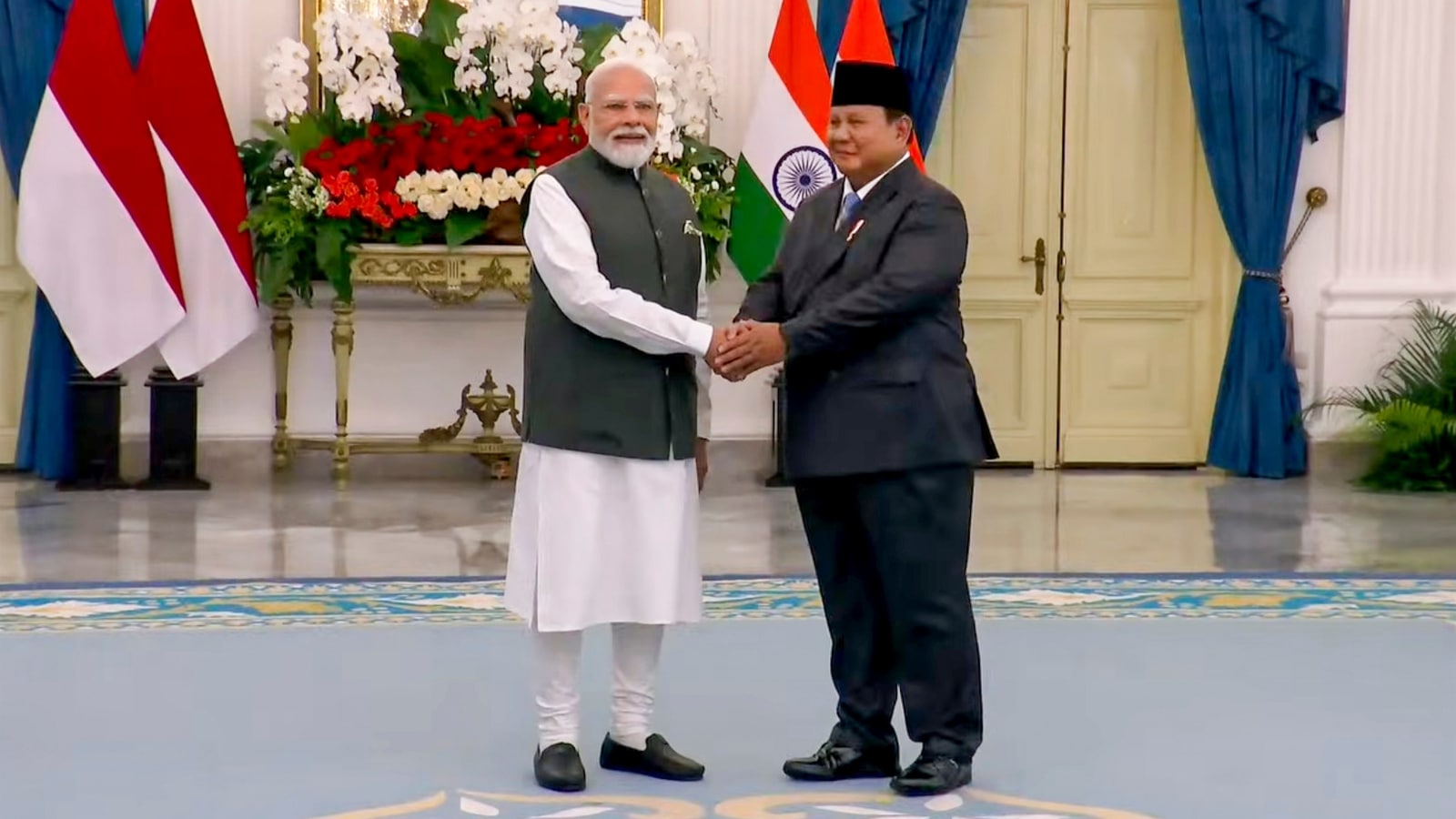
When Narendra Modi and Prabowo Subianto sat down across from each other recently, the cameras captured the usual stagecraft of international summits. There were the firm handshakes, the patterned shirts, the soft lighting of state rooms, and the polished wooden tables. The official press releases spoke of bilateral ties, trade frameworks, and defense cooperation. But the real story was not written in the bullet points of the communiqués. It was written in the shifting calculus of survival in an ocean that is rapidly becoming the most contested body of water on earth.
Consider the reality facing a cargo ship captain navigating these waters.
Every day, millions of barrels of oil pass through a narrow corridor that both New Delhi and Jakarta watch with increasing intensity. If that corridor closes, or if a hostile power decides to turn the key in the lock, the lights go out in factories thousands of miles away. The stakes are not abstract. They are measured in the cost of fuel, the price of grain, and the sudden, terrifying realization that peace is a fragile construction maintained by people who rarely sleep.
The Weight of the Chair
Prabowo Subianto is not a man who views power through a theoretical lens. His journey to the presidency of Indonesia was long, bruising, and deeply intertwined with the complex history of his nation’s military and political evolution. When he looks across the table at Narendra Modi, he sees a leader who has spent more than a decade reshaping India's global footprint.
Both men govern nations that are fiercely protective of their independence. Neither country wants to be a junior partner in someone else’s empire. Neither wants to be forced to choose between Washington and Beijing.
Yet, neutrality is changing its definition.
In the old days, staying neutral meant standing perfectly still while the giants fought around you. Today, standing still is a luxury that vanished somewhere between the expansion of artificial islands in the South China Sea and the deployment of blue-water navies across the Indian Ocean. To remain independent now, you must be strong enough to make aggression expensive. You must build an architecture of deterrence.
This is where the conversation turns from polite economic cooperation to something far more visceral.
The focus of their discussions dragged a specific word into the headlines: BrahMos. To a casual observer, it sounds like technical jargon. It is a portmanteau of the Brahmaputra and Moskva rivers, a symbol of joint Indian and Russian engineering. But to the men who design defense strategies, it represents a fundamental shift in gravity. It is a supersonic cruise missile. It flies fast, it flies low, and it is notoriously difficult to stop.
When a nation like Indonesia looks at acquiring such tech, it is not an act of casual shopping. It is an announcement. It tells the rest of the world that the waters surrounding the archipelago are no longer an open highway for anyone with a large navy.
The Quiet Commerce of Daily Bread
If weapons form the shield, trade is the blood that keeps the body alive.
We often talk about trade deals in billions of dollars, a number so large that it loses all human meaning. To understand what Modi and Prabowo were actually negotiating, you have to look away from the capital cities and look toward the palm oil plantations of Sumatra and the crowded markets of Mumbai.
Indonesia produces palm oil at a scale that defies imagination. India consumes it in quantities that drive global markets. It is an ingredient in everything from the soap used in rural villages to the cooking oil used in urban kitchens. When trade agreements stumble, the friction is felt by the housewife watching her weekly budget shrink or the farmer watching his harvest spoil because the shipping containers are stuck in a bureaucratic logjam.
The two leaders are trying to build a bridge across this gap that does not rely on traditional Western financial networks or vulnerable supply lines. They are talking about trading in local currencies, bypassing the dominant systems that can be weaponized during geopolitical crises.
Think about what happens next if this succeeds.
A trader in Jakarta can sell goods to a buyer in Chennai without worrying about the shifting value of the US dollar or the whims of a clearing house half a world away. It is an unglamorous, tedious kind of statecraft. It involves hundreds of pages of regulatory alignments, customs agreements, and banking protocols. It is completely devoid of drama. Yet, this invisible infrastructure is what allows a society to weather a global storm without collapsing from within.
The difficulty lies in execution. Bureaucracy is a beast that eats good intentions for breakfast. Both India and Indonesia are sprawling democracies with layers of administrative inertia that can stall even the most urgent initiatives. The true test of the Modi-Prabowo meeting is not the warmth of their statements, but whether those statements can survive the long, slow journey through the ministries and departments tasked with turning words into policy.
The Shared Horizon
There is a historical irony at play here. Centuries ago, the ships that sailed between the Indian subcontinent and the Indonesian archipelago carried poets, priests, spices, and philosophers. They traded concepts of kingship, language, and faith. The cultural footprints of that era are still visible today in the temples of Java and the epics performed in Balinese theaters.
For a long time, that shared past was used as a sentimental crutch. Politicians would invoke ancient ties to mask a lack of modern substance.
That era of sentimentality is over.
The new relationship is clear-eyed, pragmatic, and driven by a shared sense of vulnerability. The Indian Ocean and the Pacific are merging into a single strategic theater. What happens in the waters off Taiwan matters to the policymakers in New Delhi; what happens in the Himalayan borders matters to the strategists in Jakarta. The two nations are discovering that while they may not want to be allies in the formal, rigid sense of the word, they cannot afford to be strangers.
As the meeting concluded and the delegations packed away their briefing papers, the true impact of the talks remained out of sight, deep within the machinery of state power. The missiles and the trade quotas are just pieces on a board. The true objective is something far more human. It is the pursuit of a world where two massive, diverse societies can continue to grow, feed their people, and chart their own destinies without asking for permission from outside powers.
The ships will continue to pass through the Strait of Malacca, their hulls cutting through the dark water, carrying the wealth of nations. The leaders have spoken. The lines have been drawn. The silent ocean waits to see if the architecture they are building will hold against the rising tide.