The dust settles differently when you are ten years old. It does not settle on your shoulders like snow; it coats your tongue like chalk, gets trapped under your fingernails, and lives permanently in the corners of your notebook pages.
Outside a temporary shelter in Deir al-Balah, the air smells of diesel fumes, pulverized concrete, and the sharp, coppery tang of a world coming apart at the seams. Yet, inside a cramped tent patched together from old tarps and corrugated tin, twelve-year-old Yara holds a plastic smartphone as if it were a delicate, breathing bird. Her knuckles are white. Her voice, when she speaks into the microphone, is steady in a way that defies her years.
She is not talking about ordnance. She is not reciting casualty statistics. She is talking about the color of the Mediterranean Sea before the sky turned the color of a bruised plum.
"People think we only know how to cry," Yara says, her dark eyes flashing toward the lens. "They think our story ends when the building collapses. But my story has chapters I haven't written yet. I want the world to hear what I have to say, not just what happened to us."
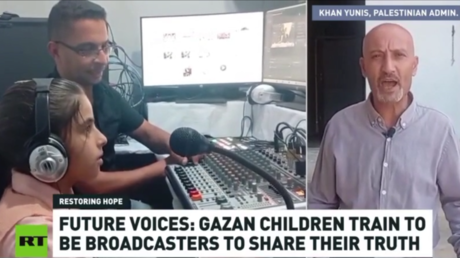
This is the quiet rebellion happening in the margins of the daily news cycle. While international broadcasts reduce an entire generation of children in war-torn Gaza to numbers on a ticker tape, a youth media initiative is handing them the tools to reclaim their narrative. These are not professional journalists with heavy flak jackets and satellite phones. They are kids holding pocket-sized microphones, recording audio diaries amidst the rumble of generators, teaching themselves how to frame a shot, how to conduct an interview, and how to preserve their own humanity through the stubborn act of creation.
Consider what happens when a child is stripped of everything familiar. Their school is a pile of rubble. Their bedroom is a memory. Their neighborhood is a map of craters. In that vacuum of powerlessness, language becomes the last standing fortress.
For decades, reporting from zones of protracted conflict has followed a predictable, numbing cadence. We see the smoke. We hear the politicians. We measure human suffering in metric tons of aid and square miles of destruction. What gets lost in the macro-lens view is the microscopic texture of daily endurance. How does a child wake up day after day in a shared tent with forty relatives and still find the urge to tell a story? How do you teach grammar when the walls shaking outside punctuate every sentence?
The answer lies in a fundamental human truth: storytelling is not a luxury. It is a biological imperative.
When youth media workshops emerged in makeshift camps across the Gaza Strip, initiated by local educators and regional cultural workers determined to keep young minds anchored, skeptics called it an impossible distraction. How could you worry about documentary framing when clean water was scarce? How could you teach audio editing when the electricity flickered and died for days at a time?
Because despair feeds on silence.
The initiative started small. A handful of donated tablets, a couple of cracked smartphones, and a makeshift studio set up under a canvas awning that billowed violently every time a coastal wind swept in. The kids didn't need instructions on how to use the technology. They were digital natives thrust into an analog nightmare. They took to the editing software with an intuitive, fierce grace.
At first, their videos were raw, shaky, and chaotic. A ten-year-old boy named Tariq pointed his camera not at the ruined storefronts down his street, but at his younger sister’s hands as she meticulously folded a paper crane out of a discarded aid wrapper. There was no narration. Just the background hum of distant drones and the rhythmic, papery crease of the origami.
That video went viral on regional social media channels. It didn't feature dramatic explosions or emotional monologues. It featured quiet dignity. It reminded millions of viewers that behind the geopolitical abstracts are human beings who still notice the small, beautiful mechanics of existence.
We often talk about trauma as a full stop. Psychologists and aid workers study Post-Traumatic Stress Disorder like a permanent architectural blueprint of a broken brain. But spending time with these young media creators reveals something else entirely. It reveals an active, desperate, beautiful agency. They are not merely surviving history; they are recording it.
Tariq puts it simply when asked why he carries his cracked phone everywhere he goes.
"If I don't film it, nobody knows we were here," he says. "Not just that we died. That we lived. That we laughed yesterday. That my sister makes the best paper cranes in the whole camp."
The logistical hurdles these children face would break most professional newsrooms. Equipment breaks down with no replacement parts available. Charging batteries requires long, dangerous walks to community generators where diesel is rationed by the drop. Internet connectivity is a phantom—a brief, glorious two-hour window in the dead of night when the signal cuts through the interference, allowing files to be uploaded to mentors outside the strip.
Yet, they persist. They interview their neighbors about traditional recipes they miss. They record the sound of children playing makeshift soccer with a deflated ball amid the concrete dust. They document the quiet heroism of teachers who hold classes on upturned plastic crates beneath the shade of a skeletal olive tree.
There is a profound shift that occurs when a child looks through a camera viewfinder. In that fraction of a second, they stop being the victim of the frame. They become the director. They choose what to illuminate and what to leave in shadow. They decide who is worthy of attention.
This is why traditional humanitarian interventions, while desperately vital for physical survival, often miss the psychological architecture of recovery. Food and medicine heal the body. But a microphone heals the voice. It restores the narrative arc that conflict seeks to shatter. It tells the child: Your perspective matters. Your observations are valid. You are not a statistic; you are an author.
Look closely at the footage produced by these workshops. Notice the framing. Notice how the camera lingers on human eyes rather than structural damage. These kids understand intuitively what professional journalists often forget: that people connect with people, not with ruins.
When Yara interviews an elderly neighbor who still carries the physical key to a home her family fled generations ago, she doesn't ask grand political questions. She asks what the jasmine smelled like in the courtyard. She asks if her grandmother's kitchen floor was cold in the winter.
The old woman smiles, her eyes crinkling at the corners, and for three minutes, the tent vanishes. The war vanishes. There is only the scent of jasmine and the warmth of a kitchen that exists now only in spoken word.
That is the magic of what is happening in those dusty, overcrowded camps. It is an act of cultural preservation under fire. It is a declaration that while buildings can be reduced to dust, identity is infinitely harder to erase.
As the sun dips toward the Mediterranean, casting long, sharp shadows across the canvas roofs, the workshop winds down for the day. The batteries are dead. The internet signal has faded back into the static of electronic warfare.
Yara packs her equipment into a battered canvas satchel, zips it shut with meticulous care, and slings it over her shoulder. She walks out into the alleyway, dodging a puddle of gray water, her chin held high. She is a reporter. She is an artist. She is a child carrying a weight that no human being should ever have to bear.
And tomorrow morning, when the sun rises over the ruins, she will turn the camera back on.