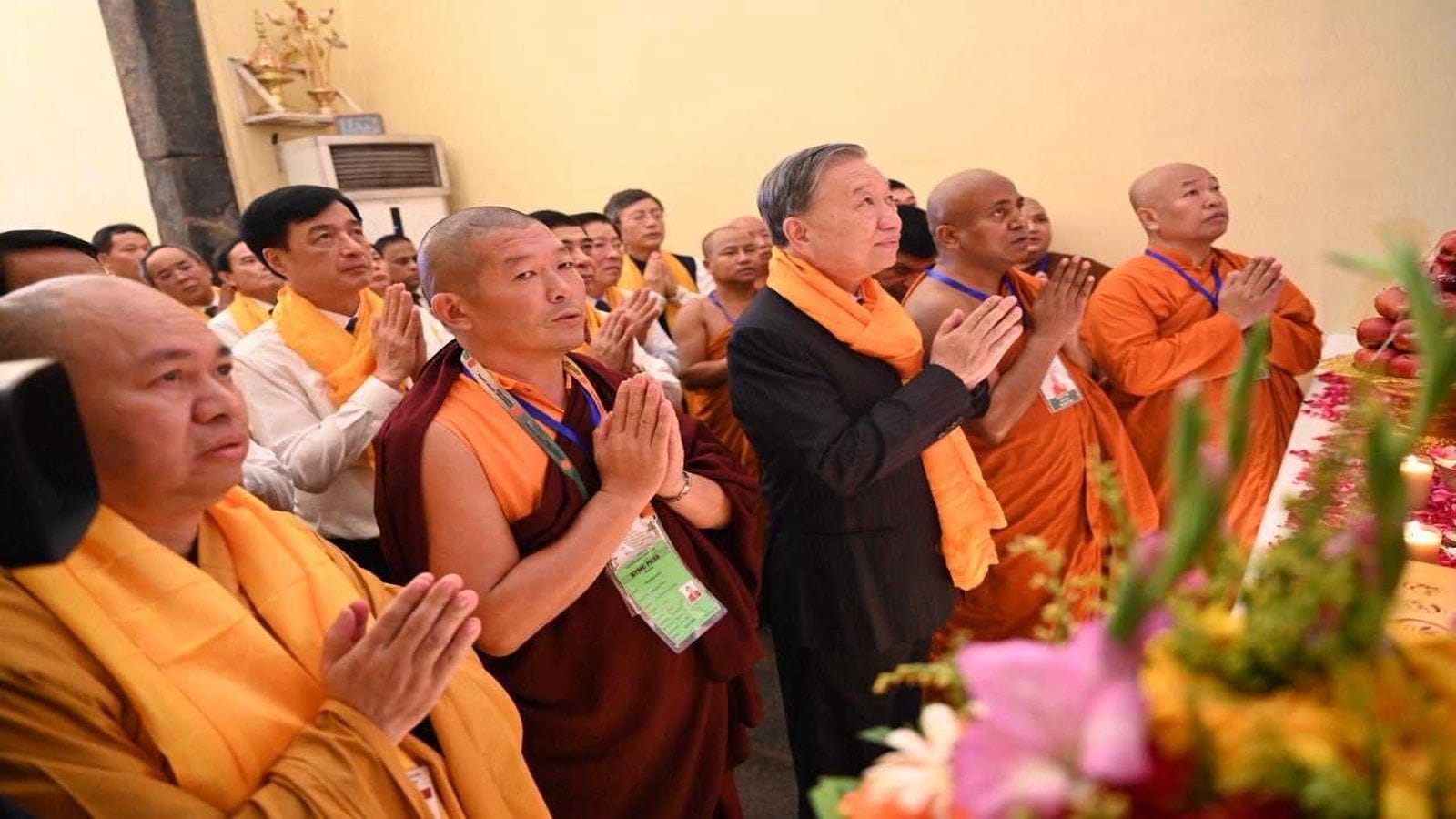
Vietnam is playing a long game that has little to do with the incense and ancient stone of Bihar and everything to do with a shifting geopolitical map. When President To Lam stepped onto the grounds of the Mahabodhi Temple in Bodh Gaya, the cameras captured a leader in prayer. Behind the scenes, the visit signaled a calculated pivot in Hanoi’s "bamboo diplomacy." Vietnam is moving to cement a strategic partnership with India that serves as a vital counterweight to regional pressures. This wasn't a mere pilgrimage. It was a high-stakes signal to Beijing and Washington that Hanoi has found a third pillar for its security and economic future.
To Lam’s presence at the site where Buddha attained enlightenment is the ultimate soft-power play. While the world focuses on trade tariffs and maritime disputes, Vietnam is using shared cultural heritage to anchor a defense relationship with New Delhi. India is no longer just a buyer of Vietnamese exports; it is becoming a silent guarantor of stability in Southeast Asia.
The Bihar Connection as a Geopolitical Shield
The images of To Lam at the Mahabodhi Temple were broadcast across Southeast Asia for a specific reason. For decades, Vietnam has walked a tightrope between its massive neighbor to the north and its security partners in the West. By stopping in Bihar, Lam highlighted a historical and spiritual link that predates modern borders.
This isn't just about religion. It’s about strategic depth.
India has been steadily increasing its footprint in the South China Sea through naval drills and oil exploration partnerships with PetroVietnam. By visiting the heart of India’s Buddhist heritage, Lam is humanizing a relationship that is increasingly defined by BrahMos missiles and patrol boats. He is telling the Vietnamese public—and the international community—that the bond with India is deep-rooted, making the military cooperation that follows seem like a natural extension of an ancient friendship.
Why India is the New Necessity
Hanoi’s traditional reliance on Russia for hardware is crumbling. The war in Ukraine has made Moscow an unreliable and politically radioactive supplier. Vietnam needs a new source of high-end tech that doesn't come with the heavy-handed strings often attached to American deals.
India fits the bill perfectly. New Delhi offers a middle path. By strengthening ties in Bihar, Lam is laying the groundwork for more than just tourism. He is looking for a partner that understands the nuances of non-alignment. India provides Vietnam with a "Goldilocks" option: sophisticated enough to deter aggression, but neutral enough to avoid triggering a total collapse in relations with China.
Beyond the Incense Smoke
The economic reality of this visit is far more grounded than the spiritual setting suggests. Bihar might seem like an unlikely backdrop for trade talks, but the symbolism facilitates the hard math of the Comprehensive Strategic Partnership.
Vietnam is currently India’s fourth-largest trading partner within ASEAN. However, the potential for growth remains largely untapped. Lam’s delegation wasn't just made up of monks and diplomats; it included the architects of Vietnam’s industrial future. They are looking at India as both a market and a source of raw materials.
- Pharmaceuticals: Vietnam wants to reduce its dependence on Chinese active pharmaceutical ingredients. India, the world’s pharmacy, is the obvious solution.
- Information Technology: As Vietnam transitions from low-end manufacturing to a tech-driven economy, it needs the talent and infrastructure models that India has perfected.
- Infrastructure: Discussions in the wake of the Bihar visit have centered on direct flights and high-speed rail cooperation, aiming to turn the Buddhist circuit into a corridor of commerce.
The Silent Struggle for Regional Lead
We are witnessing a quiet competition for the soul of Southeast Asia. While China uses its Belt and Road Initiative to build physical bridges, India is using "Act East" to build cultural and security ones. To Lam’s visit was a victory for the latter.
When a Vietnamese president spends time in Bihar, he is acknowledging India as a civilizational power. This matters in a region where history is often used to justify modern territorial claims. By leaning into the Buddhist connection, Vietnam asserts its own cultural identity, one that is distinct from the Sinitic sphere. It is a subtle but firm rejection of the idea that Southeast Asia must inevitably fall under a single sphere of influence.
The Risk of the Middle Path
This strategy is not without its dangers. Playing two giants against each other requires a level of diplomatic finesse that can easily fail. If Vietnam leans too hard into the India-US orbit, it risks harsh economic retaliation from Beijing. If it stays too close to the status quo, it remains vulnerable to maritime incursions.
To Lam knows this. His predecessor, Vo Van Thuong, left under a cloud of internal party reshuffling. Lam needs a "win" that resonates both domestically and internationally. The Bodh Gaya visit provided that. It showed him as a statesman who can command respect in the world’s most populous democracy while maintaining the dignity of the Vietnamese state.
The Architecture of a New Alliance
The real work happens after the cameras are packed away. The "Bodh Gaya Declaration" style of diplomacy only works if it translates into concrete policy. Watch the following sectors over the next twelve months to see the true impact of this visit.
Defense and Security Coordination
Expect an uptick in the frequency of "comprehensive" maritime security dialogues. Vietnam is likely to push for more technology transfers rather than simple off-the-shelf purchases. They want the ability to maintain and upgrade their own systems, a move that India is increasingly willing to support through joint ventures.
Supply Chain Diversification
The "China Plus One" strategy is the mantra of every major manufacturer in Hanoi and Ho Chi Minh City. By aligning more closely with New Delhi, Vietnam gains a massive backup plan. If supply chains through the north are constricted, the sea lanes toward India become the lifeblood of the Vietnamese economy.
The Hard Truth of Soft Power
Critics might argue that a temple visit is a distraction from the hard realities of inflation and internal power struggles within the Communist Party of Vietnam. They are wrong. In the theater of international relations, the "vibe" of a meeting often dictates the terms of the contract.
To Lam didn't go to Bihar because he had a sudden urge for quiet reflection. He went because Vietnam is at a crossroads. The old certainties of the post-Cold War era are gone. In their place is a messy, multi-polar reality where a mid-sized power like Vietnam must find friends wherever it can.
By walking where the Buddha walked, To Lam was making a move on a much larger chessboard. He was defining Vietnam not by its conflicts, but by its connections. The success of this trip won't be measured in the number of photos taken at the Mahabodhi Temple. It will be measured in the number of Indian warships that dock at Cam Ranh Bay and the number of Vietnamese tech firms that find a second home in Bangalore.
Vietnam has signaled its intent. It is no longer content to be a pawn in the struggle between superpowers. It is building its own network, starting with the ancient stones of Bihar and ending with a new, more resilient Southeast Asia.
The silence of the temple was a facade. The real noise was the sound of a regional power finally finding its voice on the global stage. Vietnam is no longer waiting for the future to happen; it is actively negotiating the terms of its survival.