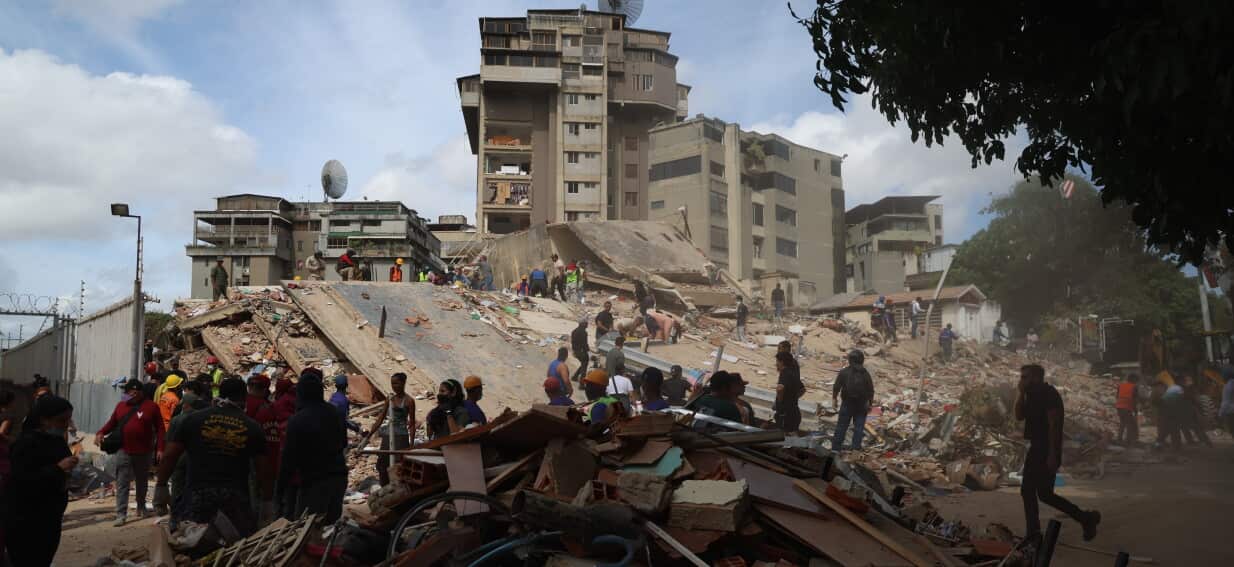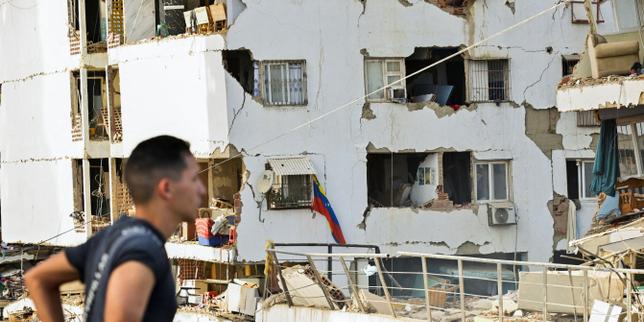
The ground in northern Venezuela didn't just shake on Wednesday evening. It violently tore apart the fragile reality of a country already hanging on by a thread. When back-to-back earthquakes of magnitude 7.2 and 7.5 struck the northern coast, they left behind a trail of ruin that the official death toll fails to capture.
Right now, the official count stands at around 235 dead and over 4,300 injured. Health Minister Carlos Alvarado confirmed those numbers, stating that many victims arrived at medical facilities already showing no vital signs. But if you talk to anyone on the ground in Caracas or the coastal state of La Guaira, they will tell you that the official figure is just a fraction of the real tragedy. Thousands of people are currently missing. Entire multi-story apartment buildings have been reduced to heaps of gray dust and twisted steel.
The United States Geological Survey ran predictive models right after the twin shocks. The data is terrifying. Their models suggest a 42% probability that the final death toll could surpass 10,000 people. This is the strongest seismic event to hit Venezuela in more than a century. The shockwaves were so powerful that buildings swayed and panicked populations evacuated as far away as the Brazilian Amazon, more than a thousand miles from the epicenters.
The Reality of the Shattered Coast
La Guaira bore the absolute brunt of this disaster. Acting President Delcy Rodriguez declared the region a total disaster zone. The structural failure here is catastrophic. In towns like Catia La Mar and Caraballeda, the seaside skyline has completely changed. High-rise buildings that once housed hundreds of families have pancaked into neat, horrific layers of concrete slabs.
Two major local landmarks illustrate the sheer force of the tremors. The Ritasol Palace, a large block of residential flats, completely folded in on itself. Not far away, the seafront Eduard’s Hotel suffered a similar fate. Emergency workers fear that hundreds of people were inside these structures when the first quake hit at around 6:00 PM local time, a hour when most residents were returning home from work.
In Caracas, the situation is equally terrifying. High-end neighborhoods like Altamira and Los Palos Grandes are seeing scenes usually reserved for war zones. Debris blocks main avenues. Fallen electric poles lie across crushed vehicles. Interior Minister Diosdado Cabello described the situation in Altamira as alarming, pleading with residents to stay out in the open air as strong aftershocks continue to threaten weakened structures.
A Broken Infrastructure Meets a Natural Disaster
You have to understand the context of Venezuela to realize why this is turning into an unprecedented humanitarian crisis. The country has endured a decade of severe economic hardship. Building codes were rarely enforced during recent construction booms. Older structures have lacked basic structural maintenance for years. When a 7.5 magnitude quake hits a city built on compromised concrete, the result is predictable.
The rescue operation itself shows the depth of the systemic crisis. There is a severe shortage of specialized heavy machinery outside of the capital city. On the streets of La Guaira, you don't see massive fleets of excavators or cranes. You see neighbors. Regular citizens are forming human chains to move heavy blocks of cement by hand. They are using shovels, hammers, and their bare fingers to dig through the rubble because official rescue teams simply haven't arrived in large numbers.
Look at the story of Dayana Delgado, a mother of three in La Guaira. She is currently searching for her eight-year-old son who disappeared when their building collapsed. She publicly questioned where the state machinery was, pointing out that only her neighbors were helping her dig through the sharp debris. Her story isn't unique. Hundreds of families are writing down handwritten lists of names, pinning them to trees and intact walls, hoping someone has seen their children, parents, or siblings.
The Broken Lines of Communication
Trying to get an accurate picture of the casualties right now is almost impossible due to a total collapse of local utilities. Large swaths of northern Venezuela lost electricity immediately after the second tremor. Cellphone towers are down or severely overloaded.
This infrastructure blackout has created a psychological torture for the Venezuelan diaspora. Millions of Venezuelans living abroad in places like Miami, Bogotá, or Madrid are spending sleepless nights staring at silent phone screens. They can't get through to their relatives. They don't know if their family home is still standing or if their loved ones are among the thousands missing under the concrete.
The state has closed the nation's primary aviation gateway, the Simón Bolívar International Airport, due to significant structural damage to the runways and terminals. This closure creates a massive logistical nightmare. Flying in international search-and-rescue teams, specialized search dogs, and medical supplies becomes a complex puzzle when your main airport cannot accept flights.
International Geopolitics and Sudden Policy Shifts
The sheer scale of this disaster has forced unexpected political movements. The geopolitical standoff that has isolated Venezuela for years briefly cracked under the weight of this tragedy.
In Washington, the US Treasury moved with unusual speed to issue a specific waiver on existing economic sanctions. This temporary license, valid into October, allows financial transactions and direct logistics related to earthquake relief efforts that would normally be strictly banned. It opens a legal corridor for humanitarian aid, medical equipment, and financial donations to flow into the country without triggering massive legal penalties for international organizations.
Even political figures who have historically held a hard line against the Venezuelan administration recognize the urgency. Comments from US political leaders have shifted toward expressing readiness to deploy fast, effective emergency responses to assist the population. The United Nations and humanitarian agencies in Switzerland are already mobilizing emergency funds and supply lines to bridge the massive gap in local medical resources.
The Legacy of Vulnerability
This is not the first time La Guaira has faced a massive catastrophe, and the historical memory makes the current situation feel even more sinister for locals. Older residents vividly remember the horrific 1999 mudslides, an event that claimed thousands of lives and completely buried coastal communities under mud and rock.
The psychological trauma of that past disaster is compounding the terror today. People refuse to go back inside any building that is still standing. Hundreds of families spent the night sleeping on the hard asphalt of public parks, parking lots, and open beaches. They are clutching blankets, minimal clothing, and their pets, preferring the vulnerability of the open elements to the threat of a ceiling collapsing overhead.
The domestic medical system is buckling under the pressure. Health Minister Alvarado issued an urgent call for all healthcare professionals nationwide to report to the nearest hospitals. Medical centers in Caracas and the coast are running low on basic surgical supplies, anesthetics, and clean water. Some schools that escaped structural damage are being hastily converted into makeshift triage centers and donation hubs, but they lack the sterile environments needed to treat severe crush injuries.
Critical Survival Actions for the Current Crisis
If you have relatives in the affected zones or are trying to coordinate support, general disaster relief protocols highlight specific steps that save lives during this critical window.
- Prioritize SMS over Voice Calls: Bandwidth is extremely limited. Short text messages or data-light messaging apps have a much higher chance of getting through weak networks than cellular voice calls. Keep messages brief to preserve phone batteries.
- Establish a Local Liaison: If you are outside Venezuela, identify a contact in an adjacent state where infrastructure remains intact. Have them act as a central communication node to relay information when local networks briefly flicker back online.
- Support Verified Transnational Networks: Stick to international agencies like the Red Cross or established UN channels that can utilize the new US Treasury sanctions waiver directly. Sending funds through unverified local accounts runs the risk of getting frozen by automated banking compliance systems.
- Focus on Immediate Medical and Water Needs: The immediate threat shifting over the next forty-eight hours is the spread of waterborne illnesses due to fractured water mains and the lack of clean drinking water. Supplies of water purification tablets and portable medical kits are more valuable right now than clothing donations.
The official number of 235 deaths will inevitably climb as heavy equipment eventually reaches the coastal towns. The true measure of this disaster won't be known for weeks, but the immediate focus remains entirely on the frantic, hands-only race against time to pull survivors from the wreckage.