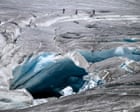
Ice has a voice. It snaps with the sharp crack of a rifle shot in the dead of night, groans under the weight of centuries as it grinds against granite, and whispers when it melts into the blue veins of a dying glacier. For generations, the people who tend the high passes of the Alps understood that voice. They knew when the cold was safe and when the mountain was shifting its weight.
Today, that voice is screaming.
In a span of just five years, between 2016 and 2021, Switzerland lost twenty percent of its glacial ice. Let those numbers settle into the quiet spaces of your mind. Not over a century. Not across the slow, geological crawl of an ice age in reverse. Five years. In the human lifespan, that is the blink of an eye—the time it takes a child to enter kindergarten and leave primary school. In the life of the Alps, it is a catastrophic hemorrhage.
Consider what a glacier actually is. It is not just frozen water. It is an archive. Every winter storm packs a page of atmospheric history into the white layers; every summer thaw presses the pages together into a dense, crystalline book that holds the climate memory of the continent. When a glacier melts at this speed, we are not just losing scenery. We are burning a library we can never rewrite.
To understand the human cost of this vanishing act, we have to step away from the satellite maps and the dispassionate graphs published in scientific journals. We have to walk the moraine.
Imagine standing above the tongue of the Great Aletsch Glacier in late August. The air should be crisp, biting with the promise of autumn even at midday. Instead, the heat clings to your skin like a wet wool blanket. The rock under your boots is raw, unweathered, and terrifyingly unstable. Where ancient ice pressed against the cliff face only a decade ago, there is now only a scar of grey dust and loose scree.
(To be clear, this specific scene is a composite based on the documented retreat patterns observed by glaciologists across the Valais canton, where markers planted in the nineteenth century now look down on empty air.)
A local mountain guide named Hans, whose grandfather taught him how to read the crevasses like lines on a palm, points to a rusted iron peg bolted into the cliff high above our heads.
"That was the ice level when I was twenty," he says. His voice is flat, devoid of theatrical alarm, which makes the reality of it hit harder. "Now look down there."
Down there is a void. The ice has dropped by dozens of meters, shrinking away from the valley walls as if withdrawing its hand from a stove. When glaciers retreat like this, they leave behind unstable hills of debris known as moraines. Without the structural support of the ice, entire mountainsides lose their integrity. Heavy rains trigger massive landslides of mud and rock that roar down into the valleys below, threatening villages, roads, and hydroelectric infrastructure that took generations to build.
Water. That is the ultimate currency of the ice.
The Alps are the water tower of Europe. When winter snows melt and summer thaws feed the Rhine, the Rhône, the Po, and the Danube, they provide drinking water, agricultural irrigation, and industrial cooling for tens of millions of people downstream. For much of the year, glacial meltwater acts as a natural buffer against drought, keeping rivers flowing even when rain refuses to fall for months.
When you shrink that water tower by twenty percent in five years, the buffer frays.
We saw a preview of this fragility during the scorched summers that followed, when commercial barges sat half-empty in the shallowing channels of the Rhine, and nuclear power plants in France had to throttle back their output because the river water used for cooling was already too warm. These are not isolated crises. They are symptoms of a systemic failure in the natural plumbing of the continent.
Yet, the most profound loss is harder to measure in cubic kilometers or megawatt-hours. It is cultural. It is emotional.
For centuries, Swiss identity has been forged in the shadow of the white peaks. The Matterhorn, the Eiger, the Jungfrau—these are not just tourist destinations; they are cultural totems that represent permanence, resilience, and a majestic indifference to human chaos. When children grow up watching those peaks turn from gleaming white armor to bare, crumbling rock, something fundamental shifts in the collective psyche. It is the realization that the permanent features of our world are temporary after all.
We have entered an era of ecological grief, whether we have a name for it yet or not.
Scientists call it solastalgia—the distress caused by the environmental change happening around us while we are still at home. It is the homesickness you feel when you are still in your own backyard, but the landscape of your childhood has been erased.
We look at the statistics and feel a paralyzing numbness. Twenty percent. Two decades. One degree. The numbers are too big to grasp, so our brains push them away. We scroll past the headlines of collapsing ice shelves and melting permafrost, searching for something more comforting, something that does not demand our grief.
Stop scrolling.
Look at what is happening to the high places. The ice does not care about our politics, our economic debates, or our hesitation. It simply obeys the laws of physics written by our choices. Every ton of carbon we pump into the atmosphere acts as a warm breath pressed against the face of a giant that has stood since before human history began.
The glaciers are not dying quietly in the remote wilderness. They are sending us a message written in water and stone. They are telling us that the systems we rely on—the predictable seasons, the steady rivers, the stable ground beneath our feet—are not guaranteed.
The ice is gone. The mountains remain, naked and exposed, waiting to see what we will do with the time we have left.