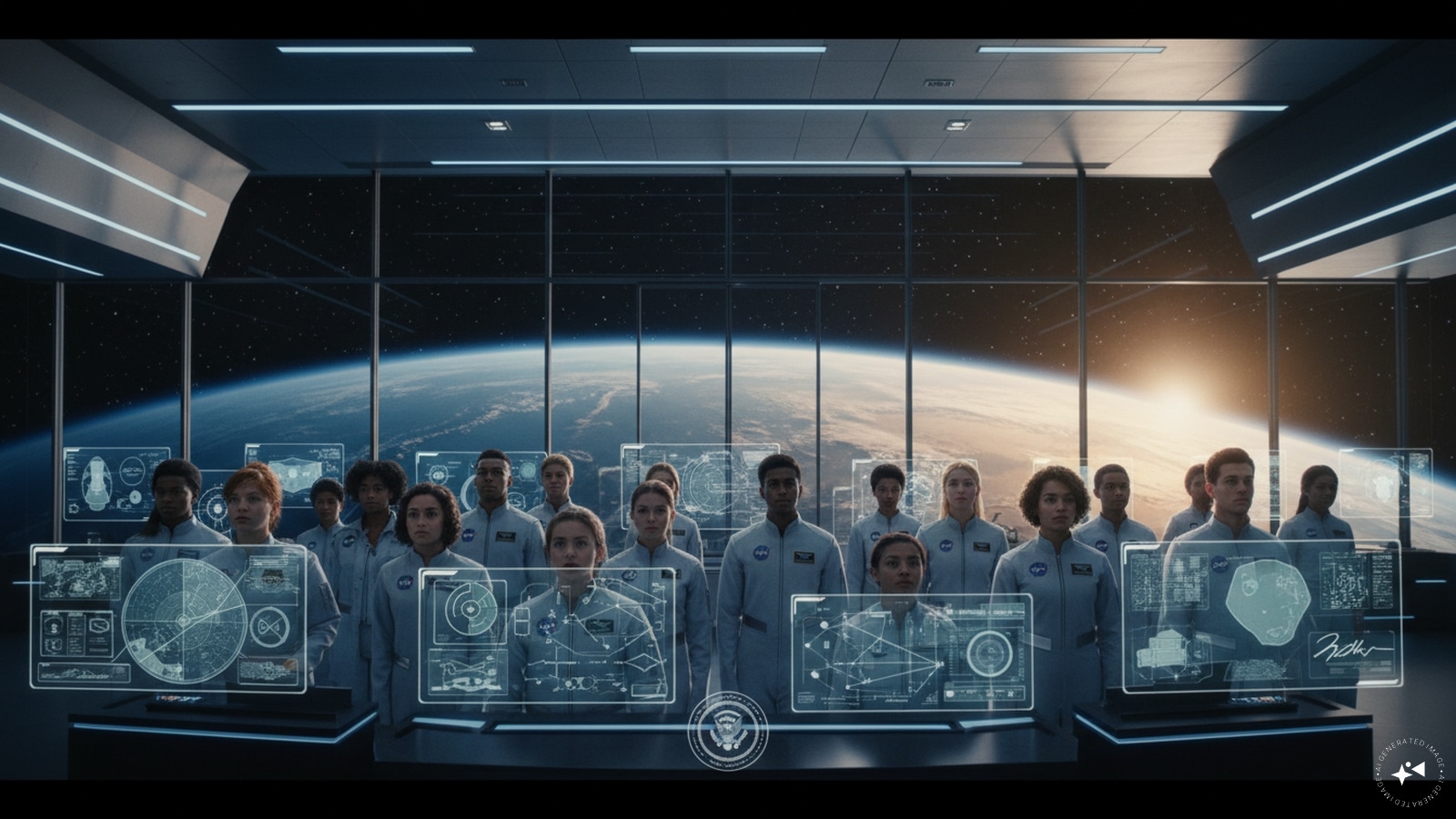
President Donald Trump signed an executive order at NASA’s Johnson Space Center establishing a Presidential Commission to design the United States Space Academy. Chaired by NASA Administrator Jared Isaacman, the newly minted commission faces a compressed 120-day timeline to deliver a comprehensive proposal covering institutional governance, curriculum design, physical location, and mandatory service obligations. Billed as a sister institution to West Point, Annapolis, and the Air Force Academy, this federal school aims to supply a steady stream of trained engineers, scientists, civil operators, and military personnel for both NASA and the United States Space Force.
Yet behind the ceremonial backdrop of awarding Congressional Space Medals of Honor to the Artemis II crew, the project exposes a fundamental tension within American aerospace strategy. For decades, the nation relied on a decentralized ecosystem of civilian universities, defense contractors, and specialized military pipelines to fuel its ambitions. Constructing a dedicated federal academy represents a sharp pivot toward centralized state training. Whether this institutional mechanism can adapt quickly enough to a fast-evolving commercial sector remains an open question.
The Structural Mandate
A specialized federal service academy for the final frontier has been discussed in defense circles for years. The rapid expansion of the United States Space Force, coupled with commercial launch cadences targeting upwards of one thousand annual flights by the end of the decade, has strained traditional talent pools. Defense contractors and civil agencies alike report persistent shortages of cleared engineers, orbital mechanics specialists, and secure systems operators.
The proposed academy attempts to bridge this gap by melding rigorous technical instruction with military discipline and public service. Under the executive order, graduates would presumably owe a service commitment to either the armed forces, NASA, or related national security entities. Proponents argue that this mirrors the proven success of legacy service academies in producing reliable, mission-focused leadership.
Critics, however, point out a critical divergence. Traditional military academies train officers for predictable branches of warfare governed by established doctrine. The orbital domain is defined by rapid commercial disruption, software-driven iteration, and a heavy reliance on private industry partners who operate on entirely different timelines than the federal government.
The Commercial Friction Point
Modern aerospace engineering is no longer the exclusive domain of government bureaucracies and cost-plus contractors. Companies like SpaceX, Rocket Lab, and a sprawling network of smaller venture-backed startups drive the current cadence of technological innovation. These entities value speed, rapid prototyping, and software agility over rigid bureaucratic hierarchies.
An academy modeled on West Point risks producing graduates conditioned for institutional command structures rather than the chaotic, high-risk environment of commercial space commerce. If the curriculum becomes too heavily weighted toward traditional defense protocols, graduates may struggle to interface effectively with commercial operators who view bureaucratic overhead as an existential threat.
Furthermore, the question of institutional location has already sparked interstate lobbying. Senator Ted Cruz has openly lobbied for placement in Texas near Johnson Space Center, while other aerospace hubs across Florida, Colorado, and Alabama eye the economic windfall. Real estate politics threaten to overshadow the core pedagogical mission before the commission even finalizes its initial report.
The Curriculum Challenge
Designing an educational framework for a domain that transforms every six months is an unenviable task. Traditional universities take years to accredit new degree paths, often leaving graduates ill-prepared for immediate operational realities. The Space Academy commission must bypass this red tape, yet it remains bound by federal civil service and military educational standards.
Consider the baseline requirements for a modern orbital operator. Beyond orbital mechanics and physics, students require deep fluency in cybersecurity for satellite constellations, radio frequency spectrum management, orbital debris tracking, and international space law.
If the curriculum defaults to legacy aerospace engineering tracks, the academy will simply duplicate what existing public universities already do well. To justify its existence and enormous capital expenditure, the institution must pioneer interdisciplinary tracks that do not cleanly fit into existing departmental silos.
Bureaucratic Realities
Administrator Jared Isaacman brings considerable commercial space flight experience to his role as commission chair, offering a pragmatic counterweight to traditional civil service thinking. His challenge will be insulating the academy's design phase from political posturing. A federal institution of this magnitude requires bipartisan consensus, stable long-term funding, and protection from shifting political priorities across future presidential administrations.
Service obligations also complicate recruitment. Outstanding engineering talent from Generation Z often prioritizes career flexibility and mobility across the private sector. Imposing mandatory multi-year government service bounds could deter top-tier candidates who might prefer working for commercial innovators without enduring military or civil service restrictions.
The 120-day countdown clock leaves little room for hesitation. As the commission gathers to draft its blueprints, the ultimate test will not be how impressive the campus looks on paper, but whether its graduates can out-engineer and out-maneuver foreign rivals in an increasingly crowded sky.