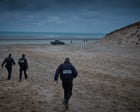
The £16 million "stopgap" payment from the United Kingdom to France represents a tactical patch on a broken operational model rather than a strategic resolution to irregular migration. This capital injection is intended to sustain a labor-intensive surveillance regime across the French coastline, yet the fundamental incentive structures for both the migrants and the smuggling networks remain untouched. When security expenditures scale linearly while smuggling innovation scales exponentially, the result is a fiscal trap where the cost per interception rises while total deterrence remains static.
The Variable Cost of Border Friction
Border security in the English Channel functions as a system of friction. The objective is not to create an impassable barrier—which is geographically impossible—but to increase the "cost of business" for smuggling operations to the point of collapse. The £16 million payment targets three specific friction variables:
- Labor Density: Funding the deployment of additional gendarmerie and specialized units to patrol 150 kilometers of coastline.
- Asset Availability: Maintaining the operational readiness of aerial surveillance (drones and fixed-wing aircraft) and shore-based thermal imaging.
- Logistical Sustenance: Housing and feeding the surge forces required for 24-hour monitoring.
The failure of this model lies in its reactivity. The UK is essentially paying for a static defense against a fluid, high-incentive market. Smuggling networks treat these security patrols as a variable environmental factor, much like weather patterns. They adjust launch points, timing, and vessel density to find gaps in the patrol rhythm. Since the French coastline is too vast for 100% saturation, the £16 million buys a percentage of visibility, not a guarantee of prevention.
The Smuggler Margin and Equipment Arbitrage
Small boat crossings persist because the profit margins for smuggling syndicates are extraordinarily high, while their capital risk is negligible. A typical "large" inflatable boat carries 40 to 60 people. At a conservative estimate of £3,000 per seat, a single successful launch generates £120,000 to £180,000 in gross revenue.
The cost of the hardware—a low-grade inflatable, a cheap outboard motor, and life jackets—rarely exceeds £10,000. This creates a revenue-to-cost ratio of nearly 15:1. Even if French patrols seize five boats for every one that launches, the syndicate remains profitable.
This economic reality renders the "stopgap" deal ineffective. The UK’s investment is aimed at the physical point of departure, which is the most expensive and least efficient place to intervene. To achieve actual deterrence, the friction must be applied to the financial or logistical supply chains (e.g., the manufacturing and distribution of outboards and inflatables across Europe), which are currently less regulated than the beaches themselves.
Jurisdiction and the Enforcement Gap
The UK-France security relationship is plagued by a fundamental misalignment of jurisdictional incentives. The United Kingdom views the Channel as a border to be defended. France, conversely, views the migrants as a transit population. For the French authorities, the primary objective is to prevent loss of life on their territory and maintain public order. They have little sovereign incentive to indefinitely detain individuals who wish to leave their jurisdiction.
This leads to the Enforcement Gap:
- Observation vs. Intervention: French patrols often monitor groups preparing to launch but may only intervene if they can do so safely or if a crime is being committed under French law.
- Legal Bottlenecks: Once a launch is intercepted, the individuals are often processed and released, allowing them to attempt the crossing again within 24 to 48 hours.
- Asset Degradation: The UK is paying for French personnel, but the UK has no command or control over how those personnel are utilized.
The £16 million is a payment for cooperation in a context where the two nations' definitions of "success" do not align. The UK measures success by "zero arrivals," while France measures success by "effective management of a humanitarian crisis on its shores."
The Technological Displacement Effect
Increased funding for beach patrols triggers a "displacement effect" rather than a reduction in attempts. When patrols intensify in the Calais and Dunkirk sectors, smuggling operations move further south to the Normandy coast or further east toward the Belgian border.
This expansion of the "operational theater" increases the surveillance burden on French forces. The £16 million "extra" payment is likely consumed entirely by the increased fuel, overtime, and maintenance costs required to cover these new, more distant launch sites. It is a treadmill effect: the more the UK pays to secure specific beaches, the more territory the French must patrol, necessitating even more funding in the next fiscal cycle.
Furthermore, the technology used for detection (thermal imaging and drones) is being countered by smuggler tactics. Networks now utilize "saturation launches," where multiple boats are sent into the water simultaneously from different locations. This overwhelms the limited number of French interceptor vessels, ensuring that at least a portion of the fleet reaches international waters where French jurisdiction ends.
The Fiscal Asymmetry of Stopgap Governance
The UK's reliance on periodic "extra" payments signals a lack of long-term structural strategy. In budgetary terms, these payments are "Opex" (Operating Expenses) being used to solve a "Capex" (Capital Expenditure) and policy problem.
- Opex Flaw: Paying for more patrols is a recurring cost that yields no permanent asset or systemic change.
- Policy Deficit: Without a returns agreement—whereby individuals who arrive in the UK can be legally and swiftly returned to France—the "pull factor" remains intact.
The UK is currently paying France to act as a security guard for a door that remains unlocked. Without the legal mechanism to return migrants to the "safe third country" they departed from, the French patrols are merely delaying an inevitable crossing.
Strategic Recommendation: Shifting the Friction Point
The current model of "Beach Defense" has reached a point of diminishing returns. To break the cycle of emergency payments and static results, the strategy must pivot toward Upstream Attrition.
- Logistical Interdiction: Rather than funding beach patrols, capital should be redirected toward a joint UK-EU task force dedicated to the seizure of maritime equipment in the European hinterland. This moves the friction point from the beach (high cost, low success) to the warehouse and transport routes (lower cost, higher impact).
- Tiered Funding for Outcomes: Future payments to France should be structured as a base maintenance fee plus a performance-based incentive tied to the disruption of smuggling cells within French territory, rather than the number of patrols on a beach.
- Digital Frontier Intelligence: Invest in the infiltration of the encrypted social media groups used to recruit and coordinate migrants. The most effective border is not the beach, but the smartphone.
The UK must accept that the English Channel is not a moat, but a highway. Paying for more police on the side of the road will not stop the traffic as long as the destination offers a perceived net gain over the point of origin. The £16 million is a sedative for the UK electorate, not a cure for the crisis. The final strategic move must be a transition from "patrol-based security" to "network-based disruption," targeting the financial heart of the smuggling syndicates rather than the physical perimeter of the coast.