Every time New Delhi drops another blistering speech at the United Nations telling Islamabad to swap terrorism for economic development, the media treats it like a heavyweight title fight. Pundits foam at the mouth. Editorial boards churn out breathless think pieces about diplomatic isolation and moral victory.
It is professional wrestling.
Both sides know the script. The choreography is locked in. India steps up to the podium, delivers a masterclass in righteous indignation, points out that a bankrupt state financing cross-border militancy is committing slow-motion suicide, and sits back down. Pakistan responds with a tired, recycled script about self-determination that ignores its own fragmentation, debt bondage to foreign lenders, and the Balochistan pressure cooker. The assembly hall is half-empty. The janitors are waiting to mop the floors. Nothing changes.
Yet, our entire foreign policy discourse treats these verbal sparring matches at Turtle Bay as monumental strategic shifts. They are not. They are safety valves. They are designed to let off steam so that neither nuclear-armed state has to deal with the terrifying reality of actually resolving the underlying territorial deadlock.
Let us stop pretending that telling Pakistan to "focus on development instead of terror" is a bold strategic insight. It is a platitude wrapped in a press release. More importantly, it completely misunderstands the structural mechanics of why Islamabad operates the way it does.
The Fallacy of the Development Lecture
When policymakers in New Delhi or Western capitals lecture Pakistan on economic development, they commit a fundamental category error. They assume that the Pakistani state is a mismanaged corporation that simply needs a better management team to pivot from manufacturing jihad to manufacturing textiles.
That is not how the entity functions.
The Pakistani security establishment does not prioritize GDP growth, foreign direct investment, or poverty alleviation because those metrics do not secure regime survival. In a state where the military owns everything from cereal brands to fertilizer plants and real estate conglomerates, the economy is structured around institutional rent-seeking. Terrorism and geopolitical confrontation are not policy errors; they are core business assets. They justify the military budget, extract foreign aid from anxious superpowers, and distract a brutalized domestic population from the fact that their currency is plummeting and their grid is failing.
Telling an institution whose entire identity and financial survival depend on perpetual hostility to "just focus on development" is like telling a shark to switch to a vegan diet because kelp is better for its cholesterol. It ignores the biological imperative of the predator.
When India stands at the UN and berates Islamabad for choosing violence over prosperity, it scores immediate domestic political points. It satisfies the evening news cycle. But it achieves zero leverage over the generals in Rawalpindi. In fact, it validates their narrative of an existential threat from the east, justifying another round of bloated defense spending.
The Domestic Audience Trap
The obsession with UN speeches is a symptom of a deeper malaise in modern statecraft: the substitution of performance for policy.
Foreign ministries are increasingly trapped in a loop of domestic signaling. A speech at the United Nations General Assembly is no longer aimed at foreign diplomats or international jurists. It is engineered for WhatsApp forwards, prime-time debate shows, and Twitter engagement metrics back home.
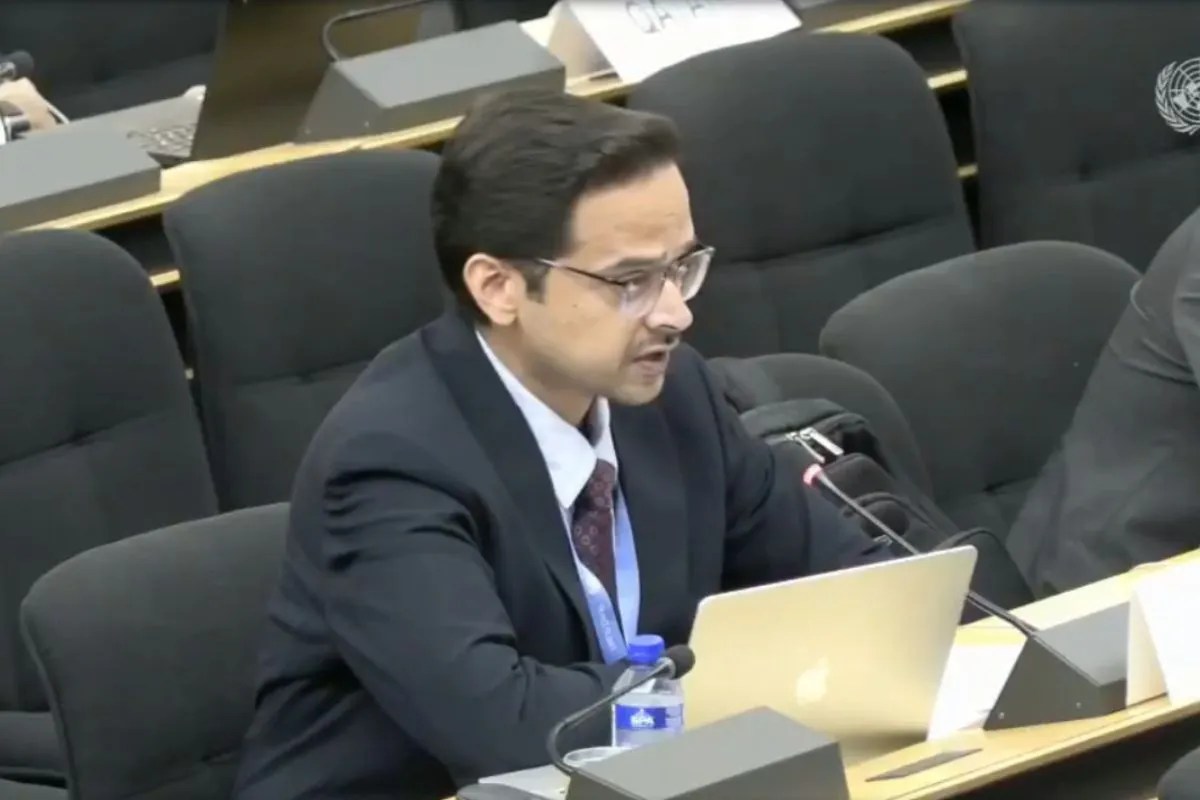
When a diplomat delivers a sharp riposte to a Pakistani delegate, the goal is not to convince the representative of a small island nation or a European middle power to change their vote on Kashmir. The goal is to trend on social media.
This creates a dangerous feedback loop. Governments become prisoners of their own rhetoric. When you spend decades convincing your domestic public that Pakistan is an irredeemable terrorist enclave that must be isolated at all costs, you box yourself into a corner. You eliminate diplomatic optionality. You make any future de-escalation or backchannel negotiation politically radioactive.
If tomorrow a pragmatic leader in Islamabad actually wanted to cut a deal on the Line of Control or freeze the dispute in place, the hyper-nationalist baseline established by decades of UN theater would make political survival impossible for either administration. We have built a rhetorical prison and handed over the keys to the cable news anchors.
The Unspoken Terror of Actually Getting What You Want
Let us run a thought experiment. Imagine the impossible happens. Imagine the international community applies crushing pressure, Pakistan collapses completely, and the territory of Pakistan-administered Kashmir is abruptly handed over to New Delhi on a silver platter.
The studio pundits would cheer. The social media celebrations would break the internet.
And then reality would set in.
Integrating a deeply radicalized, economically devastated, infrastructure-starved region with a population that has been fed anti-India propaganda for three-quarters of a century is not a victory; it is an administrative, security, and financial nightmare. Managing the internal security dynamics of the existing Union Territory of Jammu and Kashmir is already a monumental drain on state capacity. Adding millions more citizens who view the central government as an occupying force would multiply that security burden a hundredfold.
The truth—which neither side will ever admit on television—is that the status quo, however frustrating, is manageable. The Line of Control has calcified into an international border in practice, if not in name. Both capitals use the Kashmir dispute as a perpetual-motion machine for domestic political mobilization. Pakistan uses it to justify military dominance over civilian governance. India uses it to rally national cohesion during election cycles.
Neither side actually wants the issue permanently resolved because a permanent resolution means they would have to find new excuses for structural failures at home.
Dismantling the UN Mythos
Why do we continue to vest so much faith in an institution that has proven incapable of resolving a parking dispute in Geneva, let alone a territorial conflict between two nuclear-armed rivals?
The United Nations is not a global government. It is a glorified debating society with expensive real estate. Resolutions passed there carry zero enforcement power unless backed by the direct economic or military interests of the UN Security Council permanent members. And right now, neither Washington, Beijing, nor Moscow has any appetite to untangle the Kashmir knot. They have their own structural crises to manage.
When Indian diplomats use the UN rostrum to call out Pakistan’s sponsorship of cross-border terror, they are entirely correct on the facts. The documentation is bulletproof. The dossiers are thick. The historical culpability of the Pakistani deep state in orchestrating attacks like Mumbai in 2008 or the Pulwama bombing is a matter of public record.
Being correct, however, is not the same as having a strategy.
A strategy changes the adversary's calculus. A speech at the UN does not change Rawalpindi’s calculus by a single fraction of a degree. It is a grievance aired into the void, dressed up as statecraft.
What Real Statecraft Looks Like
If India is serious about neutralizing the threat emanating from across the western border, it needs to stop playing the UN podium game and focus on asymmetric structural superiority.
You do not defeat a failing, nuclear-armed rentier state by winning the applause of the General Assembly. You defeat it by widening the economic, technological, and developmental gap to such an absolute degree that their hostility becomes economically unsustainable even for their own military elites.
Look at the trajectory over the past two decades. While Pakistan has cycled through IMF bailouts, political assassinations, judicial coups, and fuel shortages, India’s economic gravity has fundamentally shifted the Asian balance of power. Global capital, technology supply chains, and strategic partnerships are aligning with New Delhi not because of eloquent UN speeches, but because of market size, digital infrastructure, and manufacturing ambition.
When your economy is scaling toward ten trillion dollars, a rogue neighbor sheltering militant proxies ceases to be a strategic existential threat. It becomes a localized law enforcement and border management nuisance.
The obsession with diplomatic sparring over PoK is a distraction from the real work of national consolidation. Every hour spent drafting witty retorts for a UN delegate is an hour not spent reforming domestic institutions, upgrading intelligence architecture, or securing critical technology supply chains.
It is time to drop the performance. Let the UN hall echo with empty rhetoric. Let the cable news networks exhaust themselves over procedural diplomatic victories.
Real power is not demonstrated by how loudly you complain about your neighbor in New York. It is demonstrated by how irrelevant your neighbor's hostility becomes in Islamabad. Stop shouting across the aisle. Build a fortress so formidable that the noise from the other side no longer reaches your ears.