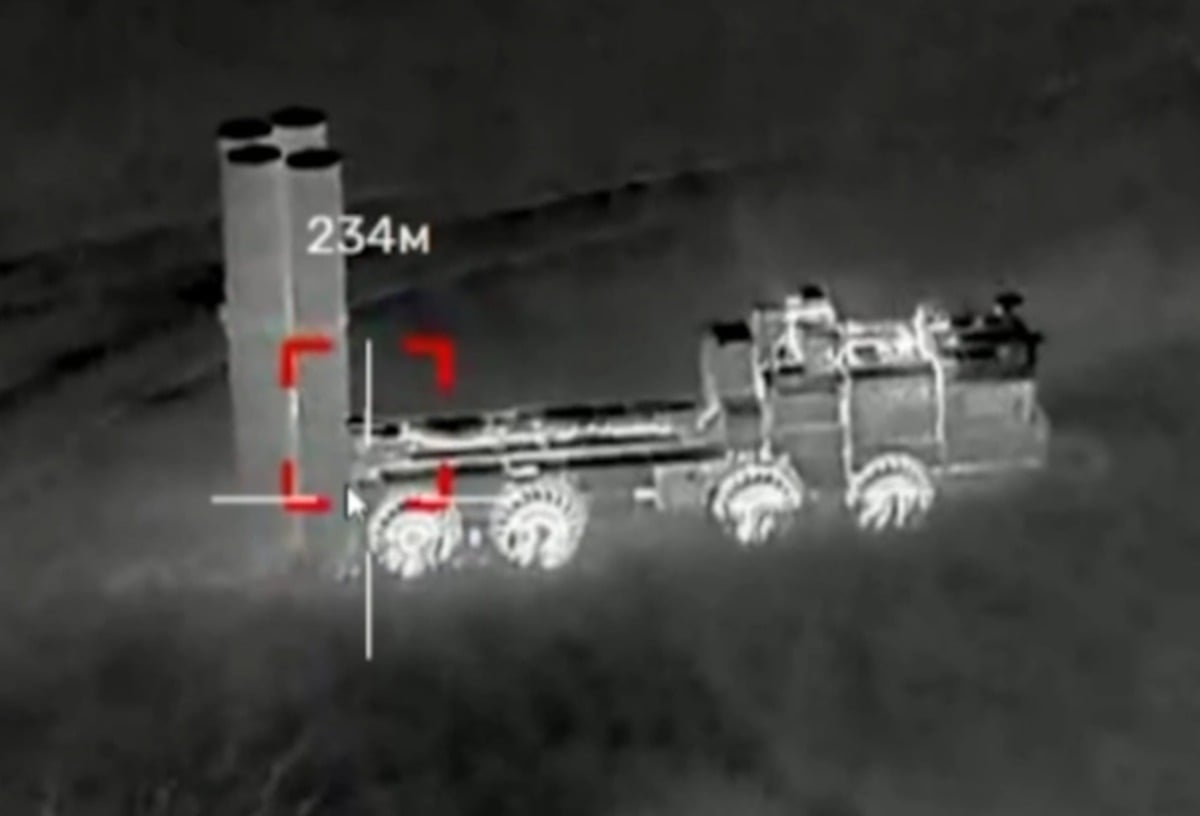
Russia spent billions building what it claimed was an impenetrable shield. The S-400 Triumf system was marketed as the ultimate weapon against aerial threats, capable of tracking stealth jets and swathes of incoming missiles. Yet, a dramatic overnight operation proved that these multi-million dollar assets are remarkably fragile when faced with coordinated drone warfare.
Ukrainian forces tracked down and obliterated two S-400 launchers in separate, high-stakes strikes. One unit burned in Russia's Bryansk region. The other turned to scrap metal inside a supposedly secure shelter in occupied Crimea. The Unmanned Systems Forces, Ukraine's dedicated drone branch, pulled off the mission right in the middle of a massive Russian missile blitz.
This wasn't just a lucky shot. It was a calculated hunt that reveals a massive flaw in Russian air defense strategy and highlights the rapidly evolving nature of modern attrition warfare.
Why Russia Uses S-400 Systems to Bomb Cities
Most people look at the S-400 as a purely defensive weapon meant to shoot down incoming aircraft or ballistic missiles. That's how Moscow sells it to international buyers. But under the pressure of dwindling missile stockpiles, the Russian military frequently modifies these anti-aircraft systems to strike static ground targets deep inside Ukraine.
When configured for surface-to-surface strikes, S-400 interceptor missiles follow a ballistic trajectory. They move fast, carry heavy explosive warheads, and give civilians very little time to seek shelter. The 413th "Raid" Regiment of Ukraine's Unmanned Systems Forces specifically targeted the Bryansk launcher because it was actively shelling Kyiv.
Taking out these units directly protects civilian lives. A launcher deployed in Bryansk can lob a missile that reaches the capital in minutes. By hunting these assets on their own turf, Ukrainian drone operators are essentially performing counter-battery warfare at a strategic scale, removing the threat before the missiles can leave the tube.
The Hunt in Bryansk and Crimea
The operation on the night of July 5-6 involved an incredible amount of coordination. Russia launched a massive combined bombardment against Ukrainian infrastructure, utilizing hundreds of drones and dozens of missiles. Ukraine used that exact moment of chaos to strike back where the enemy least expected it.
Drone operators from the Raid regiment spotted the first S-400 launcher in a firing position within the Bryansk region. It was out in the open, exposed by its own operational radar emissions. A precision strike eliminated it before the crew could repack the vehicle and relocate.
Simultaneously, another element of the Unmanned Systems Forces tracked down a second S-400 launcher in Crimea. The Russian military thought this unit was safe. They parked it inside a reinforced shelter designed to protect against shrapnel and satellite observation. It didn't matter. Ukrainian intelligence and specialized long-range strike drones breached the hideout, triggering a secondary explosion that completely gutted the asset.
According to Robert "Magyar" Brovdi, commander of the Unmanned Systems Forces, the destruction of these two premium assets was part of a larger, coordinated campaign that night. Ukrainian teams successfully hit 47 military targets across Russian territory and occupied zones, including shadow fleet petrol tankers in the Sea of Azov and a vital Nebo-U radar station.
The Economic Math is Devastating for Moscow
Wars are won on logistics and economics. When you look at the price tag of an S-400 battery, the financial reality of these losses looks grim for the Kremlin. A complete S-400 system costs roughly $1.2 billion. A single launcher vehicle represents a massive chunk of that investment, not to mention the highly trained personnel required to operate it.
Ukraine is taking these assets out using long-range strike drones and naval assets that cost a fraction of the price. Even if a drone operation requires dozens of decoys and electronic warfare support units, the cost comparison isn't even close. Spending a few hundred thousand dollars in drone tech to permanently delete a multi-million dollar strategic weapon is a trade-off Kyiv will make all day long.
Replacing these systems isn't just about money either. International sanctions make it incredibly hard for Russian defense manufacturers to source the high-end semiconductor chips, optical components, and specialized sensors needed to build advanced radars and missile guidance computers. Every radar or launcher Ukraine destroys is an asset that might not be replaced for years.
The Flaw in the Modern Integrated Air Defense Myth
The destruction of these launchers exposes a fundamental tactical flaw. Air defense systems are designed to detect targets at medium to high altitudes. They look for fast-moving fighter jets, cruise missiles, and ballistic threats.
Cheap, low-flying reconnaissance and kamikaze drones fly right under that defensive net. They move slowly, have small radar cross-sections, and often blend into ground clutter. An S-400 radar is tuned to find a supersonic jet, not a plastic drone flying just above the tree line.
Furthermore, an air defense system cannot protect itself if it is overwhelmed or bypassed. If the local radar is blinded, jammed, or simply looking the wrong way, the individual launcher vehicles become incredibly vulnerable. Once a drone identifies the coordinates of an unmasked battery, the system's survival clock starts ticking down rapidly.
How Ukraine Coordinates Deep Strikes Behind Enemy Lines
Executing a strike of this magnitude requires a seamless mix of signals intelligence, satellite tracking, and local reconnaissance networks. The Unmanned Systems Forces rely on a clear pipeline of information to make these strikes happen.
- Electronic Warfare Monitoring – Analysts track the unique radio frequency signatures of Russian search and engagement radars. When an S-400 goes active to fire or scan, it essentially lights up a beacon in the digital spectrum.
- Satellite Verification – Commercially available and military satellite imagery helps map out the exact layout of Russian bases, identifying camo netting, track marks, and hidden shelters.
- Local Resistance Inputs – Partisan networks in occupied territories like Crimea provide real-time updates on military movements, confirming whether a specific target site is occupied or empty.
- Drone Swarm Execution – Operators launch a mix of cheap decoy drones to soak up ammunition and distract remaining radars, followed closely by the actual strike platforms packed with heavy explosive payloads.
This systematic approach is how Ukraine managed to hit more than 200,000 Russian military targets in a single month earlier this year, proving that deep strikes are a standard, repeatable operational capability rather than rare anomalies.
Practical Security Steps for Strategic Air Space Management
The lessons from the Bryansk and Crimea strikes offer a clear blueprint for how modern militaries must adapt to the reality of drone saturation warfare.
Decentralize Command and Control Architecture
Relying on a single massive radar node to guide multiple launchers is a recipe for disaster. If the central node is compromised, the entire battery becomes blind. Future air defense frameworks must utilize distributed, smaller radar networks that share target data fluidly across multiple independent platforms.
Implement Hardened Physical Obstacles
Relying on basic metal hangars or simple camo netting is entirely ineffective against modern loitering munitions. Military assets parked near active combat zones require physical counter-drone netting, slatted armor screens, and active point-defense systems like automated anti-aircraft guns capable of shredding low-altitude targets.
Prioritize Short Range Air Defense Integration
Heavy systems like the S-400 should never operate without a dedicated close-in protective escort. Systems like the Pantsir-S1 are supposed to provide this protection, but they are frequently mismanaged or hunted down first. A heavy anti-aircraft battery must be surrounded by short-range, rapid-fire kinetic weapons and mobile electronic warfare jammers specifically calibrated to detect and drop small unmanned aerial vehicles.
The reality on the ground is shifting fast. Expensive, centralized weapons platforms are losing their dominance to cheap, intelligent, and distributed drone networks. As long as Ukraine maintains its edge in drone manufacturing and real-time intelligence gathering, Russian assets in Bryansk, Crimea, and beyond will continue to burn.