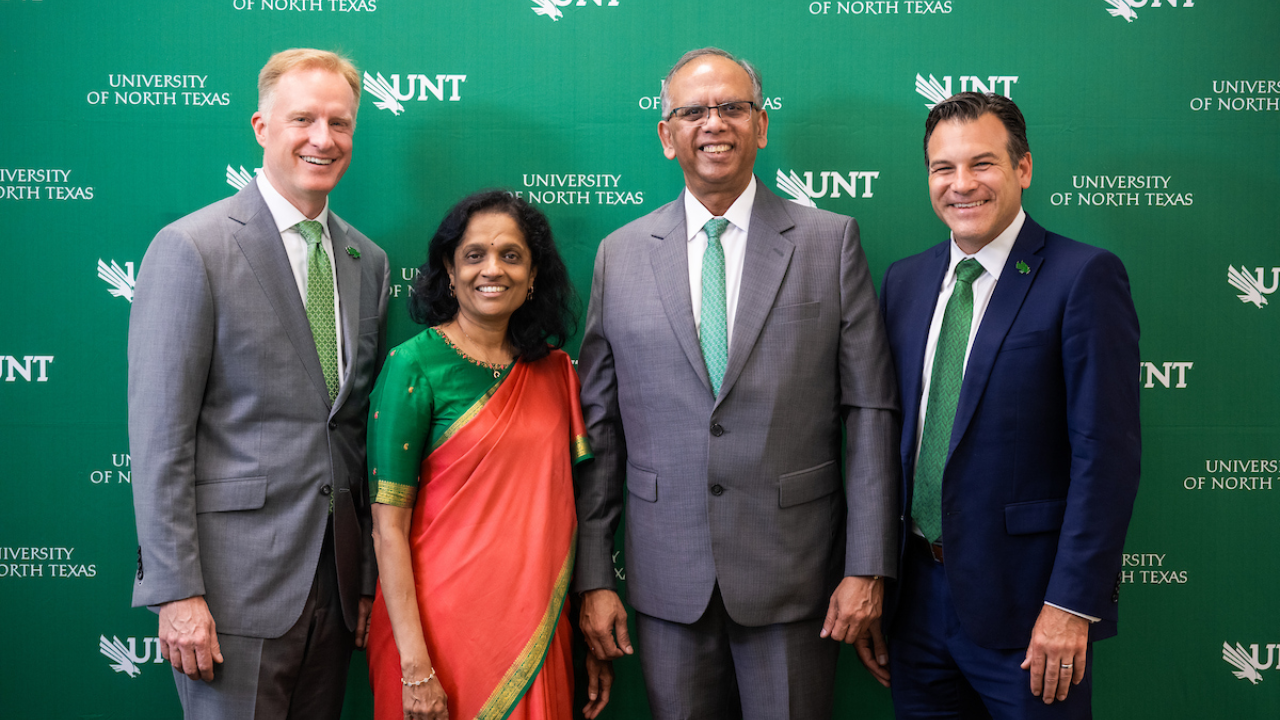
Anuradha and Vikas Sinha did not hand twenty million dollars to the University of North Texas just to buy a plaque on a limestone building. When a corporate executive and his partner endow an entire degree-granting entity—christening the Anuradha and Vikas Sinha College of Artificial Intelligence and Advanced Analytics—they are executing a calculated maneuver in the high-stakes chess match between modern corporate infrastructure and higher education.
The math of modern philanthropy reveals a deeper structural shift. Universities are no longer content with localized departments or temporary grants. They are restructuring entire academic units to mirror corporate research and development pipelines. For institutions outside the traditional Ivy League ecosystem, securing massive private capital is the only survival mechanism left to stay relevant in a tech economy dominated by automated intelligence.
The Anatomy of a Corporate Endowment
Higher education financing relies heavily on structural endowments designed to generate perpetual yields. The Sinha family gift establishes six permanent endowments, dividing twenty million dollars into targeted financial instruments. These funds cover leadership positions, student scholarships, endowed professorships, business incubation, advanced research, and emerging technology acquisition.
Look closely at how this money operates. A standard donation buys a building or funds a single laboratory. An endowment of this scale purchases institutional momentum. By funding professorships, the university can poach high-tier researchers from competing institutions. By establishing incubation funds, the college creates a captive audience of student entrepreneurs who feed intellectual property directly back into regional commercial markets.
Vikas Sinha holds a corporate leadership role as a vice president at Broadcom, giving him a front-row seat to the massive talent deficit plaguing American enterprise. Companies cannot find engineers who understand machine learning architecture alongside the messy realities of data governance and security compliance. Traditional computer science departments move too slowly to fix this gap. They teach abstract theory while the commercial software stack shifts beneath their feet every six months.
Bridging the Corporate Talent Chasm
Higher education has a structural inertia problem. Academic senates take years to approve new curricula, while language models and automated agents rewrite software engineering overnight. By injecting private capital directly into a dedicated college, donors bypass traditional bureaucratic bottlenecks.
The new entity at North Texas absorbs programs previously scattered across disparate departments, including cybersecurity, health informatics, information science, and data analytics. This consolidation breaks down academic silos. In a functional corporate environment, data scientists do not work in isolation from security engineers or domain experts. Higher education has historically failed to replicate this cross-disciplinary reality, graduating students who understand isolated algorithms but stumble when deployed into complex organizational structures.
Philanthropy of this magnitude changes the incentives for public research universities. Public funding models across the United States have stagnated over the past two decades. State appropriations cover a fraction of operating costs, forcing universities to rely on tuition hikes or private partnerships. When a donor steps in with an eight-figure check tied explicitly to artificial intelligence, the university reallocates its strategic priorities overnight to match the donor's vision.
The Immigrant Investor Class
The narrative surrounding mega-donations usually focuses on generational wealth passed down through old-money American dynasties. The Sinha trajectory represents a different economic reality. Both founders arrived from India with undergraduate degrees in civil engineering from Sri Venkateswara University, navigated the graduate school pipeline in Florida and Illinois, and built careers inside the core of corporate America.
This demographic shift among major university donors signals a maturation of immigrant wealth into institutional power. Tech executives and engineering leaders who climbed through the corporate ranks are now writing the checks that dictate how the next generation of technical workers will be trained. They bring a practitioner's mindset to academia. They do not want students spending four years memorizing theoretical proofs that automated tools can generate in seconds. They want graduates who can build, audit, question, and govern intelligent systems responsibly.
Critics often view naming rights as corporate vanity projects infiltrating public spaces. Yet, public institutions are caught in a Darwinian struggle for relevance. If a regional public university fails to produce elite machine-learning practitioners, its graduates face an inhospitable labor market. Private endowments provide the financial runway required to buy expensive compute clusters, hire top-tier faculty who could easily command millions in private industry, and subsidize tuition for students who might otherwise be priced out of technical education.
The twenty million dollar check cashed in Denton, Texas, is not an isolated act of charity. It is a blueprint for how American universities will stay afloat as public funding fades and technological change accelerates. The institutions that adapt to this corporate-philanthropic model will dominate the next century of research. The ones that cling to traditional academic isolation will quietly fade into irrelevance.