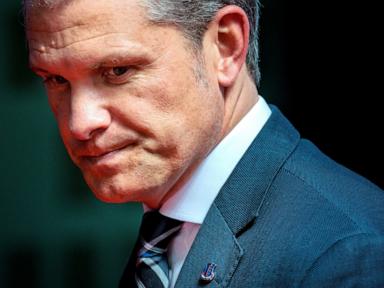
Donald Trump has publicly dismissed any possibility of replacing Defense Secretary Pete Hegseth despite mounting political and military fallout from the escalating conflict with Iran. The decision is not rooted in satisfaction with Pentagon performance, nor does it reflect consensus among Republican defense hawks. Instead, Trump is keeping Hegseth in place because firing a high-profile loyalist during an active foreign crisis would validate his critics, shatter the administration's narrative of strength, and trigger a brutal Senate confirmation battle that the White House cannot afford right now.
Washington loves a scapegoat when a military campaign hits turbulence. In almost any previous administration, a Defense Secretary overseeing the kind of operational friction, congressional backlash, and allied skepticism now surrounding the Iran conflict would already be drafting a resignation letter to spend more time with family. Yet Hegseth remains firmly seated in the E-Ring of the Pentagon, insulated by a calculation that has far less to do with grand strategy and everything to do with survival inside the West Wing.
The Architecture of Loyalty in a Wartime Cabinet
To understand why Hegseth is safe for now, you have to look at how Trump views cabinet appointments. Traditional presidents hire defense secretaries to manage a sprawling bureaucracy of nearly three million personnel and act as an institutional buffer between the Oval Office and the Joint Chiefs of Staff. Trump hired Hegseth to disrupt that exact buffer.
When Trump tapped a former Fox News host and combat veteran over traditional defense establishment figures, he was making a deliberate bet. He wanted someone who would enforce ideological alignment inside the Pentagon, purge what the administration calls "woke" military policies, and speak directly to the conservative base without filtering his words through decades of Beltway caution. Firing Hegseth under pressure from Democrats and nervous establishment Republicans would mean admitting that the bet failed.
Trump rarely admits a personnel mistake in public, especially not when the press is circling. During his first term, figures like Jim Mattis and Mark Esper eventually clashed with the president because they saw their primary duty as protecting institutional norms and alliances. Hegseth does not have an independent power base in Washington. His political survival is tied entirely to Trump. That makes him predictable, compliant, and fiercely protective of the president's instincts. In a crisis, predictability beats pedigree every time.
The Confirmation Trap Waiting on Capitol Hill
Even if Trump wanted a change at the top of the Pentagon, the mechanics of replacing a Defense Secretary during an active conflict present a massive political headache. A firing does not happen in a vacuum. It immediately forces the White House to name a successor and send that nominee before the Senate Armed Services Committee.
Right now, that committee is a minefield. A confirmation hearing for a new Pentagon chief would instantly morph into a televised inquest over the Iran war. Senators from both parties would use the platform to demand classified briefings, question rules of engagement, scrutinize troop deployments, and force the nominee to either defend or distance themselves from the administration's handling of the crisis.
Acting secretaries can run the department temporarily, as happened repeatedly during the first Trump administration. However, relying on an "acting" Defense Secretary while American forces are actively engaged in combat operations across the Middle East sends a signal of internal chaos to both Tehran and nervous regional partners. Enemies read turnover at the top of the defense apparatus as hesitation. Allies read it as unreliability. Keeping Hegseth in the chair avoids both traps, at least on paper.
How the Iran Fallout Exposed the Pentagon Divide
The pressure on Hegseth did not materialize out of thin air. As tensions with Iran escalated into direct military exchanges, maritime disruptions, and retaliatory strikes across regional bases, cracks began showing between the political appointees on the third floor of the Pentagon and the uniformed brass down the hall.
Career military planners operate on contingencies, logistics, and escalation ladders. They worry about munition stockpiles, carrier group fatigue, and what happens on day thirty of a campaign when initial air superiority meets asymmetric drone and missile swarms. Political appointees, by contrast, tend to focus on messaging, deterrence optics, and short-term decisive action.
Critics on Capitol Hill have seized on reports of friction over force posture and rules of engagement. Democrats argue that Hegseth lacks the managerial depth required to coordinate a multi-theater crisis involving naval assets, air defense networks, and diplomatic backchannels. Privately, even some Republican defense hawks have expressed unease over whether the Pentagon's civilian leadership is fully listening to combatant commanders on the ground.
Yet those very criticisms are what harden Trump's resolve. Whenever mainstream outlets and Democratic lawmakers coalesce around a demand for a resignation, the White House reflexively treats the target as a martyr. To Trump, defending Hegseth is a way of fighting back against what he views as a coordinated effort by the defense establishment to regain control of foreign policy.
The Media Factor Nobody in Washington Wants to Admit
It is impossible to separate Hegseth's survival from his background in television. Modern warfare is fought in the information space just as fiercely as it is fought at sea or in the air, and Trump has always evaluated his cabinet members largely on how they perform on screen.
Hegseth knows how to frame an argument for a camera. When he steps up to a podium or appears on a Sunday morning show, he does not speak in the guarded, acronym-heavy dialect of a career bureaucrat. He speaks in crisp, combative soundbites designed to rally domestic support and project uncompromising resolve. For a president who tracks cable news coverage closely, having a Defense Secretary who can win a five-minute television segment carries enormous weight.
Consider a hypothetical example of how this plays out during a crisis. Imagine a career defense technocrat explaining a complex naval interception in the Persian Gulf using cautious caveats about intelligence assessments and collateral risk. Compare that to Hegseth framing the exact same event as an unambiguous victory of American strength over Iranian aggression. One approach satisfies policy analysts in think tanks. The other satisfies the voter watching at home—and the man sitting in the Oval Office.
What History Tells Us About Embattled Defense Chiefs
Washington has seen this movie before, though the endings vary depending on the president's temperament. During the Iraq War, George W. Bush stood by Donald Rumsfeld for years despite relentless calls for his ouster from retired generals, lawmakers, and editorial boards. Bush believed that firing Rumsfeld mid-conflict would look like a repudiation of the war effort itself. He waited until after the 2006 midterm elections, when the political reality became undeniable, before finally making the switch to Robert Gates.
The parallel to Hegseth is instructive, with one crucial difference. Rumsfeld was a heavyweight bureaucratic operator who knew every lever of the Pentagon machine before he walked through the door. Hegseth is learning the machinery while the engine is running at full throttle. That steep learning curve creates real operational risks, especially if the Iran conflict widens into a prolonged war of attrition requiring complex coalition management.
Still, history shows that presidents rarely sack their war secretaries at the height of a storm unless the military situation suffers a catastrophic, undeniable breakdown. As long as the White House can argue that deterrence is holding and American objectives are being met, Hegseth has room to maneuver.
The Real Risks of Standing Pat
Keeping Hegseth may solve an immediate political problem for Trump, but it carries long-term costs that the administration will eventually have to confront.
First, there is the issue of allied coordination. Managing a conflict involving Iran requires constant, high-trust diplomacy with European partners, Gulf Arab states, and regional intelligence services. Many foreign defense ministers remain unsure of how much actual decision-making authority Hegseth holds versus what is being dictated directly out of the National Security Council or the Oval Office. When allies doubt whether the Defense Secretary speaks with final authority, coalition discipline frays.
Second, civil-military friction tends to compound over time. Senior generals and admirals are professionals who will execute lawful orders regardless of who occupies the secretary's office. However, when senior officers feel that operational warnings are being dismissed for political optics, candor suffers. Officers become cautious in briefings. Risk assessments get softened. Over months of sustained conflict, that erosion of trust between civilian leaders and uniformed commanders becomes dangerous.
Third, the congressional oversight battle is only going to intensify. House and Senate committees control the defense budget, procurement approvals, and supplemental war funding. If lawmakers believe the Pentagon is stonewalling legitimate inquiries about the Iran campaign, they will use appropriations bills to tie the administration's hands. Hegseth's combative posture toward Capitol Hill plays well on conservative media, but it makes passing complex defense legislation significantly harder.
The Invisible Line Hegseth Cannot Cross
Trump's public backing gives Hegseth a shield, not a blank check. In Trump's political universe, loyalty is always conditional on utility and narrative control.
Hegseth stays safe so long as he absorbs political heat on the president's behalf without letting that heat touch Trump directly. The moment the narrative shifts—if a major operational failure occurs, if casualty figures spike unexpectedly, or if polling shows the Iran fallout is dragging down Trump's own standing with core voters—that calculation changes overnight. Trump has spent a lifetime cutting ties with close associates the instant they become a net liability to his brand.
For now, firing Hegseth would hand Democrats a trophy and signal weakness to Tehran. Keeping him costs Trump very little in the short term while signaling total defiance to his critics. Until the political math in the Oval Office flips, Pete Hegseth is going nowhere.