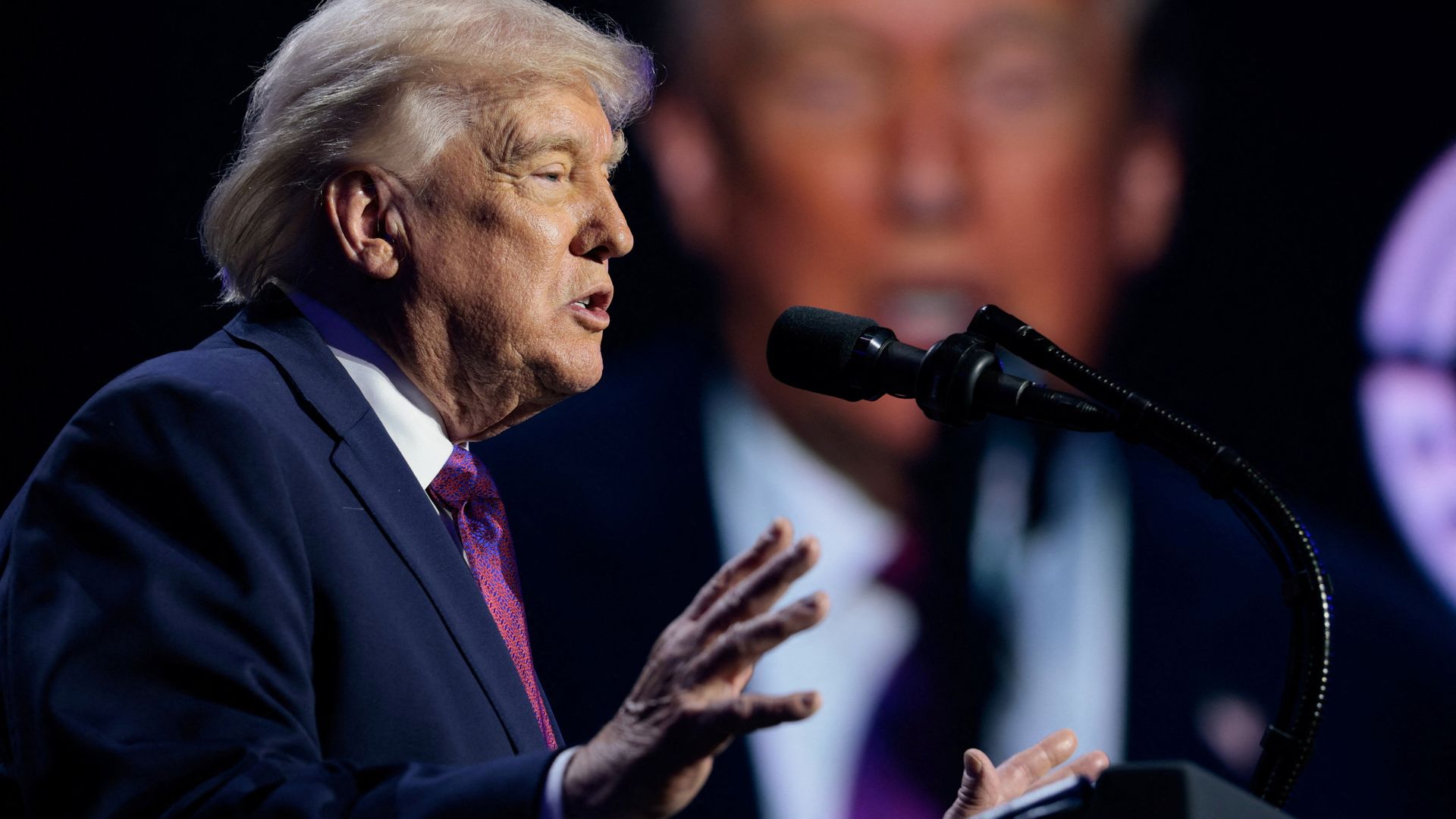
Donald Trump’s recent pledges to release "very interesting" documents regarding Unidentified Anomalous Phenomena (UAP) represent more than a campaign promise. They are a calculated strike at the heart of the national security establishment. For decades, the wall between the public and the truth about what flies in our restricted airspace has been built on a foundation of "Title 50" authorities and Special Access Programs (SAPs). Trump’s suggestion that he will tear down this wall isn't just about little green men; it is an assertion of executive power over a "Deep State" that he claims has hidden the most significant discovery in human history.
The narrative around UAP has shifted from the fringes of late-night radio to the halls of Congress with startling speed. What was once dismissed as weather balloons or mass hysteria is now the subject of bipartisan legislation and serious military concern. Trump’s rhetoric taps into a growing public demand for transparency, but the reality of declassifying such materials is a bureaucratic nightmare that few presidents have successfully navigated.
The Executive Authority vs The Intelligence Barrier
The President of the United States is the ultimate declassification authority. In theory, he can walk into a room, point at a folder of satellite imagery or sensor data, and order it released to the public. In practice, the process is a swamp of "equity reviews" and "source-and-method" protections.
When Trump mentions "very interesting documents," he is likely referring to files held by the Department of Defense (DoD) and the Office of the Director of National Intelligence (ODNI). These agencies are notoriously protective. They argue that revealing how we tracked a UAP—whether via advanced radar, hyperspectral imaging, or undersea sensors—reveals the exact capabilities of our most sensitive collection platforms to adversaries like China or Russia.
The Problem of Sources and Methods
To understand why these documents remain buried, you have to understand the Source and Method doctrine. If a Navy pilot films a "tic-tac" shaped object on a forward-looking infrared (FLIR) camera, the government doesn't just worry about the object. They worry that the clarity of the video reveals the resolution and range of the sensor.
This creates a paradox. The more compelling the evidence, the more highly classified it becomes because it was likely captured by our most advanced, and therefore most secret, technology. Trump’s promise to bypass these concerns is a direct challenge to the intelligence community’s gatekeeping.
Political Currency in the UAP Disclosure Movement
UFOs are no longer a punchline. They are a political wedge. There is a specific, highly energized demographic of voters who believe the government is hiding a "legacy program" of crashed craft retrieval and reverse-engineering. By positioning himself as the "Disclosure President," Trump is speaking directly to this base.
The Schumer-Rounds Influence
It is essential to note that Trump is not operating in a vacuum. Senators Chuck Schumer and Mike Rounds introduced the UAP Disclosure Act, which used language suggesting the existence of "technologies of unknown origin." This wasn't a crackpot theory; it was a serious legislative attempt to create a review board with the power to declassify UAP records.
While much of the teeth was pulled from the final version of the bill due to pushback from the House Intelligence Committee, the groundwork remains. Trump is essentially taking the legislative energy of the Schumer-Rounds amendment and wrapping it in his own brand of populist defiance.
The Gatekeepers of the Private Sector
One of the most significant hurdles to disclosure is not the government itself, but the private aerospace contractors. For decades, whistleblowers like David Grusch have alleged that "material" has been moved from government oversight into the hands of private companies.
Under the guise of Independent Research and Development (IRAD), these companies can keep their findings proprietary. This creates a legal gray area. If a private company owns a piece of hardware that did not originate on Earth, does the President have the right to seize and declassify it?
- Proprietary Protection: Corporations argue that their research is private property.
- Congressional Oversight: The lack of a "clear chain of custody" means Congress often doesn't know which companies hold these secrets.
- The Revolving Door: Retired military officers often move into executive roles at these companies, maintaining the wall of silence.
The tension here is palpable. If Trump attempts to force these companies to open their hangars, he will be fighting some of the most powerful lobbyists in Washington. This isn't just a search for aliens; it’s a battle over who owns the future of aerospace technology.
Analyzing the "Very Interesting" Tease
What exactly could these documents be? Based on the breadcrumbs dropped by former intelligence officials and the recent history of declassification, we can narrow it down to three likely categories.
1. High-Resolution Multi-Sensor Data
The grainy videos leaked in 2017 were just the tip of the iceberg. The military has high-definition, multi-spectral data that reportedly shows objects moving at speeds that defy our current understanding of physics—performing maneuvers that would liquify a human pilot. Releasing these would end the debate over whether the objects are real.
2. The 1940s and 50s Historical Records
The "Blue Book" era is widely considered to be a whitewash. However, internal memos from that time—documents never intended for the public eye—reportedly show that top-level officials were deeply concerned about the "interdimensional" or "extra-atmospheric" nature of these craft. Trump could be looking at historical "smoking guns" that prove the cover-up has lasted eighty years.
3. Biological and Physiological Impact Reports
There are documented cases of military personnel suffering from "anomalous health incidents" after coming into proximity with UAP. These documents are held by the Defense Intelligence Agency (DIA). They detail biological effects that suggest the craft utilize high-energy propulsion systems, such as microwave radiation or gravitational warping.
The Risk of National Instability
True disclosure is a double-edged sword. While the public clamors for the truth, the "ontological shock" of confirming a non-human intelligence could have massive economic and social repercussions.
If the government admits that it has no way to defend against these objects, the concept of national sovereignty evaporates. If the documents Trump releases suggest that we have "free energy" technology derived from these craft, the global energy market—worth trillions—could collapse overnight.
Trump’s bravado suggests he is willing to take that risk, but the pushback from the "permanent state" will be immense. They see themselves as the protectors of social order, and they view the public as unready for the implications of these documents.
The Reality of the "Soon" Timeline
In the world of government secrets, "soon" is a relative term. Declassification requires a line-by-line review by multiple agencies. Each agency has the power to "redact" or black out sections they deem too sensitive.
If Trump follows through, we should expect to see documents that are heavily sanitized. The battle will then shift from the existence of the documents to the content of the redactions. We are entering an era where the debate is no longer if something is happening in our skies, but who has been lying about it and for how long.
The documents are likely sitting in secure facilities, protected by layers of bureaucratic armor. Trump has the key, but the lock is rusted shut by decades of institutional fear and the sheer weight of the most classified secret in history. Whether he turns that key or merely uses it as a prop on the campaign trail remains the central question of the modern disclosure movement.
The move toward transparency is now an unstoppable force, hitting the immovable object of the military-industrial complex. One side has to give, and the resulting debris will change our understanding of our place in the universe forever.
If you want the truth, stop looking at the lights in the sky and start looking at the signatures on the bottom of the non-disclosure agreements. That is where the real story lives. That is what the "very interesting" documents will ultimately reveal: not just the nature of the visitors, but the lengths to which men will go to keep a secret that belongs to all of humanity.