You step out of the Trieste railway station and the light hits you differently. It is not the soft, golden glow of Tuscany or the chaotic neon rush of Rome. It is a harsh, chalky glare bouncing off neoclassical facades that look like someone picked up a piece of Vienna and dropped it squarely onto the Adriatic Sea.
Most people visit Italy expecting a seamless script of terracotta roofs, winding cobblestone alleys, and vespas buzzing past ancient ruins. Trieste breaks that script entirely. It sits on a razor-thin strip of land wedged between the Slovenian border and the sea, feeling almost accidental. For centuries, this city looked north to the Habsburg Empire rather than south to the Italian boot. When the mapmakers finally stitched it into Italy after the First World War, the city did not quite know what to do with itself.
It still doesn't.
The Habsburg Haven on the Adriatic
To understand Trieste, you have to throw out everything you think you know about Italian history unification. While Florence and Venice were busy building Renaissance empires, Trieste was a quiet, muddy fishing village until 1719. That was the year Emperor Charles VI declared it a free port.
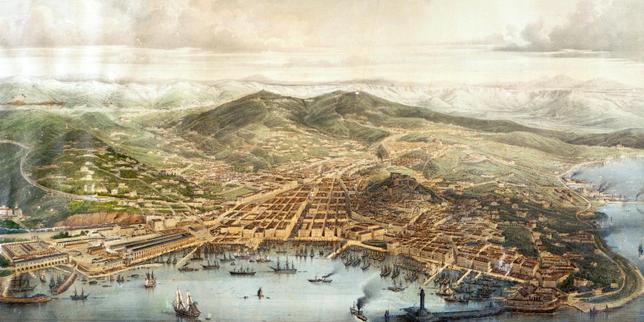
Suddenly, the sleepy village exploded. Ships from across the globe docked in the deep waters of the Gulf of Trieste, hauling spices, coffee, sugar, and cotton into the belly of Central Europe. Vienna needed a window to the world, and Trieste was the glass.
Walk through the Borgo Teresiano today and you see the blueprint of that era. The grid-like streets were named by Empress Maria Theresa to maximize trade efficiency. Canals slice right through the blocks, echoing Amsterdam or Hamburg more than Venice. The coffeehouses do not serve quick espresso shots swallowed standing up at a zinc counter. They are vast, mirrored drawing rooms where people sit for hours nursing a single mélange, reading newspapers clipped to wooden rods, exactly as James Joyce, Italo Svevo, and Umberto Saba did a century ago.
Joyce lived here for over a decade, teaching English and struggling to finish Ulysses. He once wrote to a friend that Trieste was his second home, a strange hybrid city where Italian was spoken with a guttural, Mitteleuropean accent and the architecture smelled of Vienna's coffeehouses and salt water.
The Identity Crisis of 1918
The trouble started when empires collapsed.
When the Austro-Hungarian Empire splintered at the end of World War I, Italy claimed Trieste as an unredeemed land (terre irredente). The nationalist rhetoric painted the city as an Italian heartland waiting to be liberated. But the reality on the ground was far messier.
Trieste was a cosmopolitan melting pot. Alongside ethnic Italians lived massive populations of Slovenes, Croatians, Germans, Greeks, and Jews. To the dockworkers, merchants, and writers of Trieste, joining Italy felt less like a homecoming and more like an annexation by a foreign power. The new administration immediately began a process of forced Italianization, renaming streets, suppressing minority languages, and disrupting the intricate trade networks that fed the city's economy.
The interwar period turned Trieste into a pressure cooker of fascism and ethnic tension. Then came the devastation of the Second World War. For forty days in 1945, Yugoslav partisan forces occupied the city, followed by a tense decade as the Free Territory of Trieste, governed jointly by Anglo-American allied troops. It finally reverted to Italian administration in 1954, but the psychological scar remained.
Trieste spent the second half of the twentieth century cut off from its natural hinterland. The Iron Curtain slammed shut just a few miles east of the city limits, turning its thriving Central European markets into ghost towns. The port stagnated. The grand coffeehouses grew dusty. The city became a quiet, melancholy backwater, famous mostly for the fierce, freezing wind known as the bora, which screams down from the karst plateau with enough force to knock pedestrians off their feet.
The Modern Revival
Today, the city is experiencing a quiet renaissance. You can feel it in the restored facades of Piazza Unità d'Italia, the grandest seaside square in Europe, where the marble floor literally drops off into the Adriatic.
Yet, Trieste remains proudly distinct from the rest of the country. Ask a local where they are from, and they are just as likely to say they are Triestine first and Italian second. The cuisine tells the story better than any history book. Forget heavy southern tomato sauces. Here, you eat jota—a hearty bean, sauerkraut, and potato soup—alongside boiled pork knuckles, gnocchi stuffed with plums, and strudel washed down with a glass of Teran wine grown in the rocky karst soil.
If you travel here, do not look for the Colosseum or the leaning tower. Look for the details. Check out the Risiera di San Sabba, the only Nazi concentration camp on Italian soil, which serves as a stark reminder of the dark cost of twentieth-century nationalism in a borderland city. Visit the Miramare Castle, built by Archduke Maximilian of Habsburg on a sheer white cliff, projecting imperial ambition out over the waves before his tragic execution in Mexico.
Trieste is a reminder that borders are lines drawn on paper, while culture is forged by the tides of geography and trade. It never quite knew it was Italian because, for the better part of its golden age, it belonged to the world.