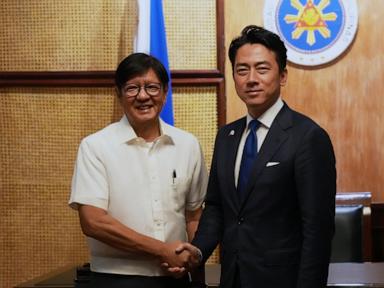
The recent arrival of Japan’s defense leadership in Manila is not a mere diplomatic courtesy call or a standard photo opportunity. It represents a fundamental shift in the tectonic plates of Indo-Pacific security. For decades, Japan operated under a self-imposed shell of pacifism, while the Philippines balanced precariously between Washington’s military umbrella and Beijing’s economic carrot. That era is over. The two nations are now moving toward a Reciprocal Access Agreement (RAA) that will essentially allow Japanese troops to operate on Philippine soil for the first time since the dark days of the 1940s. This is a cold, calculated move to counter Chinese maritime expansionism, and it changes the math for every navy in the region.
The Death of Neutrality in the South China Sea
Manila has stopped pretending that "quiet diplomacy" will protect its sovereign rights. Under the current administration, the Philippines has pivoted from the accommodationist stance of the previous decade toward a strategy of "assertive transparency." By publicizing every water cannon attack and every near-collision at Second Thomas Shoal, Manila has forced the international community to take a side. Japan, sensing its own shipping lanes are at risk, has stepped up as the primary partner outside of the United States.
This partnership isn't built on shared values alone. It is built on shared fear. Tokyo watches the tensions around the Senkaku Islands and sees the exact same playbook Beijing uses against the Philippines at Scarborough Shoal. If the Philippines loses control of its exclusive economic zone, Japan’s southern flank becomes indefensible.
Weapons Instead of Words
Tokyo is no longer just sending white-hulled coast guard vessels to help with "capacity building." The nature of the hardware being transferred has turned lethal. We are seeing the export of sophisticated air surveillance radar systems and potentially coastal defense missiles.
The strategy is clear: turn the Philippine archipelago into a "sensor wall." If you can see everything that moves in the Luzon Strait and the West Philippine Sea in real-time, the advantage of China’s massive maritime militia evaporates. Japan is providing the eyes, and eventually, the teeth.
Breaking the Ghost of the Second World War
The most significant hurdle to this alliance was never logistics; it was history. The memory of the Japanese occupation remains a sensitive subject in Southeast Asian classrooms. However, the sheer pressure of China’s "salami-slicing" tactics has achieved what decades of diplomacy could not. It has made Japan look like a protector rather than a former aggressor.
The Reciprocal Access Agreement is the legal mechanism that will allow Japanese Self-Defense Forces (SDF) to participate in large-scale combat exercises on Philippine territory. This goes beyond disaster relief. We are talking about anti-submarine warfare drills and amphibious landing rehearsals. When Japanese F-15s or soldiers land in Clark or Subic Bay, it sends a message to Beijing that the "First Island Chain" is no longer a series of isolated outposts, but a unified front.
The Logistics of a New Front
Moving troops is easy. Sustaining them is hard. The real work being done behind the scenes involves the standardization of fuel, ammunition, and communication protocols.
- Interoperability: Philippine and Japanese systems must be able to talk to each other without going through a US middleman.
- Infrastructure: Japan is funding the modernization of Philippine ports that can dock large patrol vessels and, eventually, destroyers.
- Intelligence Sharing: A formal pact allows for the exchange of high-level satellite imagery and signals intelligence regarding Chinese ship movements.
Why Washington is the Silent Third Partner
While this is a bilateral push between Tokyo and Manila, it fits perfectly into the American "hub and spoke" strategy. The US wants its allies to do more of the heavy lifting. By having Japan take the lead on Philippine maritime security, the US frees up its own assets for other global flashpoints.
This "little NATO" forming in the Pacific isn't a formal treaty organization yet, but it functions like one. The trilateral cooperation between the US, Japan, and the Philippines creates a triple-layered deterrent. If a Philippine vessel is harassed, it’s no longer just a Manila-Beijing problem. It’s a problem that involves the world’s largest and third-largest economies.
The Risk of the Cornered Tiger
Critics of this deepening tie argue that it creates a security dilemma. By ramping up military cooperation, Tokyo and Manila might be provoking the very conflict they seek to avoid. Beijing has already warned that the Philippines is "playing with fire" by inviting "external forces" into what it considers its backyard.
There is a real danger of miscalculation. As the Philippine Coast Guard becomes more emboldened by Japanese support, the chance of a physical confrontation at sea increases. A single mistake by a ship’s captain could trigger a mutual defense treaty obligation that draws in Japan and the US, turning a fishing dispute into a global conflagration.
The Economic Counter-Punch
We cannot ignore the wallet. China remains a massive trading partner for both nations. Japan is playing a delicate game of trying to decouple its security from its economy, while the Philippines is trying to find alternative sources of infrastructure investment to replace Chinese "Belt and Road" funds that never fully materialized.
Tokyo’s "Official Security Assistance" (OSA) is a new tool that allows it to provide military hardware to like-minded countries. It’s a direct competitor to Chinese economic influence. Japan is betting that the Philippines would rather have a secure border than a high-speed railway built with Chinese debt.
The Coastal Defense Evolution
The next phase of this relationship will likely involve the transfer of shore-based anti-ship missile systems. The Philippines has already acquired the BrahMos system from India. If Japan begins supplying its own Type 12 surface-to-ship missiles, the South China Sea becomes a very dangerous place for an invading fleet.
This isn't about power projection; it’s about "Area Denial." The goal is to make the cost of Chinese entry into Philippine waters so high that the People's Liberation Army Navy (PLAN) decides it isn't worth the risk. It is a strategy of making the archipelago "unswallowable."
A Change in the Regional Psychology
For the last twenty years, the prevailing wisdom in Southeast Asia was "don't make us choose" between the US and China. That mantra is dying. The Philippines has made its choice, and Japan has decided to bankroll it.
This isn't just about ships and radars. It’s about the end of the post-Cold War order in Asia. The "pacifist" Japan is gone, replaced by a nation that understands that its defense begins 1,500 miles away in the waters off Palawan. The Philippines has realized that its sovereignty cannot be defended with legal papers and international court rulings alone. You need steel to back up the law.
The upcoming RAA signing will be the final nail in the coffin of the old status quo. When the first Japanese boots hit the ground for joint exercises in the Philippine jungle, the map of Asia will be rewritten. The "steel ring" is closing, and the room for maneuver in the South China Sea is getting smaller by the day.
Watch the skies over the Luzon Strait. The planes you see there will increasingly carry the Hinomaru alongside the Philippine sun and stars, a sight that would have been unthinkable a generation ago but is now the only reality that matters.


