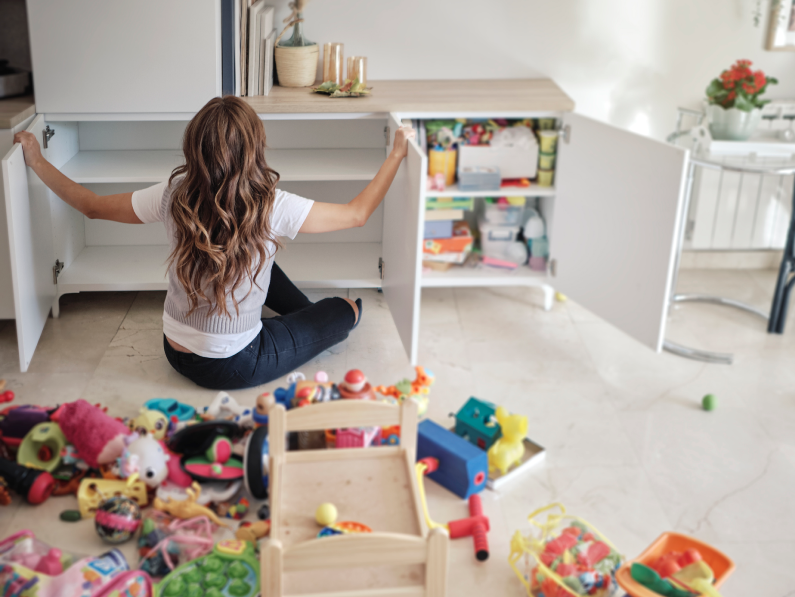
You’re sitting on the floor trying to build a Lego tower with your toddler. Your phone buzzes. It’s a work email you think will take ten seconds to answer. You swipe, type a quick "sounds good," and look back down. But the flow is gone. Your kid is frustrated because the tower fell, and your brain is still half-tangled in that email thread. This isn't just "being busy." It’s a phenomenon researchers call time confetti.
Brigid Schulte, author of Overwhelmed: Work, Love, and Play When No One Has the Time, coined this term to describe the way our free time is shredded into tiny, useless bits. For parents, this is a crisis. We think we have an hour of downtime, but it’s actually twelve five-minute gaps separated by pings, chores, and mental to-do lists. You aren't actually resting. You're just vibrating in the spaces between tasks.
The Science of Why Your Brain Feels Fried
Most people think the problem is that they don't have enough hours in the day. That’s a lie. Data from the American Time Use Survey often shows that parents actually have more "leisure" time than they did in the 1960s. The issue is the quality of that time. When your leisure is fragmented, your brain never enters a "flow state."
Psychologist Mihaly Csikszentmihalyi defined flow as that feeling where you're so absorbed in an activity that time seems to vanish. It's the ultimate stress-reliever. But you can't reach flow in four-minute increments. When you check Instagram while the pasta boils, or answer a text during a playground trip, you’re hitting the "reset" button on your focus.
The result is something researchers call contaminated leisure. This is the feeling that even when you're doing something fun, you're mentally elsewhere. You feel guilty about not working, or you're planning tomorrow's lunch while watching a movie. It’s exhausting. It’s why you can have a "relaxing" Sunday and still wake up on Monday feeling like you got hit by a truck.
Why Parents Get Hit the Hardest
Mothers, in particular, suffer from a higher density of time confetti. A study published in the American Sociological Review found that while men and women might have similar amounts of total free time, women's time is much more likely to be interrupted by domestic labor or "mental load" tasks.
Think about the "just one thing" trap.
- "I'll just start the laundry while the kids are coloring."
- "I'll just check the school calendar real quick."
- "I'll just wipe this counter."
Every "just one thing" is a pair of scissors snip. By the time you sit down, your "hour of rest" has been reduced to confetti. This constant switching increases cortisol. It keeps your nervous system in a state of low-grade fight-or-flight. You aren't parenting; you're managing a chaotic logistics firm where the employees are toddlers and the CEO is a smartphone.
The Myth of Productive Multitasking
Stop telling yourself you're good at multitasking. You aren't. Nobody is. What you're actually doing is context switching.
Every time you switch your attention from a child's story to a Slack notification, there is a "switching cost." Your brain takes several minutes to fully re-engage with the original task. If you're switching every five minutes, you're never actually at 100% capacity for anything.
This leads to a specific kind of parental rage. Have you ever snapped at your kid for asking a simple question while you were trying to read a text? That's the switching cost in action. Your brain was struggling to bridge the gap between two different worlds, and the interruption felt like a physical assault.
How to Glue the Confetti Back Together
You can't manufacture more time, but you can protect the blocks you have. It requires being aggressive with your boundaries. People will think you're being "unavailable" or "slow to respond." Let them.
Use the "Batching" Method for Life Admin
Stop answering emails as they come in. Stop checking the school portal every time you think of it. Designate two 20-minute windows a day for "life admin." If a thought pops into your head outside those windows, write it on a physical notepad and move on. Do not open the app.
Kill the Notifications
This is the single biggest source of time confetti. Your phone is a slot machine designed to steal your focus. Go into your settings and turn off every single notification that isn't a direct phone call from a human being. You don't need to know that someone liked your photo or that there's a sale at Gap in real-time. Check those things on your schedule, not theirs.
The 20 Minute Rule for Play
If you're going to play with your kids, do it for 20 minutes with zero distractions. Leave the phone in another room. Don't look at the clock. Fully immerse yourself in the floor-play or the game. You'll find that 20 minutes of "pure" time feels more fulfilling for both you and the child than two hours of "confetti" time where you're constantly checking your pockets.
Reclaiming the "Long" Moment
We've been conditioned to view small gaps of time as opportunities to "get ahead." Standing in line at the grocery store? Check email. Waiting for the kettle? Scroll TikTok.
This is a mistake.
Those tiny gaps are actually essential "micro-rests" for your brain. By filling them with digital noise, you're denying your mind the chance to wander. Boredom is the precursor to creativity and calm. When you turn your waiting time into confetti, you lose the ability to just be.
Next time you have three minutes of "nothing," try doing exactly that. Nothing. Lean against the counter. Look out the window. Breath. It feels twitchy at first because your brain is addicted to the dopamine hit of the scroll. Resist it.
Establishing Digital Low-Tide
In coastal areas, low tide is when the water retreats and the beach is exposed. You need a daily "digital low-tide." This is a period—maybe from 6:00 PM to 8:00 PM—where all screens are docked in a central location.
During low-tide, the confetti-makers are gone. The time becomes "thick" again. You can have a conversation that lasts more than three sentences. You can read a book. You can actually look your partner in the eye without a glowing rectangle between you.
Stop Treating Leisure Like a Task
The ultimate goal isn't to be more productive. It's to be more present. We've spent years optimizing our work lives, and now we're trying to optimize our parenting and our rest. It’s a losing game.
If you view your free time as something that needs to be "used" efficiently, you've already lost. True leisure is purposeless. It’s messy. It’s slow. To get it back, you have to be willing to leave things undone.
Let the email wait. Let the laundry stay in the dryer. Let the "confetti" of the world blow past you while you focus on the one thing that actually matters in that moment.
Start today by identifying your biggest "snip." Is it the phone? Is it the urge to tidy? Pick one thing and stop doing it for the next three hours. Watch how the time starts to feel heavy and whole again. You don't need a vacation; you need a day without scissors.