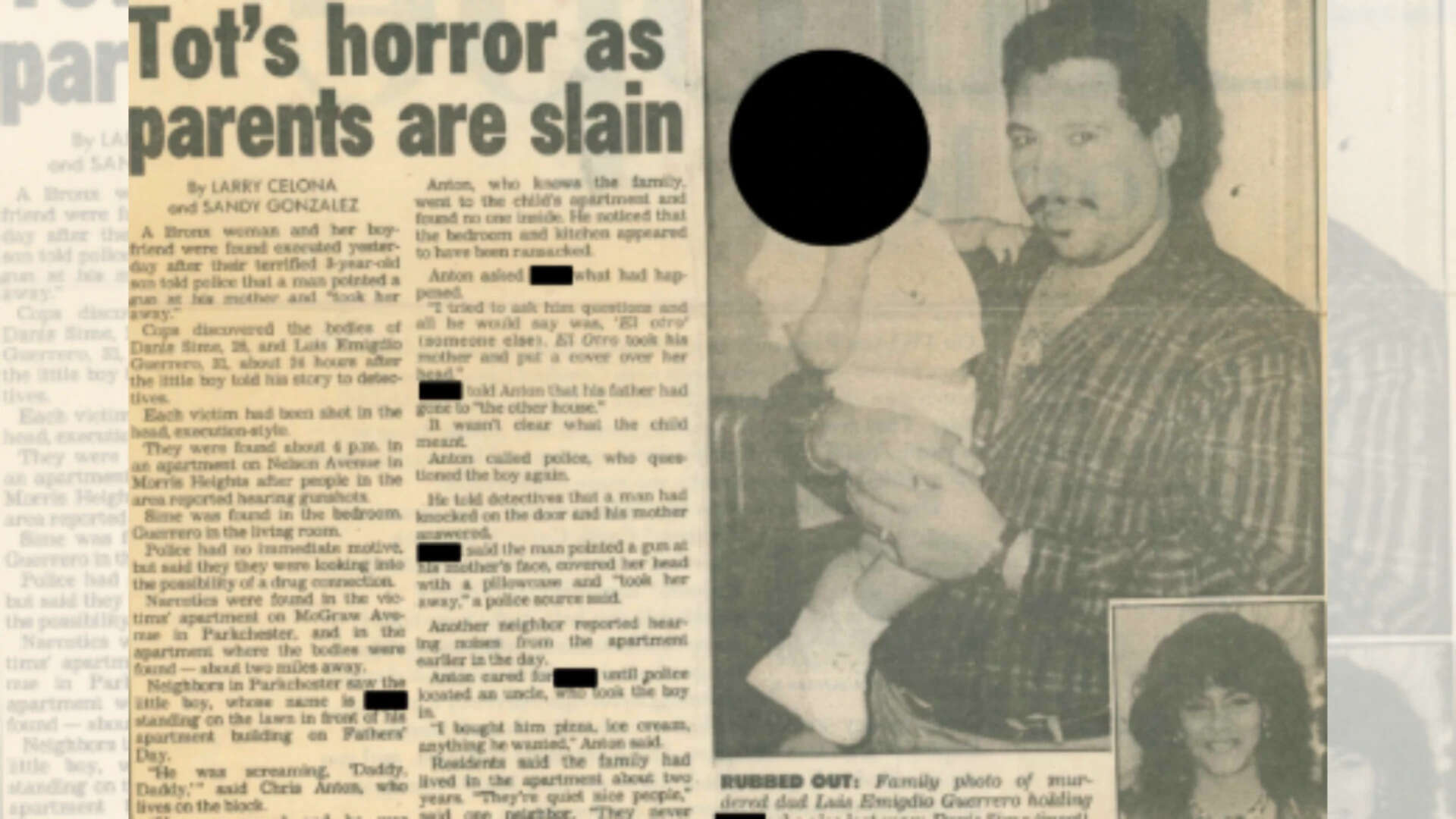
The humidity in Miramar, Florida, has a way of preserving things that should have long ago rotted away. In 1993, that heavy air hung over a quiet home where Billy Hall and his girlfriend, Connie Gish, lived. They were young, they were a family, and they were, by all accounts, unremarkable in the best way possible. They had a three-year-old son who saw the world through the uncomplicated lens of cartoons and cereal.
Then, the world shattered.
It wasn’t just a crime; it was a rupture in the timeline of a neighborhood. Billy and Connie were murdered, their lives extinguished in their own home while their toddler watched. For decades, that boy grew up with a memory that no human brain is designed to hold. He saw the faces of the people who mattered most to him turn into shadows.
The police did what they could. They collected the shell casings. They bagged the evidence. They interviewed the neighbors who heard the pops of gunfire but saw nothing but the Florida sun beating down on the pavement. And then, the trail went cold. Not just cold—frozen. The files moved from the active desks to the bottom drawers, then to the archives, gathering dust while the world outside moved on to the internet, to smartphones, and to a new millennium.
The Weight of a Cold Case
A cold case is a living wound. To the public, it is a headline that fades. To the families, it is a permanent dinner plate left on the table that no one can touch. In the case of the Hall-Gish murders, the "invisible stake" was the soul of a boy who had to become a man while carrying the weight of a 1993 nightmare. He was the only witness. But a three-year-old’s testimony is a fragile thing, easily dismissed by the rigors of a courtroom and the passage of time.
Investigative work in the early nineties relied on grit and physical fingerprints. If you didn't leave a piece of yourself behind that could be seen with a magnifying glass, you were often a ghost. The killers walked away. They breathed thirty years of air that Billy and Connie never got to taste. They grew older. They probably thought they had "gotten away with it," a phrase that implies a finish line.
But justice doesn't have a clock. It only has a pulse.
Consider the reality of the Miramar Police Department’s cold case unit. These aren't the high-speed chases you see on television. It is a grueling, monastic existence of re-reading yellowed notes. It is calling people who have changed their names, moved across the country, or died. It is looking at the same crime scene photos until the shapes of the bloodstains become burned into your retinas.
The breakthrough didn't come from a dramatic confession in a rain-slicked alley. It came from the relentless, quiet advance of forensic science.
The DNA Revolution
For thirty years, a small piece of evidence sat in a climate-controlled room. It was waiting for the world to catch up to it. In 1993, DNA testing was in its infancy—clunky, expensive, and requiring large samples. By 2023, the technology had sharpened into a scalpel. Investigators were able to extract a profile from a sample that would have been considered useless a generation ago.
This is where the narrative shifts from a tragedy to a reckoning.
The DNA didn't just point to a stranger. It pointed to Ronald Richards. At the time of the murders, Richards lived in the area. He wasn't a mastermind. He wasn't a shadow. He was a man who had been hiding in plain sight, perhaps even walking the same streets where the crime occurred. When the lab results came back, the investigators didn't see numbers or sequences. They saw a name.
Richards was already in custody on unrelated charges when the past finally caught up to him. Imagine the moment the cell door opens and an officer tells you that a thirty-year-old secret is no longer yours to keep. The arrogance of the criminal is built on the assumption that time erases truth. They believe that as they age, their sins age with them, eventually becoming too brittle to be handled.
They are wrong.
The Human Cost of Waiting
We often talk about "closure" as if it’s a gift-wrapped box. It’s not. For the son of Billy and Connie, the arrest of Ronald Richards doesn't bring his parents back. It doesn't erase the image of that 1993 living room. What it does, however, is validate the pain. It tells the survivor that the world didn't forget.
The tragedy of the "Florida Man" trope is that it often turns human suffering into a punchline. This wasn't a quirky news story about a bizarre heist or a pet alligator. This was the systematic destruction of a family unit. The "Florida Man" in this story is a murderer who thought he could outrun the DNA inside his own cells.
The stakes of solving a case this old are psychological. Every time a cold case is solved, it sends a ripple through the community of those still waiting. It tells the mother of a missing girl in Oregon or the brother of a murdered shopkeeper in Maine that the file is still open. It reinforces the social contract: if you take a life, we will look for you until the sun goes down, and then we will look for you in the dark.
The Science of the Hunt
The process of genetic genealogy and advanced DNA phenotyping has changed the landscape of American justice. It isn't just about matching a suspect to a crime scene anymore; it’s about building family trees. Investigators can now take an unknown sample and work backward through cousins, aunts, and great-grandparents until the tree narrows down to a single branch.
In the Miramar case, the persistence of Detective Joe Hoffman and his team was the engine. Science is the tool, but human obsession is the fuel. Hoffman didn't have to keep looking. He could have focused on the fresh bodies, the new crimes that scream for attention every day in South Florida. But there is a specific kind of haunting that happens when a child is left behind.
The three-year-old boy is now a man in his thirties. He has lived more life without his parents than he ever did with them. He represents the silent victims of the crack-era violence that gripped Florida in the early nineties—a time when the sheer volume of crime often buried individual stories.
The Final Reckoning
Ronald Richards now faces the consequences of a day he likely tried to forget ten thousand times. The legal system will grind forward. There will be depositions, motions, and perhaps a trial where the evidence from 1993 will be laid out under LED lights that didn't exist when the triggers were pulled.
But the real story isn't the trial. It’s the endurance of the evidence. It’s the fact that a tiny microscopic strand of biological material held a grudge for three decades. It’s the terrifying and beautiful reality that we leave pieces of ourselves behind wherever we go, and eventually, those pieces tell our story for us.
The boy who watched his parents die is no longer just a victim. He is a witness to the fact that the truth is patient. He is a man who can finally stop looking over his shoulder for a ghost, because the ghost has finally been given a name and a pair of handcuffs.
The Florida heat still hangs heavy over Miramar. The house where it happened might have a new coat of paint or a different family inside, unaware of the echoes in the drywall. But the air feels a little lighter now. The silence that followed the gunshots in 1993 has finally been broken by the sound of a closing cell door.
Justice is a slow-moving river, often choked with debris and diverted by the passage of years. But eventually, it finds the sea. And when it does, it washes away the lie that some crimes are too old to matter.
The boy is grown. The killer is caught. The files are closed.
The shadow that began in a 1993 living room has finally met the light.


