Modern critical infrastructure security relies on assumptions built for an era of predictable, state-actor symmetry. When uncrewed aerial systems breach restricted airspace above strategic logistical hubs or military installations, they exploit an asymmetric cost function. A commercial or modified platform costing a few thousand dollars forces the activation of multi-million-dollar emergency responses, total airspace shutdowns, and complex counter-terrorism investigations.
Evaluating the security deficit requires examining the mechanics of these incursions, the structural limitations of current civil-military defense architectures, and the economic friction inflicted on European transport networks.
The Economics of Asymmetric Disruption
The strategic utility of low-cost aerial incursions lies in their economic efficiency relative to the defender's expenditure. Traditional air defense systems are architected to intercept high-altitude, high-velocity threats such as ballistic missiles or military aircraft. They are neither priced nor positioned to address slow, low-altitude micro-platforms operating within civil airspace.
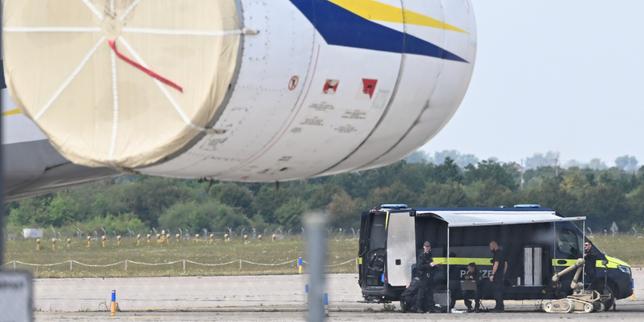
When an unauthorized system penetrates the perimeter of a major European freight hub, such as the recent incident involving explosive payloads discovered at Leipzig-Halle Airport, the immediate operational response follows a rigid protocol:
- Immediate cessation of active runway operations to eliminate collision risks.
- Diversion of inbound passenger and cargo airframes, resulting in cascading schedule failures across international networks.
- Deployment of specialized federal police, bomb disposal units, and forensic teams to secure the perimeter.
- Initiation of federal counter-terrorism proceedings to determine state versus proxy involvement.
The financial loss extends far beyond the direct cost of the investigation. Major logistical nodes operate on tight temporal margins. Halting operations for even two hours creates a multi-day backlog across European supply chains, compounding economic friction without requiring the aggressor to expend sophisticated ordnance.
Jurisdictional Bottlenecks in National Airspace Defense
A primary vulnerability exposed by the proliferation of low-altitude incursions is the jurisdictional fragmentation between domestic law enforcement and military command structures. In federal republics and centralized European states alike, peacetime airspace security is structurally divided.
Municipal and federal police maintain jurisdictional authority over civil airports and domestic territory, yet they historically lack the kinetic and electronic countermeasures required to neutralize high-grade aerial threats. Conversely, the national military apparatus possesses the detection assets and tactical counter-drone technology, but operating kinetic interception systems over densely populated civilian areas or critical economic nodes introduces unacceptable collateral risk.
This division creates an operational lag. When sightings occur near sensitive military installations—such as the repeated overflights of logistics depots housing missile defense components—the chain of command must transition authority from local precinct observers to specialized federal task forces. Attackers exploit this administrative latency, utilizing platforms whose flight endurance matches or exceeds the time required for bureaucratic authorization chains to approve electronic countermeasures.
The Evolution from Reconnaissance to Kinetic Probing
Early patterns of unauthorized aerial surveillance over European energy grids, telecommunication hubs, and training grounds were primarily classified as intelligence-gathering operations. The objective was mapping sensor blind spots, evaluating shift patterns of private security personnel, and testing the response times of local law enforcement.
Recent incidents indicate a structural shift toward active disruption and physical placement. The transition from passive observation to deploying payloads or executing mid-air collisions with cargo aircraft alters the risk matrix for civil aviation authorities.
This escalation serves three distinct operational goals for hostile actors engaging in hybrid warfare:
- Psychological conditioning of the civilian population by demonstrating that geopolitical conflict possesses direct physical proximity to domestic population centers.
- Coercion directed at state governments providing material and logistical backing to allied nations under invasion.
- Threshold testing to determine the exact point at which defensive measures trigger formal international escalation versus passive diplomatic protest.
Because these actions remain deliberately ambiguous—often executed via proxy networks or deniable commercial hardware—they occupy a gray zone below the threshold that would mandate a collective military response under mutual defense pacts.
Defensive Restructuring and Operational Integration
Mitigating this persistent vulnerability requires abandoning reactive containment in favor of integrated, multi-layered terminal defense architectures. European security agencies are moving to compress the sensor-to-shooter loop by deploying dedicated counter-drone task forces equipped with artificial intelligence-assisted jamming systems and automated interceptor platforms.
The structural blueprint for resilient civil-military protection involves three mandatory adaptations:
- Regulatory Harmonization: Updating aviation security statutes to grant specialized security units immediate legal authority to deploy electronic jamming and non-kinetic interdiction over civil critical infrastructure without civilian clearance delays.
- Sensor Densification: Installing passive radio-frequency, acoustic, and thermal tracking arrays around every designated tier-one logistics and military hub to ensure persistent coverage below standard primary radar horizons.
- Decentralized Interdiction Nodes: Doubling the number of rapid-deployment mobile counter-drone units to reduce transit times from central barracks to outlying regional airports.
Relying on ad-hoc discoveries by ground crew or sheer operational luck—such as unexploded ordnance failing due to detonator malfunctions—is mathematically unsustainable. Security policy must be engineered on the assumption of continuous daily friction, requiring an institutional posture that treats low-altitude airspace integrity with the same urgency traditionally reserved for ballistic defense.
Establish a unified command structure that permanently co-locates federal police intelligence analysts, military electronic warfare operators, and airport logistics controllers within a single operational theater to eliminate inter-agency communication latency before the next fiscal quarter concludes.
German airport drone incident signals new challenge for European security
This reporting provides direct investigative context regarding the structural vulnerabilities and operational disruptions caused by explosive drone incursions at major European transport hubs.