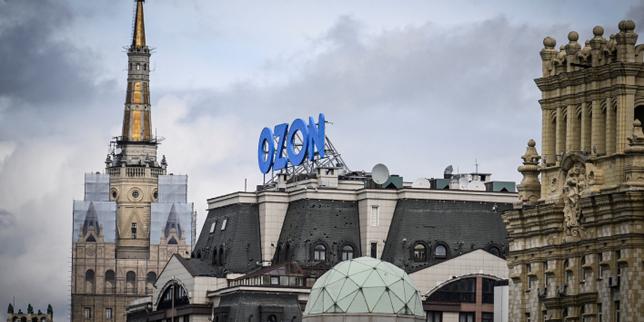
Mainstream war correspondents are treating the recent Ukrainian drone strike on a Russian e-commerce warehouse like a bizarre footnote. They see boxes of cheap electronics, winter coats, and household goods going up in smoke, and they call it collateral damage or a desperate distraction.
They are completely blind to how modern warfare actually works. Don't miss our previous article on this related article.
If you think hitting a fulfillment center is a waste of a long-range drone, you are still fighting the battles of the twentieth century. In an industrialized war of attrition, a massive automated logistics hub is not a civilian storefront. It is a dual-use military asset disguised in cardboard and bubble wrap.
The Illusion of the Civilian Supply Chain
For decades, military analysts drew a thick, bright line between the defense industrial base and the consumer economy. Tanks came from state factories; sneakers came from private warehouses. That distinction is dead. To read more about the background here, NBC News offers an excellent breakdown.
Russia’s war machine survives because it has successfully cannibalized its own commercial sector. When Moscow needed microchips, thermal optics, commercial drones, and cold-weather gear for hundreds of thousands of mobilized troops, it did not build new state-owned factories from scratch. It routed those goods through the exact same gray-market import channels and domestic e-commerce networks that deliver blenders to Moscow apartments.
I have spent years analyzing global supply chain vulnerabilities, and the biggest mistake observers make is looking at the sign on the building rather than the manifests inside it. A sprawling e-commerce fulfillment center—like those operated by Russian giants Ozon or Wildberries—possesses three things the Russian Ministry of Defense desperately lacks:
- Automated sorting and distribution infrastructure capable of moving millions of parcels across eleven time zones without human bottlenecks.
- Climate-controlled storage designed to protect sensitive electronics from sub-zero temperatures.
- Decentralized last-mile delivery networks that blend seamlessly into civilian traffic, making them nearly impossible to track via standard satellite reconnaissance.
When a drone takes out a 100,000-square-meter warehouse, it does not just burn consumer goods. It destroys the physical architecture that allows a sanctioned economy to import restricted dual-use components in small, untraceable batches and aggregate them for the front lines.
Why Tanks Matter Less Than Pallet Jacks
Western commentary remains obsessed with kinetic hardware. Every news cycle fixates on the count of artillery shells, armored personnel carriers, or glide bombs. This obsession misses the fundamental math of attrition.
Clausewitz famously noted that war is the continuation of politics by other means, yet modern strategists forget that logistics is the actual engine of both. You can have a million artillery shells sitting in a depot in the Urals, and they are functionally useless if you cannot sort, palletize, and route the supporting equipment—radios, batteries, generators, medical kits—that keep the artillery crews alive.
Consider the sheer replacement cost of modern warehouse automation. A single high-bay fulfillment center relies on foreign-made warehouse management software, optical scanners, conveyor motors, and specialized racking systems. Because of Western sanctions, Russia cannot simply call up Siemens or Honeywell to replace a incinerated automated sorting line.
A tank factory can be patched up with welding torches and brute labor. A modern logistics hub is a fragile ecosystem of precision electronics. Once it burns, it stays dead for years.
The Psychological Shockwave of the Empty Cart
There is a second, equally potent dimension to targeting commercial infrastructure that conventional military pundits ignore: the collapse of the domestic social contract.
The Kremlin’s entire political survival strategy rests on a simple, unspoken bargain with the Russian middle class. The state demands passive obedience regarding the war in Ukraine; in exchange, the state guarantees that life in Moscow, St. Petersburg, and major regional capitals remains uninterrupted. The malls stay open. The delivery apps keep pinging. The illusion of normalcy holds.
E-commerce is the ultimate symbol of that normalcy. For millions of Russians, ordering goods online is the primary way they experience modern convenience and material stability.
When Ukrainian drones bypass air defenses and incinerate a massive commercial distribution hub, that psychological firewall shatters. Suddenly, the war is not a distant television broadcast happening in the Donbas. It is the reason your order was canceled. It is the smoke rising over the industrial park ten miles from your apartment. It is the sudden realization that the state cannot protect the basic arteries of daily life.
The Economic Bleed
The financial ripple effects hit the Kremlin’s war chest immediately:
- Insurance Paralysis: Commercial insurers in Russia are already buckling under war-risk claims. Every strike on a private logistics hub forces premiums skyward, acting as a massive, self-inflicted tax on the entire Russian economy.
- Capital Flight: Private Russian tech and retail companies have spent billions building these logistics networks. Watching them burn without compensation from the state destroys domestic investor confidence faster than any Western sanction package ever could.
- Air Defense Cannibalization: Every Pantsir or S-300 battery pulled off the front lines to guard a private warehouse outside Moscow is one less battery protecting Russian troops in occupied Ukraine. Ukraine forces Russia into an impossible dilemma: leave the domestic economy exposed to daily disruption, or thin out frontline air defenses to guard civilian warehouses.
Answering the Wrong Questions
If you look at how the public searches for information on these strikes, the questions reveal a profound misunderstanding of asymmetric warfare. People ask whether hitting a warehouse violates international norms, or whether Ukraine is wasting scarce munitions on low-value targets.
Both questions are built on flawed premises.
First, under the laws of armed conflict, infrastructure that makes an effective contribution to military action—and whose destruction offers a definite military advantage—is a legitimate target, regardless of its civilian ownership. When a commercial logistics network is actively used to crowdsource and distribute military gear, dual-use electronics, and uniforms to invading forces, its protected status evaporates.
Second, the math of drone warfare completely upends traditional cost-benefit analysis. A long-range, one-way attack drone built from commercial off-the-shelf components costs a fraction of a traditional cruise missile—often between $30,000 and $100,000.
Compare that to the damage inflicted. Burning down a major fulfillment center inflicts upwards of $100 million to $300 million in immediate structural and inventory losses, not counting the downstream economic disruption. That is a return on investment of over one thousand to one. In asymmetric warfare, you do not need to match your enemy’s defense budget if you can force them to spend billions defending every square kilometer of their commercial infrastructure.
The Downside of the Logistics War
This strategy is not without severe risks, and pretending otherwise is dishonest.
Targeting commercial infrastructure always carries the danger of handing the enemy a propaganda victory. Moscow’s state media immediately frames these strikes as attacks on ordinary Russian consumers, using the footage to drum up nationalist anger and justify further mobilization.
Furthermore, there is the risk of escalation. Russia has spent years systematically destroying Ukrainian energy grids, grain silos, and civilian supermarkets. While Ukraine is merely reciprocating in kind, expanding the target list inside Russia invites unpredictable retaliatory strikes against Western-linked supply chains in Eastern Europe.
Finally, drone strikes alone cannot break an army. You can paralyze a supply chain, spike inflation, and terrified consumers, yet an entrenched infantry division will still hold its trench until someone physically pushes them out of it. Economic disruption is a force multiplier, not a magic bullet.
The New Rules of Industrial Attrition
If you want to understand where this conflict is heading, stop counting tanks and start watching supply chain bottlenecks.
Modern armies do not march on their stomachs anymore; they march on barcodes, microchips, and automated distribution networks. By targeting the commercial arteries that keep the Russian economy breathing, Ukraine has found a way to impose direct, unbearable costs on the Russian homeland without needing a single heavy bomber.
The pundits waiting for a classic armored breakthrough are looking at the wrong map. The real front line runs straight through the loading docks.