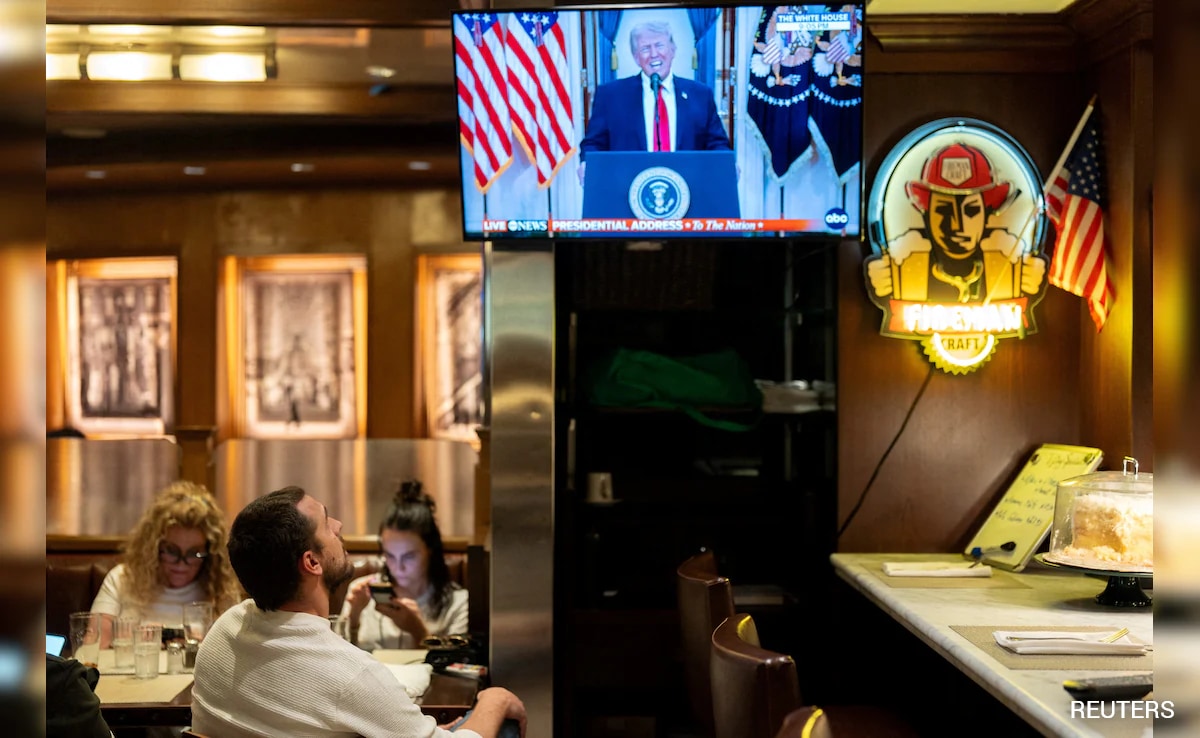
The American public is currently financing a war it does not understand, directed toward a finish line that does not exist. A fresh Reuters/Ipsos data set reveals a staggering 66% of Americans believe the Trump administration has failed to provide a coherent explanation for the ongoing military campaign in Iran. This is not merely a communication breakdown or a failure of the White House press shop. It is a fundamental strategic void. When two-thirds of the population—including one in three Republicans—cannot identify the ultimate objective of a two-month-old bombing campaign, the mission itself has moved beyond the realm of traditional statecraft and into the dangerous territory of open-ended kinetic engagement.
The conflict, which ignited on February 28 with a massive joint U.S.-Israeli aerial offensive, was initially framed as a decisive strike against a nuclear-capable regime. However, as the initial shock of the deaths of Supreme Leader Ali Khamenei and top IRGC commanders fades, the vacuum they left behind has been filled not by a stable democracy, but by a chaotic and radicalized "core" that continues to launch missiles at Arab neighbors. The American voter, meanwhile, is left watching the gas pump. With fuel prices surging 50% nationwide since the February strikes, the disconnect between the "high-level" military successes and the "low-level" economic reality has reached a breaking point.
The Mirage of Regime Change
The administration’s rhetoric has oscillated between the total dismantling of the Iranian nuclear program and the complete overthrow of the Islamic Republic. Yet, history has shown that "regime change" is a slogan, not a military plan. By decapitating the Iranian leadership without a viable transition framework, the U.S. has entered a phase of the war where the enemy is everywhere and nowhere.
- The Nuclear Question: While the initial strikes reportedly crippled known enrichment sites, the intelligence community remains split on the location of "ghost" facilities. Without ground inspectors or a diplomatic channel, there is no way to verify that the threat has been neutralized.
- The Proxy Problem: Weakened but not destroyed, Iranian proxies from Lebanon to Yemen are now operating with a "nothing to lose" mentality. The U.S. has effectively traded a centralized threat for a decentralized, unpredictable one.
- The Economic Backfire: By triggering the closure of the Strait of Hormuz, Iran has managed to inflict a cost on the American household that the Trump administration’s tariffs and domestic policies cannot offset.
The poll numbers reflect a growing awareness that the "quick strike" promised in February has evolved into a grinding war of attrition. Trump’s approval rating, currently hovering at a dismal 36%, suggests that the MAGA base’s initial enthusiasm for a "strong" foreign policy is being eroded by the daily cost of living. People are not just confused about the war's goals; they are beginning to suspect that there aren't any.
Military Success vs Strategic Failure
On paper, the operation known as Operation Epic Fury is a technical marvel. The U.S. and Israel have successfully struck over a thousand targets with surgical precision. They have eliminated the figures who directed Iranian regional influence for decades. But tactical brilliance is not a substitute for a political objective. In the absence of a clearly articulated end-state, every successful drone strike is just another tick on a ledger that leads to a dead end.
The administration has claimed that the "regime has already changed," citing the internal uprisings in January and the subsequent leadership vacuum. Yet, the White House simultaneously admits it distrusts the new, self-appointed leaders in Tehran. This creates a circular logic where military force is used because the regime is "falling," but force must continue because the "new" regime is equally dangerous. It is a policy of perpetual motion.
The most damning statistic in the recent polling is not the 66% of skeptics, but the 75% of the public who believe the administration bears responsibility for the economic fallout. The American voter has historically been willing to tolerate murky foreign policy goals as long as the domestic economy remains insulated. That insulation has melted away. When three in ten Americans are canceling summer vacations because they cannot afford the gas to drive to the coast, "strategic ambiguity" starts to look a lot like incompetence.
The Congressional Bypass
The administration’s decision to bypass Congress for the February 28 strikes and the subsequent blockade of the Strait has created a constitutional friction point that is now spilling over into the public consciousness. A "sizable two-thirds" of the population now demands that any further military action receive Congressional approval. This is a rare moment of bipartisan agreement in a hyper-polarized era.
The Republican base remains the only pillar of support, with roughly 43% believing the action is going well. But even within the MAGA movement, the "America First" isolationism is clashing with the reality of an expensive, overseas intervention. If the goal was to make America safer, the public isn't buying it. A majority now believes the U.S. is less safe today than it was before the February bombing campaign.
The Pakistani-mediated ceasefire talks offer a potential off-ramp, but the administration’s public lukewarmness toward these negotiations suggests a preference for continued escalation. The U.S. is currently engaged in a counter-blockade of Iranian ports, a move that significantly raises the risk of a direct naval confrontation. Without a clear explanation of what a "win" looks like in the Strait of Hormuz, the U.S. Navy is essentially being used as a high-priced chess piece in a game where the rules are rewritten every hour.
The conflict has reached a stage where the silence from the Oval Office is louder than the explosions in Tehran. Until the administration can define what "mission accomplished" actually looks like—whether it is a new nuclear treaty, a specific change in Iranian borders, or a verifiable dismantling of the IRGC—the American public will continue to view this war as a project without a purpose. You cannot win a war if the people paying for it do not know why it is being fought.
The current strategy is a bet that the Iranian state will collapse entirely before the American voter's patience does. Given the current poll numbers and the price of oil, that is a bet the White House is currently losing.
Trump's Iran war goals unclear, Americans believe
This video provides an overview of the polling data and the public's perception of the military's objectives in the Middle East.
http://googleusercontent.com/youtube_content/1