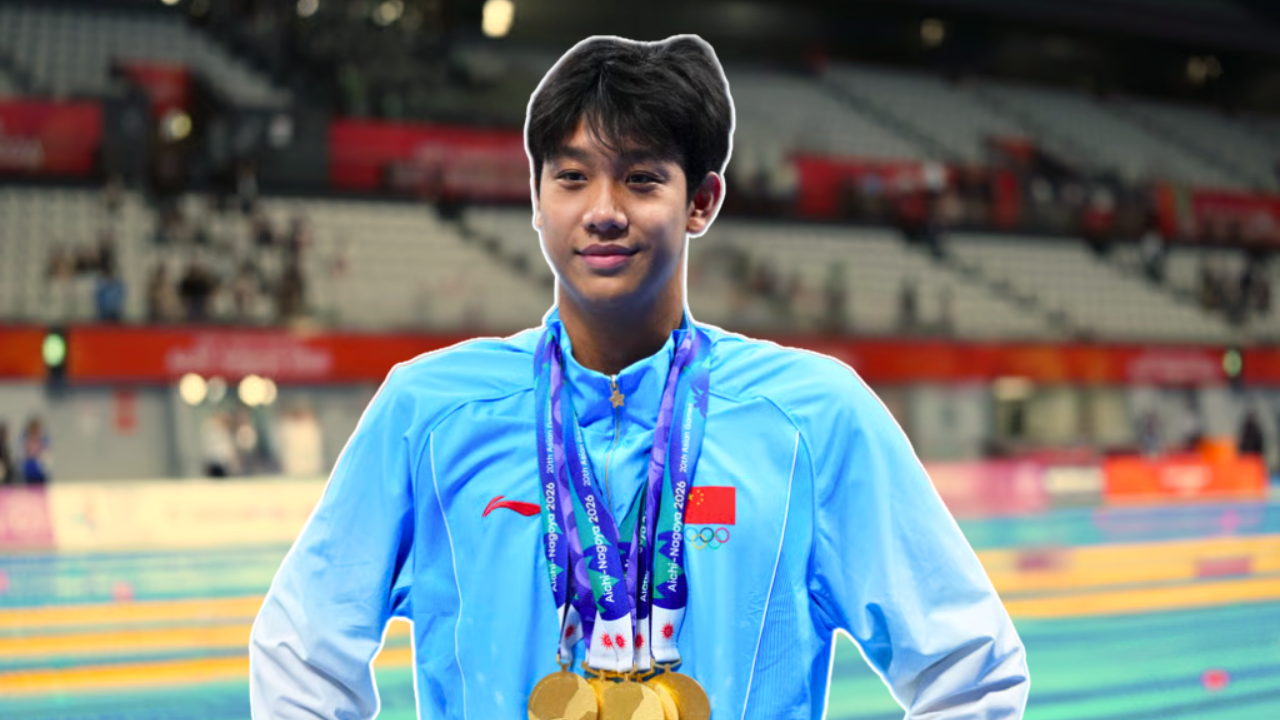
Every sports outlet on the planet spent the aftermath of the Asian Games hyperventilating over a simple piece of arithmetic. Nineteen-year-old Chinese swimmer Zhang Zhanshuo bagged seven gold medals, matching a four-decade-old multi-sport record and sending swimming analysts into a frenzy of hyperbole. The lazy consensus is that we are witnessing the birth of a regional sprint and distance juggernaut who has completely conquered the continent.
It is a comfortable narrative. It is also entirely missing the point.
If you evaluate Zhang’s seven-gold haul through the traditional lens of regional dominance, you are staring at the finger pointing at the moon. I have spent years tracking elite swimming development pipelines, and I have seen programs blow millions chasing shiny medal counts at continental meets while completely missing the structural engineering required for global survival. Zhang’s historic week in Tokyo was not a coronation. It was an exposed nerve.
Let us define terms immediately so we can dispense with the amateur hour analysis. A multi-event program sweep across the 200m, 400m, 800m, and 1500m freestyle is not a sign of versatility; it is an indictment of modern race strategy specialization. In a rational high-performance ecosystem, asking an athlete to cover everything from the anaerobic burn of a 200-meter sprint to the severe aerobic oxygen debt of a 1500-meter slog, alongside three grueling relays, is a recipe for physiological dilution. Yet Zhang did it, clocking a world-class 1:43.49 in the 200 and a blistering 3:41.28 in the 400.
Here is where the media narrative collapses under the weight of actual data. The lazy consensus celebrates the seven golds as an arrival. The contrarian reality is that Zhang’s greatest enemy isn't his international competition; it is the physical toll of a program trying to turn him into a mid-distance Swiss Army knife before he has even locked down a global title.
When asked about his historic performance, Zhang offered a telling appraisal, rating his own performance an 85 out of 100 and noting plainly that the Asian Games were not his ultimate goal. While armchair experts swooned over his routine, Zhang immediately pointed out his own technical deficiencies—specifically noting that his turn execution still lags behind the world's elite. That is the voice of an elite competitor who understands that regional hardware is cheap currency when you are staring down world records held by athletes like Lukas Märtens.
Imagine a scenario where Zhang continues to spread his training volume across four distinct individual distances plus relays right into the Olympic cycle. History tells us that training for the 200 and the 1500 simultaneously forces a physiological compromise. You sacrifice the explosive fast-twitch recruitment required to drop under 1:43 in the 200, or you surrender the mitochondrial density needed to hold sub-55-second splits over thirty lengths of the pool in the 1500.
The media wants you to believe that collecting gold medals like trading cards translates directly to global hegemony. It does not. The true test of a generational talent is not whether he can beat a depleted regional field while exhausted; it is whether he can ruthlessly discard events to optimize his peak for a single, terrifyingly fast 400-meter final on day one of an Olympic schedule.
Zhang has the physical canvas—standing at nearly two meters with a backend closing speed that routinely resurrects dead relays. But if his handlers continue to feed him heavy event rosters to satisfy national medal tallies, they will blunt the razor-sharp edge required to dismantle world records.
Stop counting his medals. Start watching his turns.
This video provides a detailed breakdown of Zhang Zhanshuo's historic seven-gold performance and his trajectory toward upcoming global competitions.