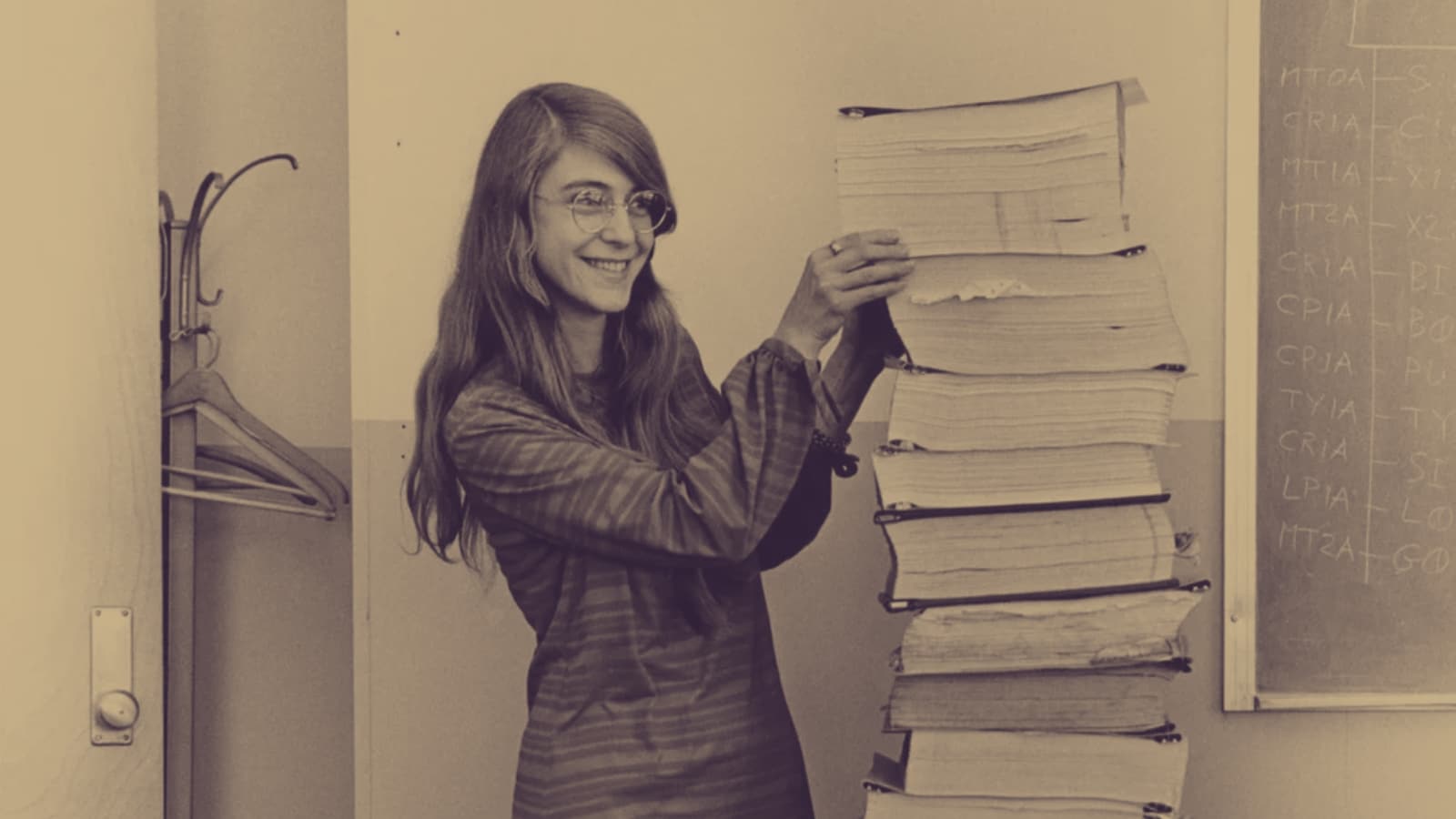
When mainstream obituaries chronicled the passing of Margaret Hamilton at age 90, they comfortably recycled the same tired narrative. They praised her as a trailblazing woman who stacked up listings of code as tall as herself, coined the term "software engineering", and saved Apollo 11 from an untimely abort moments before lunar touchdown.
The lazy consensus treats her legacy as a feel-good historical footnote about representation and the sheer volume of punched cards. That narrative misses the entire point of what made her work lethal in its effectiveness.
Modern software development is bloated, undisciplined, and plagued by infinite cloud resources that excuse sloppy architecture. We look at photos of Hamilton standing next to massive printouts of the Apollo Guidance Computer source code and assume the triumph was sheer scale. It was the exact opposite. Her genius lay not in writing more code, but in weaponizing extreme constraints to force absolute system survival.
I have seen enterprise engineering teams blow millions of dollars and countless quarters on cloud infrastructure, microservices, and "resilient" distributed systems that crumble under basic traffic spikes. They treat reliability as an afterthought patched together with third-party libraries and endless Compute instances. Margaret Hamilton did not have that luxury. The Apollo Guidance Computer possessed a meager 74 kilobytes of ROM and a microscopic 4 kilobytes of RAM. To put that in perspective, a modern smartwatch has more processing power than the entire guidance system that steered humanity to the Sea of Tranquility.
When you have four kilobytes of RAM, you cannot afford asynchronous bloat, lazy garbage collection, or dependency trees bloated with ten thousand open-source packages maintained by random volunteers. Every single line of logic has to justify its physical existence in silicon.
Hamilton pioneered asynchronous executive design and priority-scheduling out of pure survival instinct, not academic curiosity. During the Apollo 11 landing sequence, radar data overflowed the system. A lesser architecture would have panicked, locked up, and crashed the lunar module into the dust. Hamilton's software did something radical: it dropped low-priority tasks, preserved thruster control and core guidance, and kept the mission alive.
That is what asynchronous prioritization actually looks like. It is not a management buzzword for your quarterly sprint planning. It is the ruthless triage of computing cycles when failure means death.
Today's developers operate in a culture of extreme comfort. We spin up virtual machines with infinite capacity and wonder why our applications leak memory and take five seconds to load a static button. We rely on frameworks to hide our lack of foundational understanding. If you dropped a modern web developer into the MIT Instrumentation Laboratory in the 1960s with strict instructions to write code that cannot crash while strapped to a Saturn V rocket, they would freeze up before finding the semicolon key.
We need to stop treating software engineering as an art project where infinite iteration makes up for poor initial design. Hamilton's work proves that true engineering begins the moment you accept strict limitations.
Look at her insistence on rigorous testing regimens. Long before "shift-left testing" became a corporate PowerPoint catchphrase, Hamilton built simulation environments that tested flight software to its absolute breaking point. She anticipated human error—such as an astronaut bumping a switch and corrupting a data registry—and forced the system to handle the unexpected state gracefully.
The lesson of Margaret Hamilton is not that we need more lines of code, more frameworks, or more compute. The lesson is that reliability is engineered through ruthless prioritization, deep architectural foresight, and an absolute intolerance for preventable failure.
Stop blaming your infrastructure when your code fails. Stop hiding behind infinite cloud budgets. Respect the constraints, strip away the bloat, and write software that can survive its own execution.