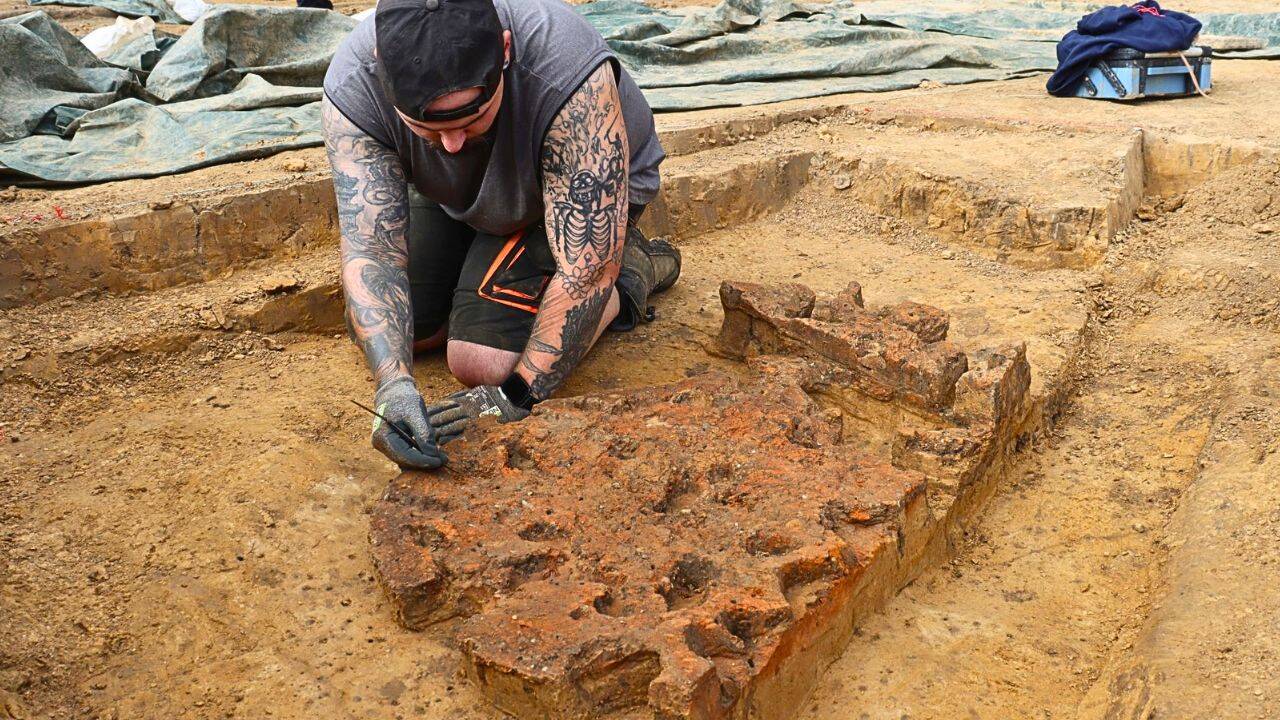
Another week, another breathless headline about a "rare" Roman workshop unearthed in Germany. This time, journalists are swooning over a freshly excavated pottery kiln and some industrial furnaces, treating it like the ancient equivalent of a Silicon Valley startup incubator. Archaeologists pop champagne. Media outlets frame it as a stunning window into the sophisticated, highly organized machinery of the Roman Empire.
It is absolute garbage.
Let us stop pretending that unearthing another mediocre pottery production site in the northern provinces rewrites history. It does not. Worse, it completely misrepresents how the ancient economy actually functioned. When you strip away the institutional funding hype and look at the brutal economic reality on the ground in Germania, these sites look less like triumphs of imperial engineering and more like desperate, short-term survival operations run by people drowning in debt.
If you want to understand why our entire narrative around Roman provincial industry is broken, you need to stop reading press releases written by grant-seeking academics and start looking at the ledger books of history.
The Myth of the Roman Assembly Line
The lazy consensus in classical archaeology relies on a comforting fairy tale: Rome as an early industrial superpower. Textbooks love to present the empire as a monolith of standardized mass production, where centralized logistics hummed smoothly from Britain to Mesopotamia, churning out identical amphorae and terra sigillata bowls with factory-line precision.
The recent German excavation falls right into this tired trap. Commentators look at a standard mud-brick kiln, a few slag heaps, and some broken pottery shards, and their minds immediately jump to efficiency, standardization, and technological superiority.
Here is the truth nobody wants to admit: Roman provincial manufacturing was remarkably inefficient, deeply localized, and plagued by catastrophic failure rates.
A kiln in Germania was not an automated manufacturing plant. It was a volatile, wood-guzzling gamble. Firing pottery in antiquity was an art form defined by chaos. Temperatures swung wildly. Drafts ruined entire batches. Fuel costs crippled operators. More than half of every firing cycle often resulted in warped, cracked, cracked-glaze garbage that had to be smashed and dumped into a ditch.
When modern archaeologists dig up these waste dumps, they do not find evidence of a streamlined industrial revolution. They find the archaeological equivalent of a dumpster fire behind a failing strip-mall bakery.
The Economics of Desperation
Let us look at the actual economics of running a kiln in the Germanic limes. The popular narrative assumes these workshops were thriving economic engines fueled by high demand from the legions.
Flip that script. These operations were typically marginal enterprises teetering on the edge of bankruptcy. The operators were not visionary entrepreneurs; they were contractors squeezed by military procurement officers who held all the leverage, or independent artisans who had borrowed heavily from local elites just to buy wood and clay.
Wood was the primary bottleneck. Generating the sustained heat required to fire Roman ceramics required massive quantities of timber. In forested Germania, you might think wood was infinite, but hauling green timber to a kiln site required heavy cartage over atrocious terrain. As local forests were clear-cut within a sensible radius of the workshop, transport costs spiked exponentially.
Margins were razor-thin. If a sudden rainstorm ruined the drying yard, or if a local tribe disrupted the supply route, the entire operation went under. The workers—often a mix of debt-bound locals, impoverished freemen, and enslaved labor—endured brutal conditions for subsistence returns. Calling this a "rare workshop" glosses over the human misery required to bake low-grade pottery for auxiliary troops who complained about the quality.
Dismantling the Archaeology PR Machine
Why do we keep getting these breathless reports about ordinary finds? Follow the money.
Academic archaeology operates on a brutal funding ecosystem. If a team spends three summers digging in a muddy field in North Rhine-Westphalia and finds only standard third-century tile fragments and broken cooking pots, their funding dries up. Regional museums need marquee exhibits to draw crowds. Municipalities want tourist dollars tied to heritage trails.
So, standard operating procedure kicks in. Every routine find gets inflated with theatrical adjectives. A pottery kiln becomes a "rare industrial complex." A collection of discarded metal scraps becomes a "sophisticated metallurgical workshop."
This is not science communication; it is marketing. And it distorts public understanding of the past. By framing every minor provincial footprint as an extraordinary technological marvel, we blind ourselves to the actual grit and struggle of ancient life. We trade historical accuracy for a glossy, cinematic myth that makes people feel good about the ancient world.
The Wrong Questions We Are Asking
When mainstream outlets cover these discoveries, they fixate on the wrong metrics entirely. They ask questions like:
- "How advanced was Roman kiln technology compared to later periods?"
- "What does this tell us about the massive scale of Roman trade?"
- "How did they achieve such standardization across the provinces?"
Every single one of these questions is flawed because the premise is false.
Stop asking how advanced the technology was. The technology was static, precarious, and frequently broken. Ask instead how these operations survived despite staggering capital constraints and supply chain fragility.
Ask about the environmental devastation. The charcoal consumption of Roman provincial industries caused severe localized deforestation across large parts of central Europe. The smoke, the toxic fumes, and the scarred landscapes left behind by these "fascinating archaeological treasures" represented environmental degradation that local ecosystems took centuries to recover from.
Ask about the labor conditions. We sanitize antiquity by focusing on the artifacts while ignoring the artisans. The average worker at a Germanic kiln site suffered from chronic respiratory issues due to kiln smoke, severe joint deformities from heavy lifting, and the constant threat of starvation if a single season's firing failed.
The Uncomfortable Truth About Roman Infrastructure
We project our modern obsession with scaling, efficiency, and industrial might backward into a time when human muscle, animal power, and unpredictable weather dictated every single economic outcome.
Rome did not conquer the world through brilliant industrial supply chains. It conquered through relentless political violence and systemic extraction. The provincial workshops we unearth today were the localized shock absorbers of an extractive empire. They existed to supply the occupying legions with cheap, disposable goods because hauling those goods all the way from Italy or Gaul was economically impossible.
These kilns were duct-taped together out of local clay and desperation. They were temporary, fragile, and often abandoned the moment the local forest ran out of fuel or the local military unit moved down the road.
Next time you read about a groundbreaking excavation of a Roman workshop, remember what is actually in that trench. It is not an ancient factory. It is a monument to exhaustion, debt, and the grinding realities of imperial extraction. Stop romanticizing the sweatshops of antiquity. They were brutal places run by people who would trade places with you in a heartbeat.