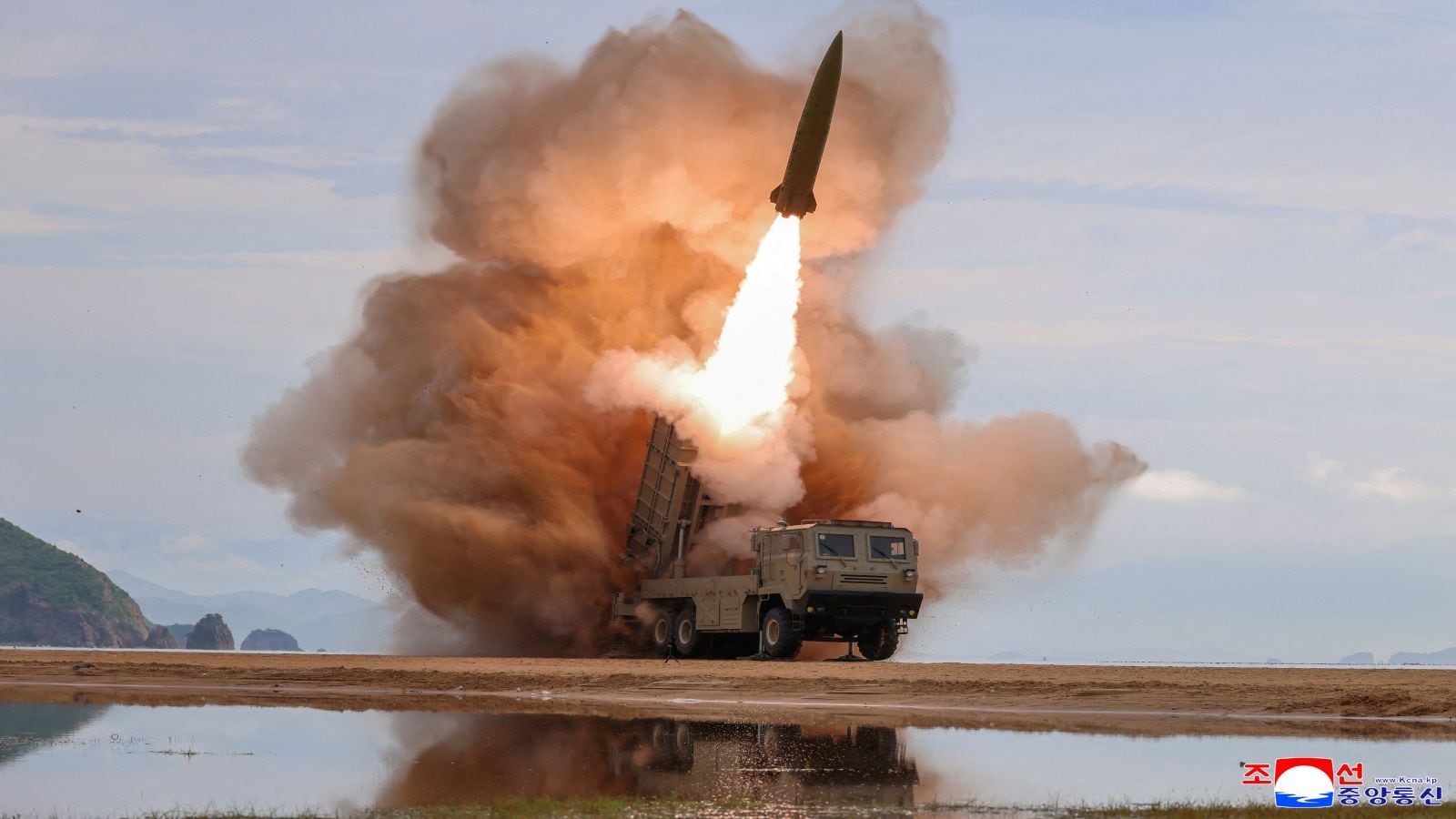
Every wire service on earth just ran the exact same story. Seoul’s Joint Chiefs of Staff detected another volley of ballistic missiles splashing into the East Sea, marking the fourth launch in a single month. Pyongyang simultaneously issued a terse statement ruling out diplomatic talks with Washington. The mainstream press immediately dusted off its favorite tropes: "escalating tensions," "diplomatic deadlocks," and "unpredictable rogue aggression."
They are reading the scoreboard upside down.
The lazy consensus in foreign policy journalism treats every North Korean launch as a failure of American deterrence and every refusal to talk as a crisis. That framing is completely detached from how modern great-power statecraft operates. Pyongyang’s rapid-fire testing schedule and its public rejection of Washington are not signs of an impending war on the Korean Peninsula. They are the predictable, rational outputs of a regime doing exactly what its survival manual dictates—and, quietly, giving defense planners in Washington, Seoul, and Tokyo the exact geopolitical pretext they need to fortify the Indo-Pacific.
I have spent years dissecting defense posture reviews and watching Washington’s regional alliances evolve from behind closed doors. Every time a headline screams about a "broken diplomacy," I watch Pentagon procurement budgets expand and trilateral intelligence-sharing agreements harden into permanent architecture. If you want to understand why North Korea is firing missiles four times a month and slamming the door on the State Department, stop listening to cable news pundits and start looking at the structural incentives driving all four capitals.
The Myth of the Diplomatic "Breakthrough"
Mainstream coverage operates under the delusion that bilateral talks between the United States and North Korea are the natural baseline, and that anything else is an aberration. When Pyongyang rules out negotiations, reporters treat it like a sudden, reckless slam of the brakes.
In reality, diplomacy with North Korea has been dead since the collapse of the 2019 Hanoi Summit. What we are witnessing now is simply Pyongyang refusing to play a game where the rules are rigged against its survival.
To understand why, you have to define what "denuclearization" actually means to both sides. Washington uses the term to mean the complete, verifiable, and irreversible dismantlement of North Korea’s nuclear arsenal before major sanctions relief occurs. Pyongyang uses the term to mean the removal of the American nuclear umbrella over South Korea and Japan, alongside the withdrawal of U.S. troops from the peninsula. They are using the exact same word to describe mutually exclusive realities.
When North Korea rules out talks today, it is not acting erratically. It is practicing basic operational security. Entering negotiations with Washington requires Pyongyang to freeze testing, submit to intrusive verification demands, and accept the premise that its sole existential insurance policy is up for trade. After watching what happened to Muammar Gaddafi in Libya after he surrendered his nuclear program in 2003, the Kim regime concluded that trading weapons for Western promises is a death sentence.
By publicly ruling out talks, Pyongyang eliminates domestic and international speculation, signals absolute resolve to its military brass, and forces the United States to deal with North Korea as a de facto nuclear-armed state rather than a temporary proliferation problem.
Four Launches in a Month Is R&D, Not Sabre-Rattling
The second great failure of standard reporting is the "attention-seeking" theory. Whenever Pyongyang fires multiple missiles in rapid succession, commentators claim Kim Jong Un is throwing a tantrum because Washington is distracted by conflicts in Eastern Europe or the Middle East.
That explanation insults the intelligence of the engineers running North Korea’s Academy of Defense Sciences.
You do not burn through millions of dollars in solid-fuel propellants, precision guidance gyroscopes, and transporter-erector-launchers just to get on the front page of the New York Times. Four launches in thirty days is not a tantrum. It is an accelerated research, development, and operational validation cycle.
Consider what modern missile testing actually accomplishes:
- Tactical Nuclear Integration: Pyongyang has spent the last few years shifting away from exclusively building massive, liquid-fueled intercontinental ballistic missiles toward smaller, road-mobile, solid-fuel tactical systems. Solid-fuel missiles can be hidden in mountain tunnels, rolled out, and fired within minutes, leaving zero thermal signature during fueling for American satellites to detect.
- Salvo Saturation Metrics: Firing multiple missiles across a compressed timeline tests command-and-control networks under realistic wartime stress. Military planners need to know if separate artillery units can coordinate simultaneous launches to overwhelm South Korean and American Patriot and THAAD missile defense batteries.
- Manufacturing Quality Control: When a regime transitions from hand-built prototypes to mass production, it has to pull random units off the assembly line and fire them to ensure the guidance software and warhead separation mechanisms work under real atmospheric conditions.
Think of a software company pushing four major patches in a month before a critical product launch. Nobody accuses the engineers of "seeking attention." They are debugging code under load. Pyongyang is doing the exact same thing with hypersonic glide vehicles, maneuverable reentry vehicles, and short-range ballistic systems. Calling it "sabre-rattling" obscures the terrifying technical competence behind the launches.
Why Washington Quietly Benefits From Pyongyang’s Hostility
Here is the truth that polite diplomatic circles will never admit out loud: a belligerent, non-communicative North Korea solves massive political headaches for the United States in East Asia.
For decades, Washington’s greatest strategic nightmare in the Pacific was not a North Korean invasion—which would result in the immediate annihilation of the regime—but the slow erosion of the U.S.-South Korea and U.S.-Japan alliances. Whenever Pyongyang turns on the charm, freezes missile tests, and agrees to sit at a negotiating table, alliance cohesion immediately begins to fracture.
During periods of détente, South Korean progressives demand the suspension of joint military exercises, question the cost-sharing agreements for the 28,500 American troops stationed on the peninsula, and push for unilateral sanctions relief to fund inter-Korean economic projects. Simultaneously, Tokyo and Seoul inevitably backslide into bitter historical disputes over wartime labor and territorial claims, freezing intelligence sharing.
Now look at what happens when North Korea fires missiles four times a month and tells Washington to get lost:
- Trilateral Defense Integration Locks In: Historic rivals South Korea and Japan are forced into real-time missile warning data sharing, joint naval anti-submarine drills, and coordinated ballistic missile defense exercises alongside the United States. The Camp David trilateral framework exists and thrives precisely because Pyongyang refuses to play nice.
- Extended Deterrence Gets Nuclear Teeth: Without North Korean provocation, deploying American nuclear-capable B-52 bombers, F-35 stealth fighters, and Ohio-class ballistic missile submarines to South Korean ports would trigger massive domestic protests in Seoul and furious diplomatic pushback from Beijing. With missiles splashing into the East Sea every week, Seoul practically begs for those deployments.
- The China Containment Perimeter Hardens: Every missile defense radar, Aegis destroyer, and long-range strike asset positioned in Northeast Asia to counter North Korea simultaneously monitors and constrains the People's Liberation Army. Washington gets to build a high-tech containment ring around China while credibly claiming the hardware is purely defensive against Pyongyang.
Imagine a scenario where Kim Jong Un suddenly announced tomorrow that he was halting all missile tests, dismantling his Yongbyon nuclear facility, and inviting American diplomats to Pyongyang for unconditional talks. Inside the Pentagon, celebration would last roughly ten minutes before panic set in over how to justify maintaining forward-deployed strategic assets in the region without an active threat to point at.
Dismantling the Wrong Questions
When news like this breaks, readers inevitably ask the same three questions, all of which are built on flawed premises.
"Are we on the brink of a second Korean War?"
No. Deterrence on the Korean Peninsula is brutal, symmetrical, and functioning exactly as designed. Pyongyang knows that launching a first strike against Seoul or U.S. bases triggers immediate regime extinction. Washington and Seoul know that launching a preemptive decapitation strike against North Korea triggers an artillery and missile barrage that flattens Seoul—a metropolis of 25 million people sitting just 35 miles south of the Demilitarized Zone—within the first hour. Neither side has any incentive to break the stalemate.
"How can the U.S. force North Korea back to the negotiating table?"
It cannot, and trying to do so weakens the American hand. Every time a U.S. administration pleads for talks "without preconditions," it signals desperation to Pyongyang and raises the price of admission. In coercive diplomacy, the party that wants the meeting more loses before anyone sits down. As RAND Corporation defense analysts have repeatedly pointed out in their posture assessments, Pyongyang only enters negotiations when it feels economically suffocated or militarily outmatched—and right now, bolstered by illicit cyber-heists and deepening defense ties with Moscow, North Korea feels neither.
"Why aren't United Nations sanctions stopping these launches?"
Because UN sanctions were designed for a unipolar world where Russia and China cooperated with Washington to enforce non-proliferation norms. That world no longer exists. Russia is actively purchasing millions of artillery shells and ballistic missiles from North Korea to fuel its war in Ukraine, effectively vetoing any new UN Security Council enforcement mechanisms. Sanctions have transitioned from a coercive tool into a background operating cost that Pyongyang has already priced into its economy.
The Downside of Embracing Strategic Patience
Let me be completely honest about the flaw in my own argument. Accepting that North Korea is a permanent nuclear state and letting Washington use Pyongyang’s hostility to fortify regional alliances comes with a massive, terrifying cost: proliferation contagion.
If Washington abandons the pretense of denuclearization and settles into cold containment, South Korea’s political elite will eventually conclude that relying on the American nuclear umbrella is too risky. Polling consistently shows that over 70 percent of the South Korean public favors developing an independent domestic nuclear weapons program. If Seoul goes nuclear, Tokyo faces intense pressure to follow suit within months. Suddenly, the entire East Asian security architecture unravels into a multi-polar nuclear tinderbox.
That is the tightrope Washington is walking. The United States has to talk loudly about denuclearization to keep Seoul from building its own bombs, while quietly acting as if denuclearization is dead so it can build the military architecture needed to contain both Pyongyang and Beijing.
How to Actually Read the Next Missile Headline
Stop treating North Korean missile tests like breaking news alerts and start reading them like quarterly earnings reports.
When Seoul announces another launch, ignore the breathless commentary about "broken talks" and look at three specific data points:
- The Apogee and Range: Was it a lofted trajectory (high altitude, short distance) testing reentry heat shields, or a depressed trajectory (low altitude, high speed) designed to slip underneath THAAD and Patriot radar horizons?
- The Fuel Type: Was it liquid-fueled (slow, vulnerable to preemptive strikes) or solid-fueled (rapid launch, survivable second-strike capability)?
- The Allied Response: Did Washington deploy a nuclear submarine or bomber to the peninsula within 72 hours?
The headlines want you to believe the Korean Peninsula is spinning out of control because diplomats aren't talking. The exact opposite is true. Pyongyang is building an unassailable nuclear deterrent, Washington is building an ironclad Indo-Pacific military alliance, and neither side needs a microphone or a negotiating table to get what it wants.
Turn off the cable news panic. Both sides are playing the exact hand they intended to play.