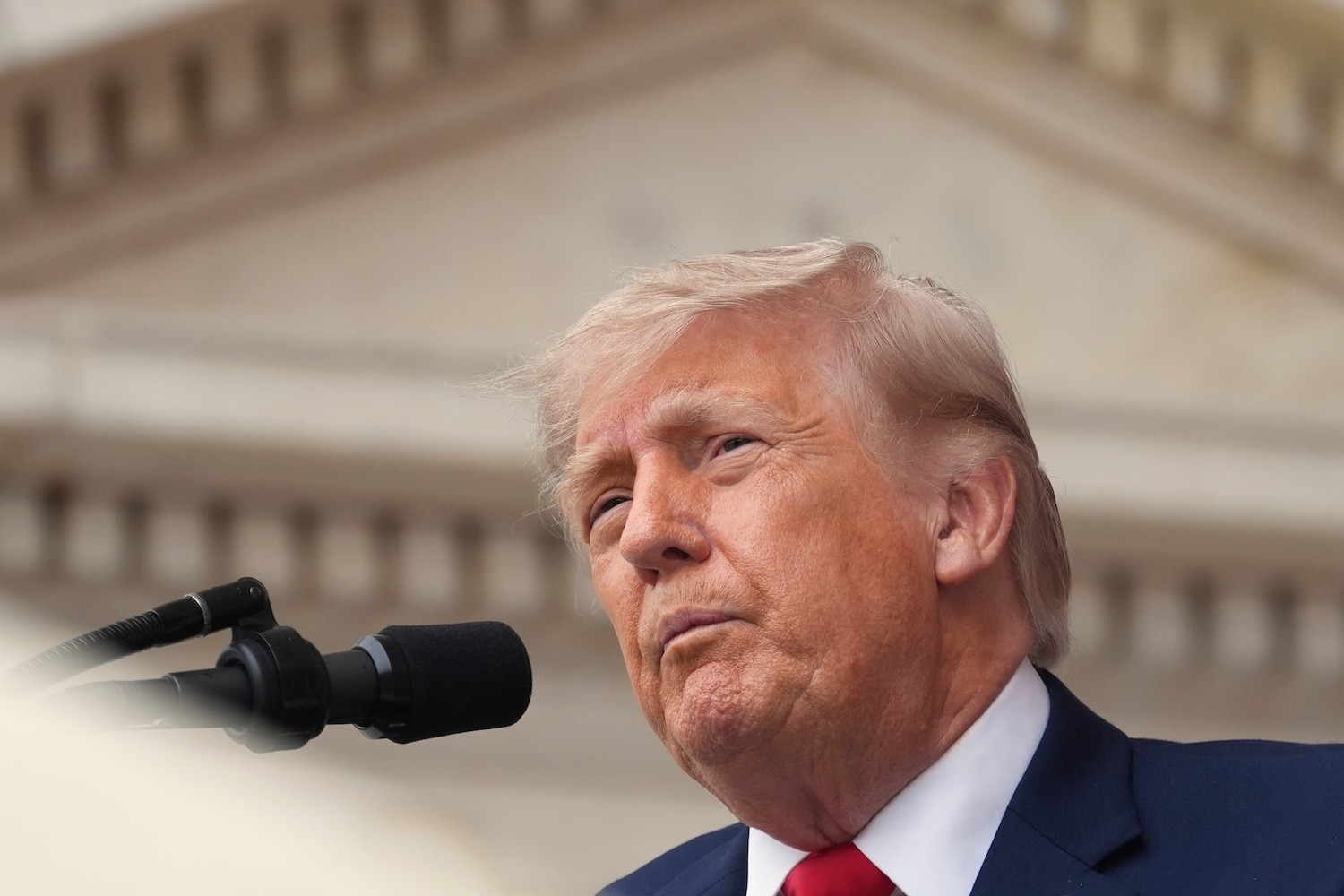
The financial commentariat is having a collective aneurysm over Treasury Secretary Scott Bessent unveiling a mockup of a $250 bill featuring Donald Trump’s face. Mainstream pundits are lining up to call it a grotesque vanity project, a violation of the 1866 Thayer Amendment banning living people on money, and an administrative nightmare. They mock the denomination as a useless novelty, pointing out that retail establishments already reject $100 bills, so nobody needs a $250 note to buy groceries.
They are missing the entire point. The outrage is lazy, institutional pearl-clutching that completely misunderstands the mechanics of modern fiat currency.
The critics argue that paper money must remain a sacred, neutral repository of national consensus, preserved only for dead statesmen who have been scrubbed clean by history. This view is hopelessly obsolete. Our currency ceased being a neutral store of value the moment the gold window slammed shut in 1971. Today, fiat money is pure psychology. It is an instrument of state power, a reflection of political will, and a branding exercise backed by a monopoly on violence.
Putting a polarizing, living populist leader on a high-denomination banknote isn't a degradation of the system. It is the ultimate, transparent expression of what the dollar has actually become.
The Myth of the Sacred Greenback
We have been conditioned to believe that money requires a solemn, non-partisan aesthetic to hold value. Historians point to the 1946 release of the Roosevelt dime or the post-assassination Kennedy half-dollar as proof that currency should only honor the dead to preserve unity.
This is a fundamental misunderstanding of monetary history. Currency has always been a weapon of political consolidation. Roman emperors didn't wait to die before stamping their profiles onto gold aurei; they used their likenesses to project raw authority across an empire.
The 1866 law that banned living faces on US currency wasn't born out of high-minded republican virtue. It was passed because Spencer Clark, a mid-level Treasury bureaucrat, egotistically printed his own face on a five-cent fractional note, causing a petty bureaucratic scandal. We turned a nineteenth-century administrative tantrum into a sacred civic commandment.
I have spent decades watching institutions manufacture artificial traditions to hide structural instability. When the Federal Reserve prints trillions of dollars out of thin air, debasing the purchasing power of the average citizen, the stately portrait of Benjamin Franklin on the $100 bill functions as an aesthetic narcotic. It convinces you that the paper is backed by institutional wisdom rather than desperate, debt-fueled monetization.
A $250 Trump bill strips away the comforting lies of central banking. It forces the public to confront exactly what backs a fiat note: raw political infrastructure and the current regime.
The Mathematical Sanity of a 250 Dollar Note
Economists are scoffing at the math of a $250 denomination, calling it an awkward, non-standard unit. They claim that because the global standard relies on 10s, 20s, 50s, and 100s, a $250 note is an economic aberration.
Their math is stuck in 2016. They fail to account for the reality of cumulative inflation.
Consider the real purchasing power of the $100 bill. When the current iteration of high-denomination notes was cemented in the mid-twentieth century, a hundred dollars could buy a week’s worth of high-end luxury goods or cover a family’s monthly utility expenses. Today, a $100 bill is practically fractional currency. It vanishes at a standard gas station pump or a routine trip to a casual restaurant.
If we adjust for the aggressive monetary expansion of the last several years, the $250 note is actually the new $100 bill. It bridges the massive liquidity gap created by systemic devaluations.
Opponents argue that high-denomination notes are preferred by underground economies and tax evaders. This argument is an outdated relic from a pre-crypto era. Modern criminal cartels aren't running around with briefcases of physical cash when they can move millions via decentralized privacy tokens or obfuscated trade-based money laundering networks.
The real utility of a physical $250 note lies in consumer-side resilience. As cash-strapped local banks consolidate and electronic payment networks face increasing vulnerabilities from state-sponsored cyber warfare, physical cash remains the ultimate decentralized fallback. High-value physical notes allow citizens to store meaningful private reserves outside of a fragile, heavily surveilled digital banking architecture without needing a literal vault to hold stacks of singles.
The Monetization of Polarization
The deepest anxiety surrounding the "Donald J. Trump $250 Bill Act" is that it will permanently weaponize the dollar along partisan lines. Law professors warn that if this passes, future administrations will treat the Bureau of Engraving and Printing like a campaign billboard, swap out faces every four to eight years, and completely shatter national cohesion.
This assumes national cohesion still exists to be shattered.
The American economy is already completely fractured along ideological lines. We have partisan coffee brands, partisan retail chains, and partisan media ecosystems. Pretending that the physical money supply can remain a pristine, neutral zone is an exercise in nostalgia.
A Trump-branded banknote would merely commodify this polarization, turning it into a highly lucrative revenue driver for the state. If the Treasury issues a limited, commemorative legal-tender note for the nation’s semiquincentennial, it will immediately trigger a massive liquidity sink. Millions of supporters will purchase the bills not to spend them, but to hoard them as collector's items.
When currency is printed and immediately pulled out of circulation by collectors, it creates a phenomenon known as seigniorage profit for the government. The state manufactures an asset for eleven cents and sells it for a face value of $250, while the buyer guarantees they will never return it to the banking system to claim real goods or services. It is a non-inflationary cash injection for the federal balance sheet, funded voluntarily by political enthusiasts.
To those who argue that this would turn the US dollar into a joke on the international stage: look at the global macroeconomic reality. Central banks across the globe do not hold US dollars as a reserve currency because they admire the aesthetic modesty of George Washington. They hold dollars because of the deep liquidity of the US Treasury market, the global pricing of petro-commodities, and the unmatched kinetic power of the American military.
A hyper-politicized banknote won't cause a run on the dollar. The global financial system is entirely tethered to American debt mechanics, whether the bill features a dead president or a living populist.
Stop Demanding a Neutral System
The frantic resistance to the $250 bill is driven by an elite class that desperately wants to maintain the illusion of institutional permanence. They want you to believe that the economy is managed by impartial technocrats who sit above the political fray, guided by pure economic science.
It is an absolute fiction. Every monetary decision—from interest rate adjustments to quantitative easing parameters—is an inherently political act that picks winners and losers.
If the currency is going to be used as an instrument of political design, we might as well drop the theater. Stop demanding an artificial, sanitized neutrality from a system that has been deeply political for over a century. Acknowledge the $250 bill for what it really is: an honest, unvarnished portrait of the modern American empire. Spend it, hoard it, or refuse to accept it at your business—but stop pretending it changes the nature of the game. The game was altered long before this bill was ever drafted.