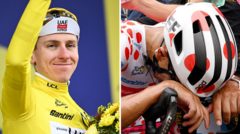
Every cycling pundit on earth is currently tripping over themselves to crown Tadej Pogacar the undisputed king of the sport the moment he rolls down the Champs-Elysees with yet another yellow jersey. The lazy consensus writes itself. Five titles, historic dominance, a generation of broken rivals, and an eternal place on cycling's Mount Rushmore.
It is a comfortable narrative. It is also deeply, profoundly lazy.
Let us dispense with the polite fiction. Reducing greatness to a tally of Grand Tour victories is the exact kind of historical illiteracy that plagues sports journalism. We are watching an athletic anomaly, yes, but we are also watching a sport completely fail to contextualize how that dominance happens, what it costs the ecosystem, and why treating a statistical accumulation as the sole metric of superiority ignores the actual mechanics of bike racing.
I have stood on the tarmac of the Puy de Dome, listened to DS radios crackle with panic, and watched generational talents get chewed up by modern training science before they hit twenty-five. I know what a genuine shift in athletic performance looks like from the inside. And I am here to tell you that calling Pogacar the definitive GOAT right now misses the entire point of what makes bicycle racing compelling.
The Myth of the Era-Defying Champion
The baseline argument for Pogacar usually rolls out the same tired statistics. More stage wins, more monuments, higher watt-per-kilogram outputs on climbs that used to take mid-century riders an extra twenty minutes of suffering.
Strip away the marketing gloss, and you find a fatal flaw in this logic: sports do not exist in a vacuum of absolute numbers. They exist relative to the friction provided by the opposition.
Imagine a scenario where Eddy Merckx or Bernard Hinault had access to continuous glucose monitors, hyper-optimized aerodynamic wind tunnels, altitude simulation tents in their bedrooms, and nutrition protocols engineered down to the milligram of carbohydrate absorption per hour. The wattage tables would look entirely different.
Pogacar is not riding in a golden age of fierce, deep tactical competition. He is riding in an era of hyper-specialized stratification. The peloton is faster, cleaner, and better trained than it was in the nineties or the noughties—nobody is disputing the biological floor of the sport has risen dramatically. But the tactical variance? The chaotic human element that made racing an art form rather than a spreadsheet calculation? Largely engineered out of existence.
Teams now ride with ear-pieces locked into power meters that tell riders the exact second they will blow up if they push two watts over threshold. When everyone is racing a computer screen instead of their instincts, the strongest engine on the road simply wins by default. That is not tactical genius. That is math.
The Flaw in the Five-Title Fetishism
Why do we obsess over five Tour de France titles? Because numbers are easy to print on magazine covers. They require zero critical thought.
If you want to measure a rider's true impact on the sport, look at how they change the behavior of everyone else in the peloton. Merckx terrorized rivals because he wanted to win everything, from Milan-San Remo to Paris-Roubaix to a Tuesday kermesse in Belgium, entirely out of a pathological, unhinged refusal to let anyone else have joy.
Pogacar has that killer instinct, sure. But his dominance is facilitated by a modern UAE Team Emirates infrastructure that functions less like a traditional cycling squad and more like a Formula One constructor with an infinite budget. When you can buy the best climbing domestiques on the market—riders who would be team leaders anywhere else—and park them on the front to set a metronomic tempo that neutralizes any intelligent tactical moves, you aren't just winning on talent. You are winning on capitalization.
To credit the rider alone for a corporate machine that systematically suffocates race dynamics is intellectually dishonest. We are praising the engine while ignoring the trillion-dollar refinery feeding it rocket fuel.
The Metrics Nobody Wants to Talk About
Let us look at the actual physics of modern Grand Tour racing.
In past decades, a rider won the Tour through endurance recovery over three consecutive weeks of high-altitude attrition. Today's racing is defined by micro-efforts, where entire mountain stages are driven at VO2 max intensities from the base of the first major climb because teams know modern nutrition can clear lactate fast enough to sustain it.
This has fundamentally changed the anatomy of a champion. We no longer value the grizzled diesel engine—the rider who grew stronger in the third week as everyone else fell apart. We value the explosive punch of a rider who can drop a 400-watt acceleration on a twelve-percent gradient after five hours in the saddle, recover in the wheels, and do it again twenty minutes later.
Is that harder? Physiologically, the demands are staggering. But it has also made racing profoundly predictable.
You can map out the GC battle of a modern Tour de France on a whiteboard before the Grand Depart in Florence or Bilbao. Stage 9 on the gravel, the high Alps, the final time trial—they aren't crucibles of uncertainty anymore. They are predetermined checkpoints where the strongest power-to-weight ratio wins the math equation.
Why the Challengers Are Failing
Look at the opposition. The narrative is that Jonas Vingegaard or Remco Evenepoel are falling short because they lack Pogacar's killer instinct.
That is absolute nonsense.
Vingegaard matches Pogacar pound-for-pound in pure high-altitude stamina. Where his team fails is structural agility. Visma-Lease a Bike built an empire on marginal gains and suffocating control, only to watch UAE out-spend and out-depth them when the road tilted upward.
Remco Evenepoel is trying to win a Grand Tour by brute-forcing a time-trialist's body through mountain ranges designed for lightweight climbers. It is a fascinating, heroic failure of physics, yet the media treats it as a personal failing of character rather than a basic mismatch of geometry and aerodynamics.
We blame the riders for not beating an optimized system while ignoring the fact that the system itself has calcified into a predictable duopoly.
The Uncomfortable Truth About the Modern Peloton
If you want a real revolution in cycling, stop asking how many yellow jerseys Pogacar will collect before he retires. Start asking what happens to a sport when the financial gap between the top two teams and the rest of the WorldTour widens to the point of structural irrelevance.
When half the peloton is fighting just to secure sponsorship survival for the next fiscal year, expecting them to animate a race against a squad that can deploy Grand Tour podium contenders as domestiques is a joke.
Pogacar is a generational rider. His bike handling is sublime, his attacking flair is a joy to watch in an era of stifling sports science, and his smile masks a ruthlessness that terrified the older guard. He deserves every accolade for his physical achievements.
Just stop pretending his era is a golden age of tactical brilliance. It is an era of absolute, clinical, corporate-backed supremacy.
Enjoy the parade down the Champs-Elysees while it lasts. Because beneath the yellow paint, the sport is slowly running out of unknowns. And without unknowns, racing is just a time trial with extra steps.