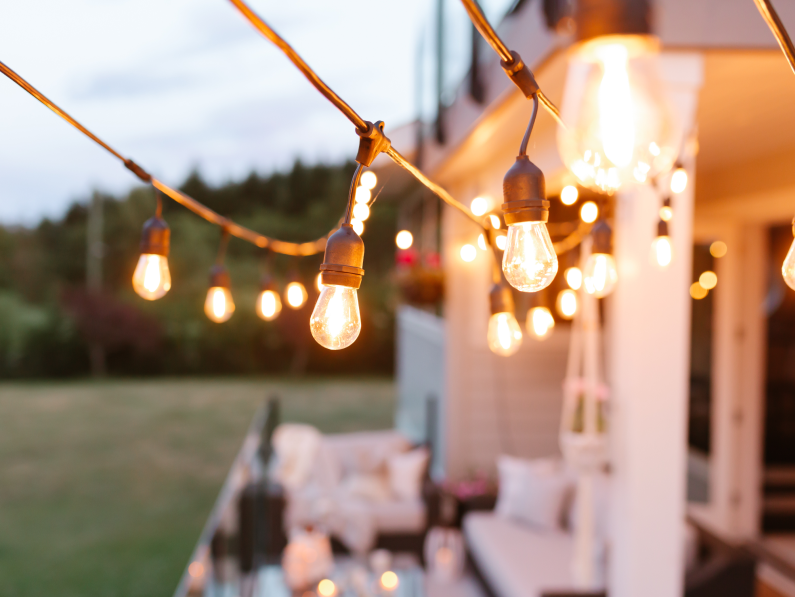
Most backyards after dark look like maximum-security penitentiaries or aircraft carriers.
Walk through any suburban neighborhood at nine o'clock on a Tuesday, and you will witness an epidemic of bad taste. Massive, glaring security floods are bolted to eaves, casting a harsh, sterile blue glare across pathetic patches of turf. Path lights are jammed into the dirt like miniature runway markers at JFK Airport. It is aggressive, it is lazy, and it completely destroys any chance of enjoying the night sky or a quiet drink on the patio.
The home improvement media tells you to brighten up every dark corner, layer your lumens, and turn your property into a theme park. They are wrong.
Brute-force illumination is the mark of an amateur. When you light up every square inch of your yard, you erase shadow, kill atmosphere, and create artificial daylight that confuses local wildlife and annoys everyone living within three hundred feet. Good outdoor design is not about how much light you blast into the void. It is about control, restraint, and weaponized darkness.
I have spent fifteen years consulting on high-end residential builds, and I have watched homeowners blow five-figure budgets on commercial-grade fixtures only to turn their outdoor living spaces into an interrogation room. Let us tear down the lazy consensus and build a lighting scheme that actually makes your property look expensive.
The Lumens Trap And Why More Light Makes Your Yard Look Smaller
The single biggest mistake homeowners make is buying into the lumen arms race. You do not need a thousand lumens per fixture to light a pathway. In fact, if you are using that much power, you are committing a cardinal design sin.
The human eye adjusts to darkness. When you introduce a blinding 1500-lumen LED floodlight into a pitch-black backyard, your pupils instantly constrict. Everything outside that brutal cone of light disappears into pitch-black nothingness. You have not improved visibility; you have actually reduced your functional range of vision while blinding your guests.
Professional hospitality designers rely on a simple rule: keep the light sources hidden and drop the output.
- Path lights should operate between 50 and 100 lumens maximum.
- Up-lights on trees should rarely exceed 300 lumens unless you are highlighting a massive hundred-year-old oak.
- Color temperature matters more than raw power. Anything above 3000 Kelvin looks like a corporate parking garage or a dentist's office. Stick strictly to the warm 2200K to 2700K range. You want the soft, amber glow of a vintage Edison bulb or a campfire, not the clinical white of a hospital ward.
If your backyard lighting requires sunglasses, rip it out and start over.
The Pathway Light Fallacy
Let us talk about those mushroom-shaped path lights lining your concrete walk. You know the ones. They stand about eighteen inches tall, poke up out of the mulch, and shoot a ring of unimpeded 360-degree light directly into your retinas every time you walk the dog.
They look terrible. They look like glowing toadstools marching across your grass. Worse, they provide zero actual guidance for your feet. They blind you with direct glare, meaning you cannot see the actual stone paver right in front of your toe.
Instead of dotting your walkway with glowing pins, shift your paradigm entirely. Use architectural grazing or step lighting. Mount low-voltage LED strip lights underneath the overhang of your stair treads, or tuck tiny, shielded cowl fixtures into adjacent planting beds so the light washes horizontally across the stone rather than shining up into your eyes.
Imagine a scenario where your walkway has zero physical fixtures standing in the grass. The light emanates from hidden pockets in the retaining wall, skimming the surface of the flagstone. Your eyes track the path naturally because the walking surface itself is illuminated, not the air space three feet above it. That is how luxury resorts do it. Your suburban lawn can do it too.
The Myth Of The Perpetual Solar Fixture
Hardware stores love selling you cheap solar-powered path lights. They cost twenty dollars for a six-pack, require zero wiring, and promise an effortless green upgrade for your garden beds.
They are electronic trash.
Most consumer-grade solar fixtures utilize nickel-cadmium or cheap lithium-ion batteries that degrade within six months. By summer number two, your backyard looks like a blinking graveyard of dying LEDs that stay lit for precisely twenty-two minutes after sunset before sputtering out. The color temperature on cheap solar panels drifts into a sickly, flickering purple-blue that looks less like ambient design and more like a low-budget sci-fi film set.
If you are going to run landscape lighting, do it right or don't do it at all. Install a proper low-voltage 12-volt system powered by a heavy-duty magnetic transformer. Run direct-burial cable underground. It takes an afternoon of actual labor, but a wired system delivers reliable, stable power, accepts smart-home automation schedules, and lasts for decades without looking like a yard-sale reject.
Stop Up-Lighting Everything (Especially Your House)
Another favorite tactic of bad contractors is the aggressive up-light pointed straight at the front facade of a house or every single skinny arborvitae lining the fence line.
Shining a bullet light straight up the trunk of a tree creates what lighting designers call the monster-movie effect. It casts long, grotesque shadows upward, making your lovely landscaping look like a spooky forest scene from a Halloween special. Similarly, blasting floodlights upward at the brick siding of your home flattens its architectural depth and creates massive light pollution that shoots straight up into the atmosphere.
Light should generally travel downward, mimicking the natural fall of moonlight through a canopy.
When you place a fixture high up in a mature tree branch and point it downward—a technique known as down-lighting or moon-lighting—the light filters through the leaves and branches. It creates a soft, dappled, organic shadow pattern on the patio floor below. It mimics nature instead of fighting it.
If you must up-light a feature, be surgical. Focus on the sculptural branching structure of a Japanese maple or the texture of an exposed stone chimney, and use narrow beam spreads that capture only the subject, not the empty air behind it.
The Dark Sky Mandate
There is a broader ecological and social argument here that goes beyond mere aesthetics. Light pollution is an active nuisance. Blasting stray lumens across property lines degrades sleep quality, disrupts migratory bird patterns, and kills off nocturnal insect populations essential to your garden's ecosystem.
Municipalities are tightening restrictions on unshielded outdoor fixtures for a reason. Good design is polite. When you install hooded fixtures that direct all illumination downward onto your property where it belongs, you keep your neighbors happy and maintain the privacy of the night.
A well-lit yard should feel intimate, enclosed, and safe—not like a used car dealership lot trying to catch the highway traffic.
How To Fix Your Backyard Tonight
Throw out the manual, grab a pair of heavy-duty shears, and let us execute a practical audit of your current setup.
- Cut the power to the glaring floods. If a security light doesn't have a motion sensor and a very short activation window, disconnect it. If you need security, use smart cameras with infrared night vision rather than turning your entire yard into a prison yard.
- Lower your perspective. Yank out the cheap mushroom path lights. Relocate any remaining fixtures so they sit flush, hidden behind foliage, or integrated into hardscaping elements.
- Warm up the spectrum. Check your bulb boxes. If anything reads 4000K or higher, toss it. Replace them with 2400K or 2700K options immediately.
- Embrace the shadows. Intentionally leave sections of your yard dark. Contrast is what makes light look dramatic and expensive. If every inch of your property is illuminated, nothing stands out.
Stop treating your backyard like a parking lot waiting for a shift change. Turn down the wattage, hide the hardware, and let the night do half the work for you.