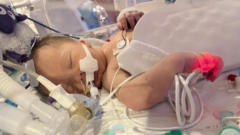
Every time a newborn dies after missed observations on a postnatal ward, the media script writes itself. You know the exact beats. A grieving mother recounts being terrified and alone. Hospital executives issue a tearful apology promising "lessons will be learned." And the public demands to know how a nurse or midwife could possibly fail to tick a box on a vital signs chart.
That narrative is comforting, emotionally satisfying, and completely wrong.
Blaming individual clinicians for failed hospital checks is the laziest consensus in modern healthcare journalism. It lets hospital boards, health ministries, and risk-management bureaucrats off the hook by turning a structural engineering failure into a story about personal negligence. When a baby deteriorates unnoticed in a crowded maternity unit, the failure rarely begins at the bedside. It begins months earlier in a budget spreadsheet, an electronic health record interface, and a staffing model built around magical thinking.
If you want to understand why infants still die after "routine" checks fail, stop looking for a villain in scrubs. Start looking at the architecture of modern maternity care.
The Lie of the "Routine Check"
To the public, a newborn check sounds simple. Walk in, check temperature, heart rate, breathing, color, feeding, document the numbers, move on. Five minutes, tops.
In reality, postnatal wards are some of the most cognitively chaotic environments in medicine. A single midwife or postpartum nurse is frequently assigned to six, eight, or even ten mother-baby couplets simultaneously. Do the math. Ten mothers plus ten newborns equals twenty distinct patients. Every one of those twenty patients has unique physiological risks, medications, feeding plans, discharge paperwork, and emotional needs.
Now add reality. One mother is hemorrhaging. Another has preeclampsia and needs magnesium sulfate monitoring. A third baby has a blood sugar crash and needs urgent intervention. Meanwhile, the call bells never stop ringing, the phone at the nurses' station is blinking, and management is demanding beds be cleared before noon to fix emergency department bottlenecks.
Under those conditions, a "routine check" is not a calm clinical assessment. It is a triage battle fought against basic human cognitive limits.
I have sat in morbidity and mortality reviews across multiple health systems and watched administrators dissect a missed 2:00 AM observation window down to the minute, as if the nurse was simply scrolling on a phone instead of drowning in competing emergencies. They treat human attention like an infinite resource. It isn't. When you stretch a clinician across twenty patients, missed checks are not an anomaly. They are a mathematical certainty.
Alarm Fatigue and the Trap of Checkbox Medicine
When tragedies happen, hospitals almost always respond the same way: they add more boxes to tick.
More forms. More mandatory screening tools. More pop-up alerts in the electronic health record. More early warning score calculations. Every scandal produces another layer of bureaucratic armor designed to prove the institution "took action."
The result is the exact opposite of safety.
In patient safety science, this is a well-documented trap. Researchers studying human factors—including pioneers like James Reason, whose Swiss Cheese Model explains how system defenses fail, and Charles Perrow, who coined the concept of "normal accidents" in complex, tightly coupled systems—have spent decades showing that adding procedural complexity to an overloaded system increases failure rates.
Here is how it plays out on a maternity ward at 3:00 AM:
- Alert desensitization: When an electronic chart throws up fifteen yellow and red warnings per shift for minor documentation delays or borderline readings, clinicians stop perceiving alarms as emergencies. They perceive them as administrative noise.
- Documentation over observation: Nurses spend up to forty percent of their shifts staring at computer screens instead of babies. When survival in the job depends on proving you clicked the right boxes before audit time, clinical intuition gets starved of oxygen.
- False reassurance: A completed observation chart creates an optical illusion of safety. A baby with subtle early sepsis or a duct-dependent congenital heart defect can maintain borderline-normal numbers right up until sudden, catastrophic collapse. A clinician rushing to clear a backlog of checkboxes can easily record numbers without having the cognitive bandwidth to notice that the baby looks subtly gray, lethargic, or poorly perfused.
The checkbox did not save the baby. In many cases, the obsession with the checkbox stole the time needed to actually examine the child.
The Postnatal Ward Is Treated Like a Hotel, Not an Acute Unit
Ask any obstetrician or neonatologist what happens to hospital priorities once a baby is born and cries. The adrenaline drops. The operating room team disperses. The labor and delivery unit moves on to the next high-risk birth.
And the mother and newborn get transferred to the postnatal ward—a unit chronically treated by hospital finance departments as a low-acuity recovery hotel.
That classification is lethal.
The first twenty-four to forty-eight hours of extrauterine life represent one of the most dramatic physiological transitions a human being will ever survive. Fetal circulation shuts down. Pulmonary vascular resistance drops. Thermoregulation, glucose homeostasis, and independent respiration all have to fire simultaneously without a hitch. Most babies clear that hurdle effortlessly. A small, predictable percentage do not.
At the exact same time, the mother is recovering from major abdominal surgery or severe physical trauma, often sleep-deprived for thirty-six hours, medicated, and terrified of making a mistake.
Yet hospitals routinely staff postnatal wards at a fraction of the nurse-to-patient ratios seen in labor and delivery or neonatal intensive care. Worse, many facilities have slashed nursery staffing entirely under the banner of "rooming-in" initiatives.
Let's talk honestly about rooming-in. Keeping mothers and babies together twenty-four hours a day has real benefits for bonding and breastfeeding. Hospitals also love it because it allows them to close central nurseries and cut nursing payroll. When a hospital eliminates nursery staff without increasing bedside nurse ratios on the floor, they are not practicing progressive family-centered care. They are outsourcing clinical surveillance to an exhausted, post-surgical patient.
And when that mother—dizzy from blood loss, painkillers, and sleep deprivation—falls asleep or misses subtle signs of neonatal respiratory distress, the system blames her for not ringing the bell sooner, or blames the lone nurse covering ten rooms for not catching it in time.
Why "Terror and Isolation" Are Clinical Red Flags, Not Just Emotional Quotes
When a grieving mother says she felt "terrified and alone" while her newborn was dying, journalists treat that quote as emotional color. Clinicians should treat it as a diagnostic symptom of systemic breakdown.
Parents possess a surveillance advantage no clinician can match: continuous presence. A mother staring at her newborn for six straight hours notices when the baby's cry sounds slightly weaker, when the breathing looks subtly fast, or when the baby suddenly refuses to latch.
In high-functioning units, maternal instinct is integrated directly into the clinical escalation pathway. In broken units, maternal concern is treated as an inconvenience.
Imagine a scenario where a first-time mother presses her call button at 1:30 AM because her newborn feels cold and is making a faint grunting sound. If the ward is properly staffed, a nurse responds within two minutes, recognizes expiratory grunting as a classic sign of neonatal respiratory distress, checks oxygen saturation, and calls the neonatal team immediately.
Now imagine the reality on an understaffed floor. The call light blinks for twenty minutes while the nurse is stuck in another room managing a postpartum hemorrhage. When an aide finally answers, they tell the mother, "Newborns make weird noises, try warming him up with another blanket," and leave without taking a full set of vitals. Two hours later, the baby is unresponsive.
The mother wasn't ignored because healthcare workers are heartless monsters. She was ignored because the ward was operating beyond its safe capacity, forcing staff into informal, dangerous rationing of attention.
What People Get Wrong About Hospital Accountability
Whenever these stories hit the front pages, three predictable questions dominate public debate. Every single one misses the point.
"Why wasn't the nurse fired immediately?"
Firing the bedside clinician after a system-induced failure is corporate theater. It satisfies public outrage while leaving the exact same staffing ratios, broken escalation protocols, and toxic workload in place for the next shift. Aviation figured this out forty years ago. When a plane crashes because of cockpit overload and flawed warning systems, the Federal Aviation Administration doesn't just blame the dead pilot and walk away; they redesign the cockpit. Healthcare still prefers public executions.
"Don't hospitals have strict protocols for newborn checks?"
Hospitals are drowning in protocols. They have binders full of them. Protocols do not perform physical exams; human beings do. A policy stating that high-risk newborns must be checked every hour is worthless if the unit assigns one nurse to eight couplets and provides zero float coverage when an emergency hits. Writing a strict policy without funding the labor to execute it isn't safety—it's liability deflection.
"Can't AI or wearable monitors solve missed checks?"
Technology vendors love pushing wireless pulse oximeters and smart socks as the cure for understaffed wards. Here is the uncomfortable truth: putting continuous monitors on healthy term newborns without fixing staffing creates an avalanche of false alarms from movement artifacts and loose sensors. If nurses are already ignoring alerts because they don't have time to walk into the room, strapping more sensors onto babies just makes the alarm noise louder while outcomes stay the same.
The Downside of My Own Argument
Let's be brutally honest about the flaw in a purely systemic defense: individual competence and accountability still matter.
Blaming "the system" for everything can easily curdle into fatalism, where nobody is responsible for basic clinical vigilance. Some clinicians do cut corners when they aren't overwhelmed. Some do dismiss worried mothers out of arrogance rather than exhaustion. Some do falsify check times on charts to cover up laziness.
If you remove all personal accountability from medicine, standards collapse. A nurse who actively ignores a cyanotic newborn while sitting at an empty desk is negligent, full stop. No staffing ratio excuses basic apathy.
The nuance the media misses is that true personal negligence is rare, whereas structural overload is everywhere. You cannot discipline your way out of an arithmetic problem. If a ward requires forty hours of nursing care during an eight-hour shift and management provides twenty-four hours of labor, sixteen hours of care will disappear. Every single night. Regardless of how dedicated, compassionate, or well-trained the staff happens to be.
How to Actually Fix Postnatal Safety
If hospital executives actually wanted to stop newborns from dying after failed checks—instead of just surviving the next news cycle—they would implement four non-negotiable changes tomorrow morning.
- Enforce hard, transparent couplet caps. A single postpartum nurse should never care for more than three or four mother-baby couplets—six to eight patients total—and fewer if any patient has elevated acuity. When admissions push a unit past safe ratios, elective inductions and scheduled cesareans must pause until staffing catches up.
- Establish "Martha's Rule" style parent-activated rapid response teams. Named after Martha Mills, a thirteen-year-old who died in the UK after clinicians repeatedly dismissed her parents' concerns about sepsis, parent-activated escalation systems allow families to bypass overwhelmed ward staff and summon an independent critical care outreach team directly. When a mother says something is wrong with her baby, she shouldn't have to beg a gatekeeper for a second opinion.
- Strip non-clinical documentation out of bedside nursing. Every mandatory quality-metric checkbox that does not directly alter immediate patient care needs to be deleted from the electronic health record. Give nurses their eyes and hands back.
- Publish real-time ward staffing alongside executive bonuses. Hospital boards love tying executive compensation to financial margins and patient satisfaction scores. Tie it instead to shift-by-shift safe staffing compliance and neonatal readmission rates. Watch how fast nursing budgets materialize when executive paychecks depend on them.
The mother in that headline was terrified and alone because the institution promised her a safety net that existed only on paper. Until we stop treating systemic abandonment as an isolated human error, another mother will live through the exact same nightmare next month—and another hospital spokesperson will read the exact same apology.