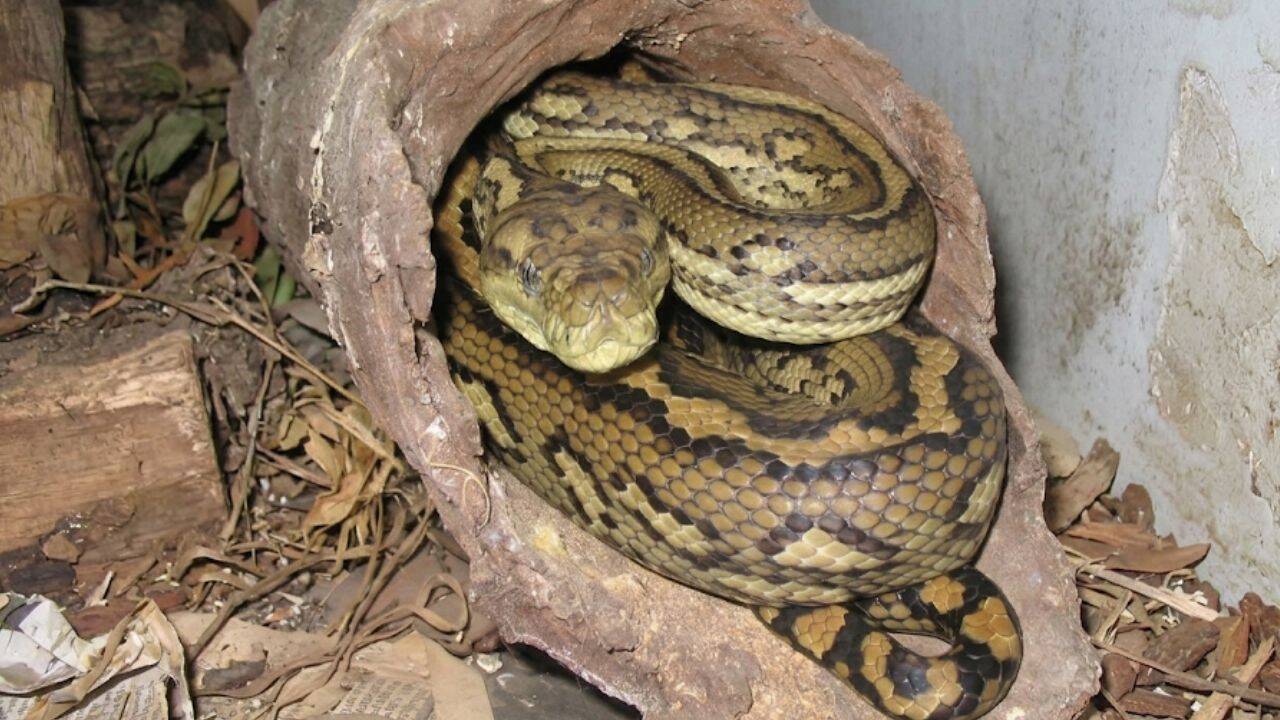
Habitat selection among apex ectotherms rarely follows a uniform distribution across adjacent biomes, even when an animal possesses the physiological capacity to traverse both environments. Between May 2013 and October 2016, field researchers conducted nocturnal road surveys across a 28.8-kilometer transect in the Lockerbie Scrub at the northernmost tip of Australia's Cape York Peninsula, logging 40 capture events across 37 individual carpet pythons (Morelia spilota). Every single specimen was located exclusively within open woodland zones, with zero detections inside the contiguous 8.7 kilometers of rainforest canopy.
This stark spatial division exposes a fundamental flaw in how generalist predators are modeled across biogeographic transition zones. Standard wildlife management frameworks frequently assume that Morelia spilota—a species spanning diverse Australian and Papuan habitats—exhibits uniform ecological plasticity. The Cape York dataset dismantles that assumption by isolating three operational variables: thermal-spatial partitioning, asymmetric sexual dimorphism, and non-linear somatic growth.
The Mechanics of Biogeographic Boundary Friction
The Lockerbie Scrub represents a critical evolutionary junction where Australian and New Guinean herpetofaunas intersect. Molecular analyses indicate that reptile populations at the northern tip of Cape York often share closer genetic affinities with New Guinean conspecifics than with Australian populations located further south. Yet the Cape York Morelia spilota cohort aligns genetically with the widespread eastern Australian morphotype while remaining distinct from populations further north in New Guinea.
Understanding how this specific lineage utilizes local terrain requires examining the transect design and environmental geometry:
- Transect Composition: The 28.8-kilometer survey corridor comprised 20.1 kilometers of woodland and 8.7 kilometers of dense rainforest.
- Detection Protocols: Surveys operated strictly during nocturnal windows from 19:30 to 22:00 hours, yielding 23 systematic detections alongside 17 opportunistic encounters.
- Distribution Divergence: If pythons utilized available habitat randomly, roughly 30 percent of captures (approximately 11 to 12 individuals) would have occurred within the rainforest segment. Observing zero rainforest captures produced a statistically significant divergence between expected and observed habitat distribution.
The Thermal and Structural Bottleneck
Why does a constrictor capable of arboreal and terrestrial movement reject 8.7 kilometers of closed-canopy rainforest? Two primary hypotheses explain this exclusion, though observational transect data alone cannot isolate which variable exerts greater selective pressure.
First, ectothermic thermoregulation imposes severe energetic constraints. Closed rainforest canopies intercept solar radiation, compressing the thermal gradient available on the forest floor during nocturnal foraging windows. Open woodland provides higher daytime solar exposure, retaining substrate heat into the evening hours when Morelia spilota initiates movement between 19:30 and 22:00.
Second, prey accessibility and structural ambush geometry differ sharply between biomes. In southern Wet Tropics regions of Queensland, a distinct rainforest-associated color morph—often termed the jungle carpet python—occupies forest edges. At Cape York's northern tip, however, the local population operates as a woodland specialist. An alternative methodological limitation must also be weighed: dense rainforest vegetation adjacent to road transects creates severe visual occlusion compared to open woodland understories, potentially depressing detection probability even if transient individuals cross the corridor.
Morphometric Asymmetry and Sample Size Sensitivity
Field processing of the 37 captured individuals—22 males and 15 females—revealed pronounced morphological divergence between sexes, alongside critical statistical vulnerabilities inherent to small-sample wildlife datasets.
- Male Cohort Metrics ($n = 22$): Males recorded an average snout-to-vent length (SVL) of 98.1 centimeters and a mean body mass of 352 grams.
- Female Cohort Metrics ($n = 15$): Females recorded an average SVL of 73.7 centimeters and a mean body mass of 91.8 grams.
At face value, males averaged 33.1 percent longer and nearly four times heavier than females. When researchers applied length-adjusted statistical controls, males still exhibited significantly greater body mass per unit of length than females.
However, rigorous stress-testing of the dataset uncovered an outlier dependency. Removing the single largest male specimen from the regression rendered the overall snout-to-vent length difference between males and females statistically insignificant. This distinction separates confirmed biology from statistical artifact:
- Confirmed Pattern: Relative body condition and mass-to-length ratios skew higher in males within this sample.
- Unconfirmed Hypothesis: Absolute structural length superiority in Cape York males cannot be definitively established without larger sample sizes, as a single extreme individual skewed the cohort mean.
Somatic Growth Kinetics and Short-Term Mass Volatility
Mark-recapture protocols yielded only three repeat encounters out of 37 individuals across the multi-year window. Despite the low recapture rate of 8.1 percent, the longitudinal data exposed a sharp contrast between short-term metabolic depletion and multi-year structural expansion.
The Short-Term Depletion Phase
Two pythons recaptured within two months of initial processing demonstrated zero linear growth and measurable mass loss:
- Specimen A: Initially measured at 77 centimeters SVL, recaptured after 57 days with no length increase and a mass reduction of 13 grams.
- Specimen B: Initially measured at 102 centimeters SVL, recaptured after 59 days with no length increase and a mass reduction of 42 grams.
In ambush ectotherms, short-term mass fluctuations reflect episodic feeding cycles rather than systemic decline. A single digestive event or prolonged fasting period alters body mass without affecting skeletal elongation. Furthermore, capture, bag transport, field-station processing, and release within 24 to 48 hours impose acute handling stress that can temporarily suppress foraging behavior.
The Multi-Year Expansion Trajectory
In contrast, a single adult male initially recorded at 142.5 centimeters SVL was recaptured 848 days later. Over that 2.32-year interval, the individual added 33.5 centimeters in snout-to-vent length—reaching 176.0 centimeters—and gained 366 grams in body mass.
$$\text{Annualized Linear Growth Rate} = \frac{33.5\text{ cm}}{848\text{ days}} \times 365\text{ days/year} \approx 14.42\text{ cm/year}$$
$$\text{Annualized Mass Accretion Rate} = \frac{366\text{ g}}{848\text{ days}} \times 365\text{ days/year} \approx 157.54\text{ g/year}$$
This trajectory demonstrates that Morelia spilota at the northern tip of Australia maintains substantial somatic growth capacity well past the 140-centimeter threshold. The underlying cause-and-effect mechanism connects seasonal resource pulses to stepped growth: while short 60-day intervals capture flat or negative mass balances during dry or low-prey cycles, multi-year windows capture wet-season rodent booms that fuel rapid skeletal and muscular expansion.
Trophic Dynamics and Reproductive Thresholds
Opportunistic necropsies of road-killed specimens provided baseline verification of dietary composition and sexual maturity benchmarks. Because destructive sampling was restricted to existing road mortalities, sample sizes remained minimal ($n = 2$ for diet; $n = 2$ for reproductive anatomy), requiring strict separation between direct empirical observations and population-wide extrapolations.
Trophic Specialization on Murid Rodents
Stomach content analysis confirmed predation exclusively on small mammals:
- A 77-centimeter SVL female contained an unidentified small rodent.
- A 150-centimeter SVL male contained an adult Cape York melomys (Melomys capensis).
Melomys capensis is an endemic rodent native to northern Queensland woodlands and forest margins. The presence of an adult melomys inside a 150-centimeter python confirms that mid-sized to large adults rely on terrestrial and scansorial rodents as primary caloric drivers. While carpet pythons in other regions consume birds and arboreal marsupials, the Cape York dataset documents strictly mammal-focused predation, reinforcing the link between open woodland rodent density and python spatial distribution.
Gonadal Maturity Benchmarks
Histological and anatomical inspection of reproductive tracts established baseline size-at-maturity markers for the northern Cape York population:
- Female Benchmark: A 142-centimeter SVL female weighing 392 grams exhibited ovarian corpora lutea, confirming recent ovulation and reproductive activity.
- Male Benchmark: A 150-centimeter SVL male weighing 1,100 grams possessed convoluted, opaque efferent ducts, confirming active spermatogenesis.
Comparing these maturation thresholds against the broader cohort reveals a critical demographic skew. The mean SVL of all captured males was 98.1 centimeters and all captured females was 73.7 centimeters. Consequently, the majority of individuals detected during nocturnal road surveys were sub-adults that had not yet reached the ~140 to 150 centimeter reproductive threshold. Road transects systematically oversample dispersing juveniles and sub-adults while under-detecting large, sedentary breeding adults.
Operational Limitations of Road-Transect Ecology
Evaluating the Lockerbie Scrub dataset through an operational lens exposes four structural constraints that govern how conservation planners must interpret these metrics:
- Temporal Window Bias: Surveying exclusively between 19:30 and 22:00 hours captures early-evening thermal emergence but misses late-night or pre-dawn foraging shifts, particularly among larger adults with higher thermal inertia.
- Detection Asymmetry Across Biomes: Road edges bisecting open woodland offer high visual contrast for spotlighting, whereas dense rainforest margins create structural blind spots that depress recapture and detection probabilities.
- Demographic Filtering: Road surveys disproportionately intercept mobile sub-adults, explaining why average body masses (352 grams for males; 91.8 grams for females) fall far below the 1,100-gram mass recorded in a reproductively mature male.
- Low Recapture Yield: An 8.1 percent recapture rate (3 of 37 individuals) prevents the construction of population-wide von Bertalanffy growth curves, leaving growth rate estimates reliant on a single long-term male observation.
Strategic Directives for Northern Herpetofauna Monitoring
Conservation agencies and field researchers managing Morelia spilota across the Cape York-New Guinea biogeographic transition zone must abandon passive road-cruising as a standalone population metric.
Deploy subcutaneous passive integrated transponder (PIT) tagging paired with targeted radiotelemetry on adult cohorts exceeding 130 centimeters SVL. Shifting from opportunistic road transects to telemetry-driven tracking eliminates visual occlusion bias in closed-canopy rainforests, isolates true microhabitat selection from road-edge thermal attraction, and captures the multi-year growth and reproductive intervals of breeding adults that nocturnal vehicle surveys systematically miss.