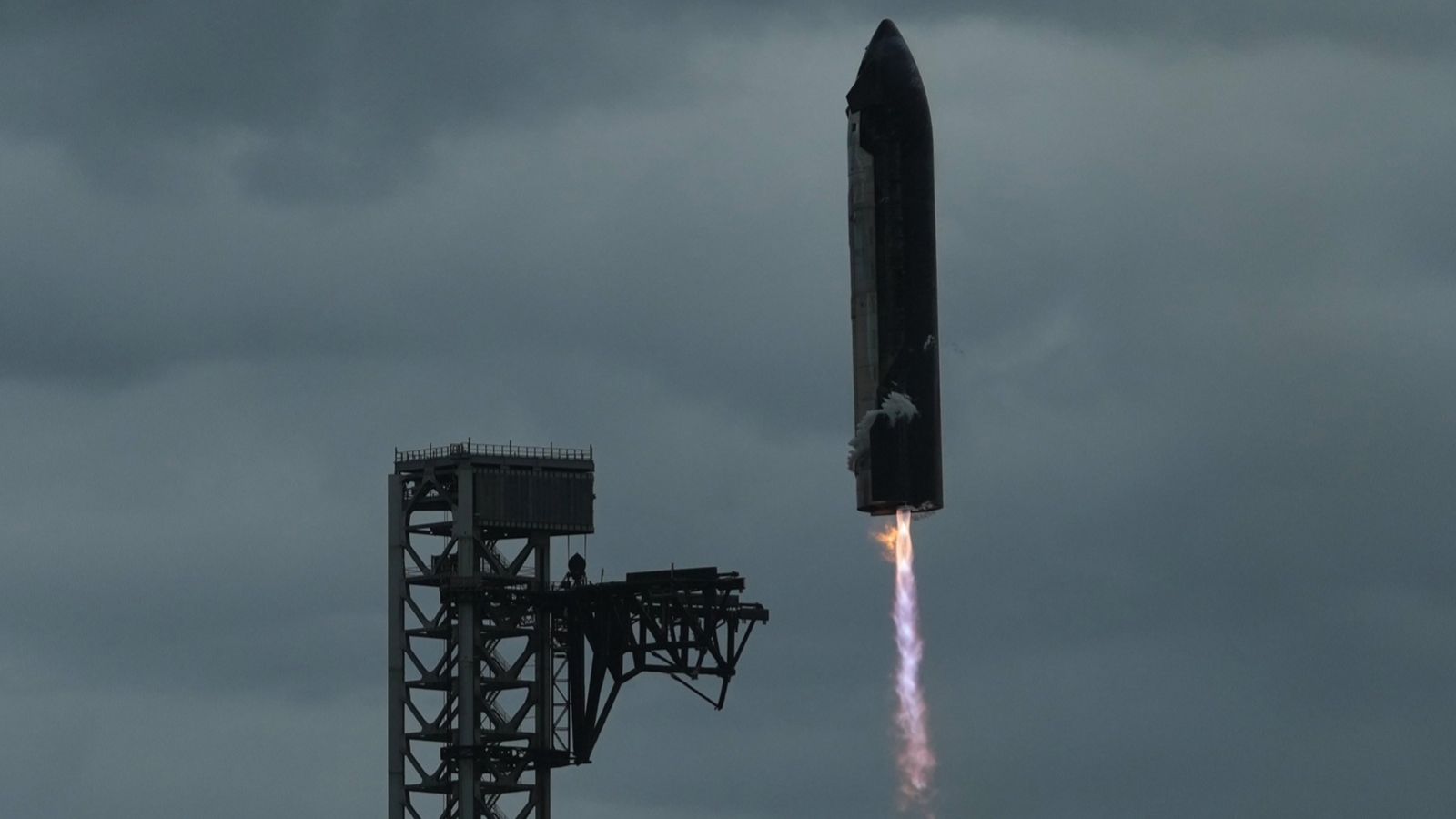
On October 13, 2024, SpaceX did something that defied sixty years of aerospace orthodoxy. During Starship’s fifth integrated flight test, the company guided its 232-foot Super Heavy booster back to the Starbase launch pad in Boca Chica, Texas, and plucked it out of the sky using two massive mechanical arms attached to the launch tower. By eliminating traditional landing legs and capturing the booster directly on the pad infrastructure, SpaceX proved that rapid, airline-style rocket reusability is physically achievable—a breakthrough that fundamentally alters the unit economics of orbital launch and leaves traditional aerospace contractors scrambling to justify their existence.
Most coverage of the Flight 5 catch focused on the spectacle. The flame, the sonic booms, the sheer audacity of catching a stainless-steel skyscraper traveling from the edge of space. That misses the point entirely. The spectacle was merely a byproduct of a ruthless engineering calculus designed to drive the marginal cost of putting mass into orbit down toward the price of propellant.
To understand why Elon Musk’s engineers risked destroying their only operational orbital launch mount in South Texas, you have to look at the tyranny of the rocket equation. Every kilogram of dead weight bolted onto a rocket’s first stage—landing legs, hydraulic actuators, structural reinforcement—steals directly from the payload capacity that stage can push toward orbit. On the Falcon 9, SpaceX accepted that penalty. The carbon-fiber legs fold down just before touchdown, adding several metric tons of dry mass that serve no purpose during ascent. For a vehicle the size of Super Heavy, scaling up those legs would require a massive, heavy deployment mechanism capable of supporting a structure weighing roughly 200 metric tons empty, while withstanding the violent acoustic and thermal environment of 33 Raptor engines firing at full thrust.
SpaceX decided the best landing leg is no landing leg at all.
The Brutal Mechanics of the Chopstick Catch
The tower itself, officially designated the Orbital Launch Integration Tower and universally known as Mechazilla, is the actual spacecraft recovery system. Standing 480 feet tall, the steel truss structure holds two articulated arms, commonly called chopsticks, which serve a dual purpose. Before launch, they stack the 165-foot Starship upper stage onto the Super Heavy booster. Upon return, they act as a precision shock-absorbing cradle.
The physics of the Flight 5 maneuver leave zero margin for thermal or guidance drift. After separating from the upper stage at an altitude of roughly 70 kilometers, Booster 12 executed a boostback burn to reverse its trajectory, sending it hurtling back toward the Texas coastline. As it re-entered the thicker layers of the atmosphere, grid fins—large, waffle-like titanium control surfaces near the top of the booster—steered the falling cylinder through hypersonic and supersonic regimes.
For the final descent, the booster ignited 13 of its 33 Raptor engines to decelerate rapidly, eventually throttling down to just three center engines for the terminal hover and translation maneuver. This is where traditional aerospace engineering wisdom predicted failure. Hovering a rocket in a crosswind while sliding it laterally toward a steel tower introduces terrifying aerodynamic instabilities. Plume impingement—the chaotic bouncing of supersonic exhaust gases off the ground and surrounding structures—can violently destabilize a vehicle in milliseconds.
Yet Booster 12 slid between the open chopsticks with millimeter-level accuracy. Two small, reinforced load points just below the forward grid fins settled onto cushioned rails atop the arms. The engines cut off. The booster hung suspended above the launch mount, scorched and venting liquid oxygen, completely intact.
It looked effortless. It was anything but.
What the Telemetry Actually Revealed
In the days following the catch, spaceflight analysts and former NASA propulsion engineers began dissecting the public telemetry and high-resolution tracking footage. The consensus among industry veterans is sobering for SpaceX's rivals, though not entirely without caveats.
First, the thermal protection and structural integrity of the booster held up better than many skeptics anticipated, though not without visible wear. During the descent, sections of the aft engine skirt glowed cherry-red, and small fires burned along the chines—the aerodynamic fairings running down the sides of the booster that house propellant transfer lines and avionics. While the primary stainless-steel hull (constructed from proprietary 300-series alloy) shrugged off the extreme heat of re-entry without needing ablative coatings, localized heating near the engine bay remains an engineering headache.
Second, the precision of the autonomous flight safety and guidance software demonstrated a level of closed-loop control that legacy defense contractors simply do not possess. The rocket was not flying a pre-programmed rail; it was continuously recalculating its trajectory based on real-time wind shear, engine performance variations, and structural flex. Had a single sensor fallen out of bounds by a fraction of a percent during those final six seconds, the automated flight termination system would have aborted the catch, diverting the booster into the Gulf of Mexico to save the tower.
Here lies the primary vulnerability of the Mechazilla architecture, a gray area that SpaceX fanatics routinely gloss over. By moving the landing gear from the rocket to the ground infrastructure, SpaceX concentrated catastrophic risk at a single point of failure. If a booster experiences a sensor glitch or an engine flameout two seconds before capture, it does not merely crash into a concrete landing pad miles away from critical hardware. It slams directly into the launch tower, the orbital launch mount, and the propellant tank farm. A single botched catch could easily knock an entire launch complex offline for six to twelve months.
The Economics of Zero Turnaround Time
Why accept that kind of existential risk to ground infrastructure? Because in the commercial launch market, cadence is the only metric that matters.
Consider the current state of heavy-lift rocketry. NASA’s Space Launch System (SLS), built by a consortium of legacy aerospace giants including Boeing, Northrop Grumman, and Aerojet Rocketdyne, costs upwards of $4.1 billion per launch according to NASA’s own Office of Inspector General. Every single piece of that rocket—from the four RS-25 engines upgraded from the Space Shuttle era to the core stage fuel tanks—is dumped into the ocean after eight minutes of flight. It takes years to build a single SLS stack.
Blue Origin’s New Glenn and United Launch Alliance’s Vulcan Centaur represent more modern approaches, yet both remain tethered to twentieth-century operational timelines. Vulcan is entirely expendable, though ULA plans to eventually recover just the main engines via an inflatable heat shield—a complex, multi-step process requiring mid-air helicopter capture or ocean recovery and extensive refurbishment. New Glenn features a reusable first stage designed to land on a sea-going vessel, mirroring SpaceX’s own Falcon 9 operations.
Even Falcon 9, the undisputed workhorse of global spaceflight, suffers from the logistical drag of maritime recovery. When a Falcon 9 booster lands on an autonomous spaceport drone ship hundreds of miles downrange, it takes days to tow the barge back to port, hours to crane the booster onto a transporter, days to truck it back to the hangar, and weeks to inspect, refurbish, and re-mate it with a second stage.
Starship’s tower catch obliterates that entire logistical chain.
By bringing the booster directly back to the launch mount, SpaceX eliminates the drone ships, the tugboats, the heavy-lift cranes, and the cross-country road transport. In theory, the chopsticks can lift the caught booster, place it straight back onto the orbital launch mount, stack a freshly refueled upper stage on top, pump in 4,500 metric tons of subcooled liquid methane and liquid oxygen, and launch again within hours.
The Destructive Reality of Raptor Engine Economics
Of course, rapid reuse only works if the engines survive the trip without needing to be torn down to the bolts after every flight. This is the quiet, unglamorous battleground where Starship’s ultimate viability will be decided.
The Super Heavy booster relies on 33 Raptor engines. Operating on a full-flow staged combustion cycle—a notoriously difficult architecture that pushes propellants through two separate preburners at extreme pressures—the Raptor is a marvel of metallurgical engineering. SpaceX has already iterated through Raptor 1 and Raptor 2, steadily stripping away external plumbing, flanges, and sensors to reduce mass and manufacturing cost. Raptor 3, which debuted publicly just months before the Flight 5 catch, looks less like a traditional rocket engine and more like a smooth, 3D-printed metal sculpture, with cooling channels and secondary flow paths integrated directly into the cast components.
Yet full-flow staged combustion runs hot and angry. Turbopumps spin at tens of thousands of revolutions per minute while bathed in oxygen-rich gas that wants to ignite the metal blades themselves. During the Flight 5 landing burn, the engines had to relight mid-air under intense aerodynamic buffeting, throttle deep down, and gimbal violently to center the booster between the tower arms.
Industry insiders remain deeply divided on how many flights a Raptor engine can endure before turbine blade fatigue or injector erosion forces a replacement. If SpaceX has to swap out five or ten Raptor engines after every catch, the dream of 24-hour turnaround evaporates. Replacing engines inside the tight confines of a 33-engine cluster is brutal, labor-intensive work. The true victory of Flight 5 is not that SpaceX caught the booster once, but that they now possess a recovered flight article whose engines can be torn down, borescoped, and analyzed under real-world re-entry stress rather than static test stand simulations.
The Upper Stage Problem Remains Unsolved
While the booster catch dominated headlines, the second half of the Starship equation—the upper stage—remains a massive engineering hurdle.
Unlike a first stage, which separates at roughly Mach 6 or 7 and experiences relatively benign thermal loads on the way down, an orbital upper stage must decelerate from Mach 25. The kinetic energy that needs to be dissipated during orbital re-entry is orders of magnitude higher.
During Flight 5, the Starship upper stage survived re-entry and executed a controlled splashdown in the Indian Ocean, hitting its target coordinates within meters. That was a major improvement over Flight 4, where intense plasma burned straight through one of the forward aerodynamic flaps, turning the hinge into glowing slag before the vehicle managed a soft water landing. SpaceX spent the months between flights completely re-engineering the heat shield, applying a thinner, tougher generation of hexagonal ceramic tiles backed by a secondary ablative layer to protect the stainless-steel skin if a tile cracks or falls off.
Even so, inspecting the post-flight footage from the Indian Ocean buoy cameras revealed that the heat shield is still taking a beating. Orange plasma plumes around the flap hinges indicated localized thermal breaches. Furthermore, catching the upper stage with the same tower chopsticks—which is SpaceX's explicit plan—presents a vastly more complex challenge than catching the booster. The upper stage is lighter, has a different center of gravity, lacks grid fins, and relies on four massive body flaps that must fold back at the exact microsecond the engines light for the terminal flip maneuver.
Until SpaceX proves it can catch the upper stage intact and re-fly it without spending three months replacing thousands of cracked ceramic tiles by hand, Starship remains a partially reusable system—albeit one with a payload capacity that dwarfs every other rocket on Earth.
What Happens to Legacy Aerospace Now
For competitors in the United States and Europe, the October 13 catch was an extinction-level warning.
For decades, the aerospace industry operated on cost-plus contracts and low launch rates. Governments paid defense primes to build bespoke, expendable hardware, absorbing schedule slips and billion-dollar overruns as the unavoidable price of accessing space. SpaceX broke that model with Falcon 9, capturing over 80 percent of global orbital payload mass by 2024.
Starship threatens to make Falcon 9 itself obsolete.
If SpaceX achieves even a fraction of its cadence goals with a fully reusable Starship, the cost per kilogram to Low Earth Orbit will plummet below $100—down from roughly $1,500 on a Falcon Heavy and over $10,000 on legacy expendable vehicles. At that price point, payload mass ceases to be the primary constraint in spacecraft design. Satellite manufacturers will no longer need to spend hundreds of millions of dollars shaving grams off components using exotic composites or folding delicate solar arrays like origami to fit inside narrow five-meter payload fairings. They can build heavy, cheap, rugged hardware out of off-the-shelf components and launch it inside Starship’s massive nine-meter-wide cargo bay.
European aerospace consortium Arianespace, which struggled for years to bring the expendable Ariane 6 to the launch pad, is already priced out of the commercial market without heavy government subsidies. China’s state-owned space contractors and commercial startups like LandSpace are aggressively copying SpaceX’s stainless-steel and methane architecture, with several firms openly developing their own tower-catch concepts, though they remain years behind in flight-tested hardware and closed-loop guidance software.
Even NASA is now structurally dependent on SpaceX’s progress. Under the Artemis program, the agency awarded SpaceX contracts worth over $4 billion to develop a human
How SpaceX Caught a 23-Story Rocket Out of Thin Air and Rewrote Orbital Economics
technology, business
On October 13, 2024, SpaceX achieved what aerospace engineers spent half a century dismissing as suicidal physics. During Starship Flight 5 in Boca Chica, Texas, the company guided its 232-foot-tall Super Heavy booster back from the edge of space, decelerated it from supersonic speeds, and caught the falling stainless-steel cylinder mid-air using two massive mechanical arms attached to its launch tower.
No landing legs. No concrete touchdown pad. Just a controlled collision with a pair of giant steel chopsticks.
For decades, the fundamental financial flaw of spaceflight was simple. Every time a nation or corporation launched a satellite, they threw away a machine worth tens of millions of dollars into the ocean. SpaceX solved the first half of that problem years ago with the Falcon 9, proving that an orbital-class booster could land vertically on a drone ship or concrete pad. Yet even Falcon 9 required days or weeks of refurbishment, inspections, and transport before flying again. Catching the Super Heavy booster directly on the launch mount eliminates the heavy landing legs, removes the need for recovery fleets, and slashes turnaround times from weeks to hours. It is the single most consequential engineering milestone in the history of rocketry.
The Physics of a Controlled Crash
To understand why the Mechazilla catch tower works, you have to look at the tyranny of the rocket equation. Every kilogram of mass you attach to the bottom of a rocket—like heavy hydraulic landing legs, crush cores, and reinforced structural mounting points—is a kilogram of payload you cannot send to orbit. On a vehicle as massive as Starship, traditional landing legs would weigh several metric tons.
SpaceX chose to move the landing hardware off the rocket and onto the ground.
During the final moments of Flight 5, Booster 12 fell toward the Gulf Coast at terminal velocity. Three of its 33 Raptor engines reignited for the landing burn, rapidly bleeding off speed while gimbaled nozzles steered the 200-ton empty hull toward the orbital launch integration tower. Seconds before zero altitude, the booster hovered momentarily, translating sideways until two small load-bearing pins beneath its forward grid fins aligned with the tower's massive mechanical arms. The arms swung shut, absorbing the remaining downward momentum, and the engines cut out.
The margin for error was measured in centimeters. Had the booster drifted slightly off-axis, or had a single hydraulic actuator on the tower lagged by a fraction of a second, the resulting explosion would have obliterated the Stage 0 ground infrastructure—setting the entire Starship program back by a year or more. SpaceX gambled its primary launch pad to prove a thesis. The bet paid off.
What Legacy Aerospace Missed About Reusability
When the Space Shuttle program launched in 1981, NASA promised a fleet of reusable spaceplanes that would fly every two weeks at a fraction of traditional costs. The reality was a maintenance nightmare. Technicians had to inspect and replace thousands of fragile silica thermal protection tiles after every mission, driving launch costs to over $1.5 billion per flight when adjusted for inflation. Reusability became a dirty word in aerospace boardrooms, synonymous with hidden operational expenses.
Traditional contractors like Boeing, Lockheed Martin, and Arianespace internalized that trauma. They doubled down on expendable rockets, arguing that building simple, single-use boosters was cheaper than engineering complex recovery systems. Even as SpaceX began landing Falcon 9 boosters in 2015, legacy executives publicly doubted the economics, claiming the cost of refurbishing used engines would outweigh the savings of hardware recovery.
They missed the core operational principle behind SpaceX's design philosophy. Rapid reusability is not about saving a rocket so you can rebuild it in a hangar. It is about building a rocket so durable that you can refuel it and launch it again the same day, much like a commercial airliner.
Catching the booster on the launch mount is the linchpin of that operational model. By placing the Super Heavy directly back onto the Orbital Launch Mount, SpaceX bypasses the multi-day process of lowering a landed booster onto a transporter, driving it miles down a highway to a processing facility, lifting it with a crane, and re-stacking it. In theory, once the booster cools down and passes automated telemetry checks, the tower's quick-disconnect arms can immediately begin pumping liquid methane and liquid oxygen back into its tanks.
The Hidden Engineering Hurdles Nobody Mentions
Watching a 23-story cylinder hover gracefully into mechanical arms makes the feat look effortless. It is not. Behind the triumphant livestream lies a series of brutal engineering trade-offs that SpaceX has yet to fully resolve.
First is the thermal and acoustic punishment inflicted on the launch tower itself. When three Raptor engines fire at close range inside the confined geometry of the tower arms, they generate over 600 metric tons of thrust and extreme acoustic vibrations. During Flight 5, telemetry and post-flight imagery revealed visible scorching and localized damage to the outer chines and engine bay components of Booster 12, alongside significant wear on the tower's shielding. A catch is only commercially viable if the tower and the booster survive the encounter without requiring weeks of welding and sensor replacement.
Second is the propellant penalty. Saving fuel for a boost-back burn, an entry burn, and a precision hover catch consumes roughly 10% to 15% of the booster's total propellant capacity. That directly reduces the maximum mass Starship can lift to Low Earth Orbit. SpaceX compensates for this through sheer scale—Super Heavy is the largest and most powerful rocket ever built—and through continuous upgrades to the Raptor engine, pushing chamber pressures higher to squeeze out more thrust per kilogram of fuel.
Third, the regulatory friction remains immense. Every trajectory that brings a massive orbital booster back over populated coastlines triggers intense scrutiny from the Federal Aviation Administration and the Fish and Wildlife Service. SpaceX had to prove through exhaustive probabilistic risk assessments that a guidance failure would steer the falling rocket harmlessly into the Gulf of Mexico rather than onto South Padre Island. Scaling this operation to multiple launches per week will require navigating an environmental and airspace approval process designed for an era when rockets flew once a month.
The Chokepoint of the Modern Space Economy
The mid-air catch of Booster 12 changes the math for every satellite operator, defense contractor, and space agency on Earth. Until now, the global space economy has been constrained by launch supply. Even with Falcon 9 flying more than 100 times a year, payload mass is expensive, and spacecraft designers spend millions of dollars shaving grams off satellites using exotic composites and miniaturized electronics.
Starship breaks that bottleneck. Designed to carry over 100 metric tons to orbit—and eventually 200 tons in future iterations—a fully reusable Starship system lowers the marginal cost of reaching space from thousands of dollars per kilogram to potentially under $100 per kilogram.
At that price point, satellite engineering changes completely. Companies no longer need to build delicate, ultra-lightweight spacecraft that fold up like origami to fit inside a narrow payload fairing. They can build heavy, rugged, inexpensive satellites out of standard industrial materials and launch dozens at a time. Space-based solar power, orbital manufacturing, and massive constellations become financially viable overnight.
Why NASA and Competitors Are Suddenly Cornered
The geopolitical and commercial ripples of Flight 5 extend far beyond Boca Chica. For NASA, the successful catch is a critical validation of its Artemis program. The space agency has contracted SpaceX to use a modified lunar variant of Starship to land astronauts on the Moon later this decade. That mission architecture relies entirely on orbital refueling—launching a propellant depot into Earth orbit and filling it via multiple rapid-fire tanker flights. Without a catch-and-relaunch cadence measured in days rather than months, orbital refueling is logistically impossible. Flight 5 proved the foundational recovery mechanism works.
Meanwhile, SpaceX's competitors are facing an existential crisis. Blue Origin's New Glenn rocket, which utilizes traditional deployable landing legs and an ocean recovery barge, is already lagging behind the operational tempo Starship aims to set. European and Asian launch providers, many of whom are still struggling to field partially reusable rockets comparable to the decade-old Falcon 9, now find themselves two full technological generations behind.
A rocket that lands on a barge is a remarkable feat of engineering. A rocket that flies back to its own launch pad, slots itself into mechanical arms, and prepares for another flight before the exhaust has cleared the coastline is an industrial revolution.
The aerospace industry spent seventy years treating gravity as an insurmountable tax on human ambition. In seven minutes over South Texas, SpaceX turned a falling skyscraper into a reusable machine, leaving every rival on Earth scrambling to explain why their rockets still end up at the bottom of the sea.