Morning light hits the linoleum floor of a suburban hallway in a way that should feel ordinary. It hits the frayed edges of a backpack left by the kitchen island. It hits a pair of scuffed white sneakers. But ordinary is a luxury we traded away years ago, trading it piece by piece for bulletproof glass, ID badges that click like turnstiles, and the heavy, metallic echo of corridor doors locking from the inside.
I remember the first time I heard a lockdown drill. It wasn't the sound of danger. It was the sound of silence—the absolute, suffocating quiet of twenty children sitting knee-to-chest behind a row of filing cabinets, holding their breath because an adult told them the dark keeps you safe.
Now, the dark is getting company.
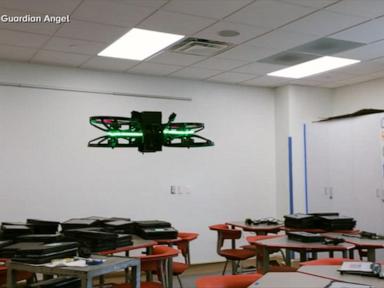
Look up. Above the asphalt of the parking lot, past the maple trees turning gold in the autumn wind, something new hovers. It is small. It is loud, buzzing with the mechanical whine of a giant insect. It has four rotors, a high-definition lens, and, tucked beneath its chassis, a canister of pepper spray.
This is the newest frontline in American education.
The Calculus of Fear
To understand how we arrived at a moment where unmanned aerial vehicles are being test-flown over schoolyards, you have to look at the math of desperation. When a crisis unfolds inside a building, seconds stretch into eternities. The average response time for law enforcement to arrive at an active shooter scene hovers around three minutes. In those three minutes, an entire generation can be altered.
Administrators, school boards, and frantic parents are looking at the clock and blinking. They want a buffer. They want an intervening force that doesn't bleed, doesn't hesitate, and can cross a football field in the time it takes a human to draw a weapon.
Enter the defense tech startups pitching autonomous or remote-piloted security drones. The pitch is clean, clinical, and dressed in the language of innovation. Deploy the drone. Locate the threat. Neutralize the attacker with a blinding cloud of oleoresin capsicum—pepper spray—from above, buying precious minutes for first responders to breach the perimeter.
It sounds like science fiction. It feels like science fiction. But the invoices are real, and the debates are echoing through town halls from Texas to Ohio.
Consider what happens next in this scenario, which I will call the hypothetical deployment morning. Imagine the drone is parked in a rooftop docking station, wired into the school’s security network. A silent alarm trips—perhaps a glass-break sensor in the west wing, perhaps a motion detector triggered after hours. Before a security guard can stand up from a desk, the drone’s rotors spin to life. It drops off the roof, cuts through the morning air, and navigates a pre-programmed corridor directly toward the source of the anomaly.
Through the lens, a human face appears.
And right there, in the crosshairs of a machine engineered to pacify, the math breaks down.
The Human Element We Forgot to Program
I have stood in those hallways. I have felt the cold chill of institutional panic. Technology promises to strip the human error out of catastrophe, but it often just automates our worst impulses.
What happens when the drone gets it wrong?
This is not a theoretical abstraction. Computer vision is notoriously brittle. Shadows stretch across lockers at odd angles. A student carrying an oversized umbrella or a long cardboard poster tube for a science fair can cast a silhouette that a remote algorithm, trained on worst-case scenarios, misinterprets.
If a drone unleashes a chemical irritant into a crowded corridor based on a false positive, the chaos is instantaneous. Oleoresin capsicum does not discriminate between an active threat and a terrified sophomore trying to find his homeroom. It burns the eyes. It closes the throat. It induces panic, trampling, and disorientation. In a space designed for learning, introducing a chemical weapon—even a non-lethal one—creates a secondary disaster zone.
We are trying to engineer our way out of a cultural failure with hardware. We are building a fortress and then putting remote-controlled guards on the battlements, hoping that if we make the environment hostile enough, the violence will look elsewhere.
But violence doesn't care about our hardware. It adapts.
The Sound of the Future We Didn't Choose
There is an emotional cost to living under surveillance that we rarely calculate on balance sheets. Walk a high school hallway today and you can feel the weight of it. Cameras dome from the ceilings. Metal detectors frame the entrances. Now, add the faint, high-pitched whir of a rotor blade outside the second-story window.
What does it do to a child’s mind to know that the sky above the playground is armed?
We are teaching kids that safety is synonymous with occupation. We are telling them that peace is not the absence of fear, but the presence of overwhelming force. Every time a drone hums past a classroom window, it whispers a reminder: You are not safe. Not here. Not ever.
The debate splits neatly down predictable lines. On one side, proponents argue that we must use every tool at our disposal. If a drone can disorient an active shooter for thirty seconds, it saves lives. Period. In the grim calculus of modern survival, optics and optics-driven aesthetics matter less than body counts.
On the other side, civil liberties advocates, educators, and developmental psychologists point to the erosion of the educational environment. They ask where the line is drawn. Today, it is pepper spray. Tomorrow, what? Autonomous intervention? Lethal payloads mounted on quadcopters? The slope is not just slippery; it is vertical.
The Lingering Horizon
I look at that backpack by the kitchen island, and I feel the familiar, hollow ache of a parent trying to bridge the gap between the world as it was and the world as it is.
We want simple answers. We want a device we can buy, install, and plug in that will make the nightmares go away. But there is no software patch for the human heart, and there is no drone agile enough to outfly our collective failure to address the roots of why someone picks up a weapon in the first place.
The rotors keep spinning in the testing grounds. The venture capital flows into defense tech designed for hallways. The debate rages on cable news and school board agendas.
Outside, the wind picks up, rustling the autumn leaves, drowning out the mechanical hum for a moment, leaving only the quiet space between what we are building and what we are losing.