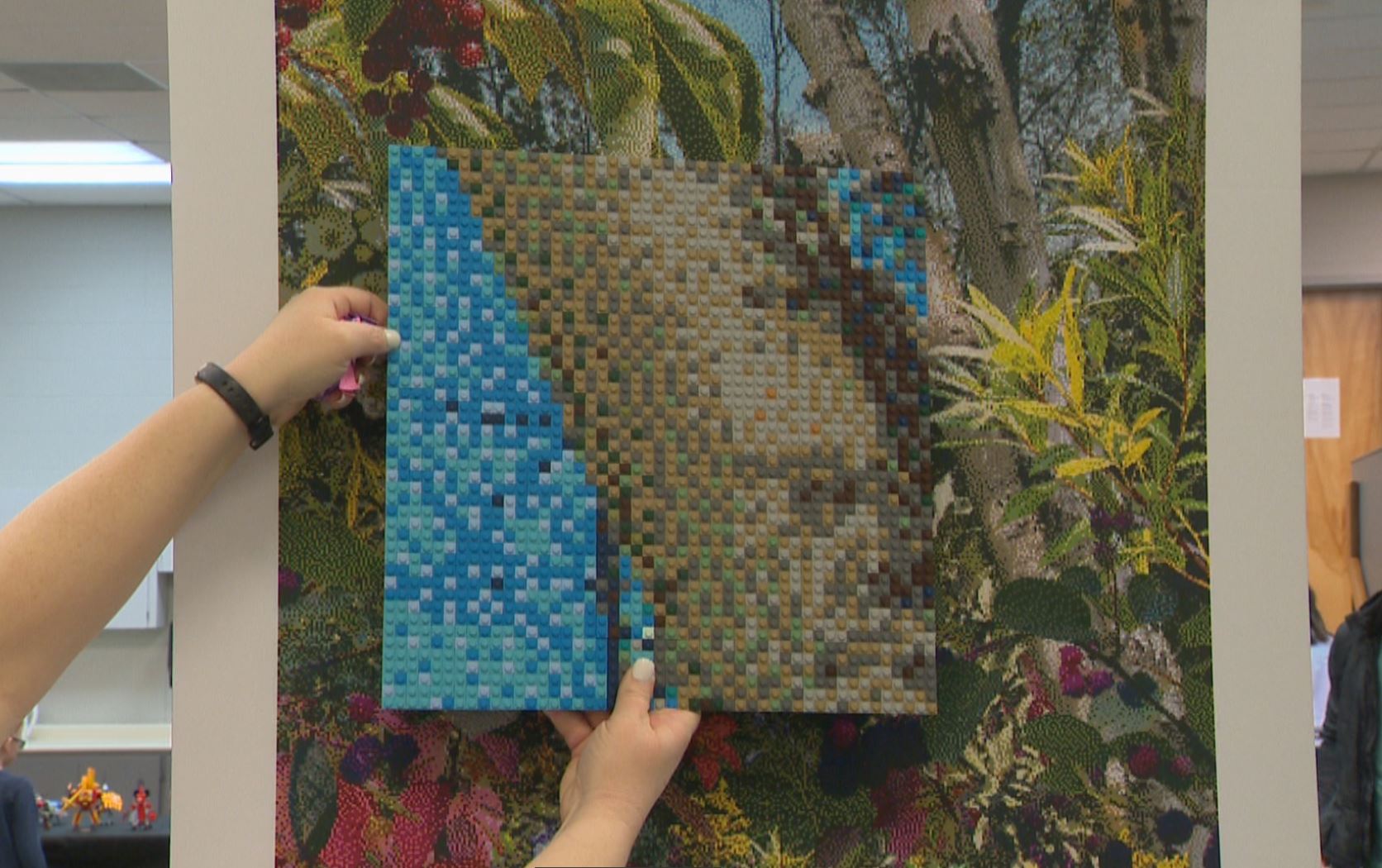
The air inside the Western Development Museum smells like old grease, weathered prairie wood, and the faint, metallic ghost of a 1910 steam engine. Usually, it is a place of static history, where the past is bolted to the floor behind velvet ropes. But today, the silence is broken by a distinct, rhythmic clatter. It is the sound of thirty thousand plastic bricks hitting a table.
In Saskatoon, a city built on the grit of the northern plains, we are used to seeing construction in steel and concrete. We understand the language of cranes. Yet, there is something profoundly different about watching a historic landmark rise from the ground up when the materials are no larger than a thumbnail. This isn't just about a toy. It is an exercise in collective memory, a frantic, beautiful attempt to reconstruct the soul of a city before the details of the past fade into the gray of a digital age.
Consider the hands of the builders. On one side, you have the historians, people whose fingernails are stained with the ink of old blueprints and the dust of archives. On the other, you have the hobbyists—adults who never quite outgrew the tactile satisfaction of a "click." When these two groups meet over a pile of bright primary colors, the friction creates something more than a model. It creates a bridge.
The Weight of a Single Stud
The project is an ambitious reconstruction of one of Saskatoon’s most iconic heritage sites. To the casual observer, it looks like a fun weekend activity. To those involved, it is a high-stakes puzzle where a single missing 1x2 plate can halt a week of progress.
Precision is the enemy of speed. In a standard construction project, you have the luxury of custom-cutting your materials. If a beam is too long, you saw it. If a gap is too wide, you fill it. Here, the geometry is unforgiving. You are beholden to the system. If the historic window of the real building has a specific arch, and the plastic mold doesn't exist in that exact radius, you have to innovate. You have to lie to the eye. You use a headlight brick sideways. You stack plates in a "SNOT" (Studs Not On Top) configuration.
This technical struggle mirrors the reality of prairie life. We have always been a people who make do with what we have. Our ancestors arrived in Saskatchewan with little more than what could fit in a wagon, and they built a civilization out of sod and sheer will. Watching a volunteer sweat over the pitch of a miniature roofline feels like a poetic echo of that original struggle. It is a reminder that nothing—not a house, not a community, and certainly not a memory—stays standing without constant, deliberate effort.
The Invisible Stakes of Play
Why does a city stop to watch a plastic building grow?
Perhaps it is because we are living in an era where everything feels temporary. Our buildings are glass boxes designed to last forty years. Our interactions are fleeting swipes on a screen. In contrast, there is a defiant permanence to a physical model. You can touch it. You can feel the weight of it.
Think about a child standing at the edge of the display. Let’s call him Leo. Leo doesn't know the architectural significance of the Gothic Revival style. He doesn't care about the zoning bylaws of 1920. But as he watches a miniature version of his city take shape, something shifts. The scale of the world becomes manageable. For the first time, he sees that a city is not a monolith that dropped from the sky; it is a series of choices. It is a sequence of individual actions.
If a piece of plastic can represent a window, then Leo can represent a citizen. The stakes are the realization that he, too, is a builder.
But the real problem lies elsewhere. While we celebrate the "new" build, we are often blind to the slow decay of the "old" one. We are a culture obsessed with the snapshot of completion. We love the ribbon-cutting. We love the final, polished product. We are less enamored with the thousand hours of invisible labor that precede it—the sorting, the cleaning, the trial and error of a design that collapsed three times before it finally held.
The Anatomy of the Build
The logistics of a project this size are staggering. To build a landmark at this scale requires more than just bricks; it requires a digital cartography of the past. Builders often spend months staring at black-and-white photographs, counting the number of bricks in a real wall to determine the exact proportions of the model.
- Phase One: The Foundation. This is the least glamorous part. It involves hundreds of thick, gray baseplates and internal supports that will never be seen by the public. It is the hidden skeleton.
- Phase Two: The Cladding. This is where the personality emerges. The color matching must be perfect. If the original sandstone has a weathered, tan hue, you cannot simply use yellow. You search for the "Dark Tan" or "Sand Green" pieces that are often rare and expensive.
- Phase Three: The Life. This is the addition of "greebling"—the tiny, intricate details that give a surface texture and realism. A pipe, a flower box, a miniature figure leaning against a lamp post.
Consider what happens next: the model is finished, the crowds cheer, and the museum has a new centerpiece. But the true value isn't the plastic sitting on the table. It’s the conversations that happened while it was being built. It’s the veteran who walked by and told a story about working in that building in 1954. It’s the teenager who realized that history isn't just a textbook; it’s a physical reality you can hold in your hands.
The Fragility of the Whole
There is a terrifying vulnerability in a build like this. It is held together by friction. No glue. No screws. Just the "clutch power" of the plastic. If a table is bumped too hard, or if a structural wall is miscalculated, the entire thing can come crashing down in a cacophony of clicking shards.
We often treat our actual heritage with the same precariousness. We assume the landmarks we love will always be there, held up by some invisible force of nature. We forget that they are held up by us. They are held up by our interest, our taxes, and our willingness to protect them. When we see a historic building represented in a toy, it strips away the intimidation of "History" with a capital H. It makes the past look like something we can protect. It makes it look like something we can fix.
The project in Saskatoon isn't just a hobbyist’s dream. It is a quiet protest against the disposability of the modern world. Every brick snapped into place is a vote for the importance of the local story. It is a rejection of the idea that a small city in the middle of the Canadian prairies doesn't have a grand narrative.
As the sun sets over the South Saskatchewan River, the light hits the museum windows and reflects off the thousands of tiny plastic facets of the model. From a distance, you can’t tell it’s a toy. It looks solid. It looks real. It looks like home.
We are all builders, whether we use hammers or small plastic rectangles. We are all trying to assemble a version of the world that makes sense, piece by agonizing piece. The only question is whether we are willing to do the tedious work of the foundation, or if we are only interested in the view from the top.
The clattering sound continues. One more brick. One more memory. One more connection between the city we were and the city we are becoming. The work is never truly finished, because the story of a place is always being rebuilt, stud by stud, by anyone brave enough to pick up a piece and try to make it fit.