Cold rain in November tastes like iron and wet limestone when you stand on the north side of Dublin.
At 1:30 in the afternoon on November 23, 2023, Parnell Square East sounded like any other Thursday in the Irish capital. Traffic hummed along the Georgian terraces. Buses hissed at their stops. Outside Gaelscoil Choláiste Mhuire, a primary school where children learn in the Irish language, a line of five- and six-year-olds stood waiting on the pavement, chattering under the watchful eye of their care worker, Leanne Flynn.
Then, a man stepped forward with a kitchen knife.
Six seconds. That is all it took to shatter the ordinary rhythm of a city afternoon, leave three children and their care worker bleeding on the pavement, and ignite a firestorm of street violence that would burn through the heart of Dublin before nightfall.
Now, after a trial that forced an entire nation to relive the horror of that afternoon in clinical, agonizing detail, the perpetrator—Riad Bouchaker—has been sentenced to life in prison for the attempted murder of those children and the devastating injuries inflicted upon the woman who tried to shield them.
A standard news report will give you the docket number, the judge's remarks, and the timeline of the sentencing. It will tell you that the verdict closes a dark chapter.
It does not. A life sentence locks a man behind steel doors, yet it cannot lock away the ghosts left standing on Parnell Square, nor can it erase the night Dublin nearly tore itself apart in the name of grief.
The Anatomy of an Ordinary Thursday
To understand the weight of what happened outside Gaelscoil Choláiste Mhuire, you first have to picture the microcosm of a school pickup line.
Think of any afternoon outside an elementary school anywhere in the world. Parents check their watches. Children clutch crumpled drawings and half-empty lunchboxes. There is an unspoken social contract in that space—an invisible shield forged by habit and trust. You believe, without ever needing to articulate it, that the sidewalk outside a school is neutral ground, untouchable by the chaos of the wider world.
On Parnell Square East, that contract broke without warning.
When Bouchaker approached the line of children, there was no shouted manifesto, no theatrical buildup, no cinematic warning. Real violence rarely announces itself with a score. It arrives like a sudden drop in barometric pressure, silent and suffocating. Within moments, three young children—two girls and a boy, none of them old enough to tie their own shoes reliably—had suffered stab wounds. One five-year-old girl sustained critical injuries to her chest and brain that would keep her fighting for her life in Temple Street Children's University Hospital for months, requiring multiple surgeries and forcing her to relearn how to swallow, move, and communicate with the world around her.
And there was Leanne Flynn.
In the courtroom testimony that formed the backbone of the prosecution's case, Flynn's actions emerged not as calculated heroism, because human beings do not calculate when a blade is moving toward a child. Her response was pure, unfiltered instinct. She threw her own body between the attacker and the children in her care, absorbing catastrophic wounds to her chest and neck in the process.
Consider the physics of that choice. When danger strikes, the human nervous system is wired for self-preservation—flinch, recoil, retreat. Overriding that evolutionary programming in a fraction of a second requires a depth of character that no courtroom citation can adequately measure. Flynn survived, carrying the physical and psychological scars of those six seconds into every day since.
The Bystanders Who Stepped Into the Breach
Before sirens could wail down O'Connell Street, ordinary people intervened.
Delivery drivers, passersby, parents—strangers who had woken up that morning thinking about grocery lists, rent payments, and weekend plans—ran toward the screaming rather than away from it. Among them was Caio Benicio, a Brazilian delivery rider who happened to be passing on his scooter. Seeing the attack unfold, he stopped, pulled off his helmet, and used it as a weapon to strike the assailant to the ground. Others pinned the man down, wrestled the knife away, and held him until Gardaí arrived at the scene.
Pause and sit with the irony of that moment.
A Brazilian immigrant working the gig economy in Dublin risked his life to save Irish schoolchildren from a knife attack. A French trainee chef, Alan Loren-Guille, helped disarm the attacker. An American tourist, Warren Donohoe, assisted in holding him down. Local Dubliners knelt on the wet pavement, pressing coats and scarves against bleeding wounds, whispering comfort to terrified five-year-olds while waiting for paramedics.
In those first chaotic minutes, Parnell Square was a portrait of human solidarity at its most raw and unscripted. Nationality, accent, and passport status vanished entirely. There were only human beings protecting the vulnerable.
Yet, just blocks away, another kind of fire was already catching.
How Grief Was Hijacked Before Sunset
By 5:00 PM, darkness had fallen over the River Liffey, and the information vacuum surrounding the attack had become toxic.
When trauma hits a community, the human mind scrambles for an explanation. Uncertainty feels intolerable; a villain, any villain, feels easier to process than random, senseless brutality. Into that vacuum stepped a coordinated network of agitators, rumor-mongers, and far-right extremists on encrypted messaging apps and social media feeds.
Before paramedics had even finished stabilizing the injured children, unverified claims about the attacker's identity and immigration status began spreading across phones like gasoline across dry timber. Voice notes circulated with breathless certainty. Calls to assemble near O'Connell Street multiplied.
If you walked down O'Connell Street that evening, you could feel the air change before you saw the smoke.
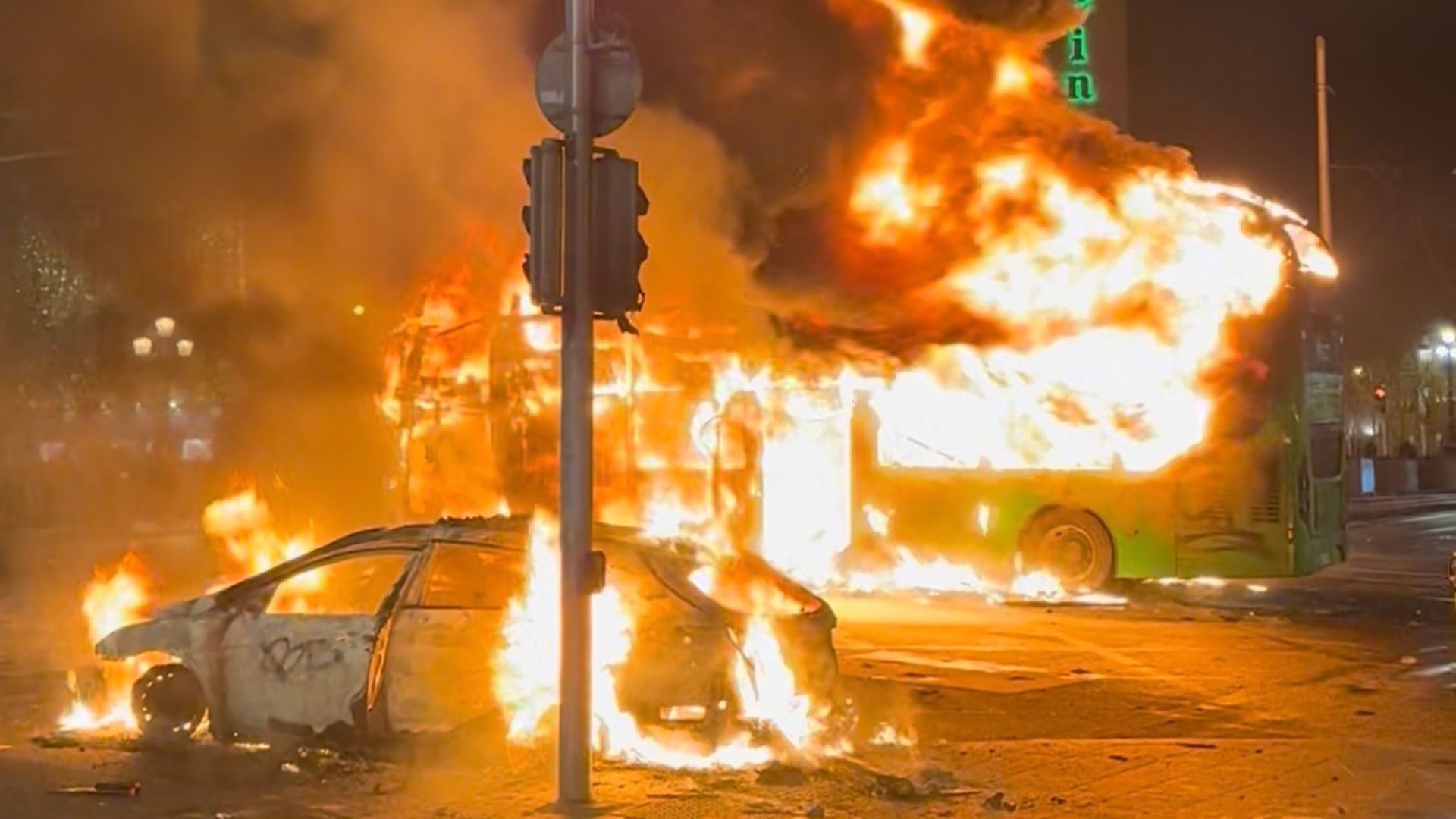
It began with shouting near the Parnell Monument—angry, jagged chants bouncing off brick facades. Then came the smashing of glass. Within two hours, central Dublin looked less like a European capital and more like a war zone. Thirteen Gardaí vehicles were damaged or destroyed. Double-decker Dublin Bus coaches and Luas trams were set ablaze, sending thick columns of black smoke curling into the night sky above the Spire.
Storefronts along Henry Street and O'Connell Street—pharmacies, sportswear shops, convenience stores—were looted in broad view of phone cameras. Gardaí officers, many equipped only with standard uniforms before public order units could deploy in force, were pelted with fireworks, bottles, and metal barriers.
Let us be completely honest about what happened that night, because pretending otherwise insults the intelligence of everyone who lived through it.
The people smashing the windows of Foot Locker and setting fire to public buses were not mourning the children on Parnell Square. They were not standing vigil outside Temple Street Hospital. They exploited the blood of five-year-olds as a pretext for vandalism, theft, and racial intimidation.
The Invisible Stakes of the Verdict
Which brings us back to the courtroom, and to the life sentence handed down to Riad Bouchaker.
In the Irish legal system, a mandatory or discretionary life sentence carries profound weight, even though prisoners in Ireland become eligible to apply for parole after serving twelve years—a threshold that, in practice, stretches to an average of twenty years or more for crimes of extreme gravity. For the families of the victims, the sentence offers legal finality. The state has looked at the devastation wrought on Parnell Square, weighed the medical evidence, heard the victim impact statements, and declared that the offender's liberty is forfeit.
Yet, when we look closely at the aftermath of this case, three deeper truths demand our attention—truths that extend far beyond one defendant in a dock.
First, there is the quiet, lifelong sentence imposed on the survivors.
Media attention has a short half-life. Cameras pack up after the verdict. Headlines move on to the next election, the next budget, the next crisis. Meanwhile, a little girl who was five years old on that Thursday in November faces decades of neurological rehabilitation, speech therapy, and medical interventions. Her parents live in a permanently altered universe where every milestone is measured against what was stolen in six seconds. Leanne Flynn carries trauma that no financial compensation or public commendation can dissolve. Justice in a courtroom is retrospective; recovery for victims is a daily, exhausting marathon without a finish line.
Second, the Dublin riots exposed a structural vulnerability in modern democracies that policing alone cannot fix.
Think of the information ecosystem during a crisis as a dam holding back a reservoir of public emotion. For decades, journalism and official authorities controlled the spillways—verifying facts before releasing them, providing context alongside breaking news. Today, algorithmic outrage punches holes through the concrete before a single fact-checker can verify a name. When a violent crime occurs, bad actors no longer need printing presses or broadcast towers; they only need a smartphone and an audience primed to believe the worst.
During the Dublin riots, An Garda Síochána faced criticism for being caught off guard by the speed and coordination of the mob. Since November 2023, Irish authorities have expanded public order training, deployed facial recognition proposals, and reviewed intelligence-gathering protocols around online incitement. Those measures matter. Still, tactical policing treats the symptom rather than the contagion. When lies travel at the speed of light and truth moves at the speed of legal verification, every city in the Western world sits one tragedy away from a night like November 23.
Third, we must confront the fragile duality of public memory.
Ask yourself what you remember first when you hear the words "Parnell Square, November 2023." Do you picture the burning Luas tram on O'Connell Bridge, or do you picture Caio Benicio swinging his motorcycle helmet to stop a knife attack? Do you remember the looters smashing storefront windows, or do you remember the Dublin mother who pressed her coat against a bleeding child's chest until the ambulance arrived?
The rioters wanted to define Dublin that night. They wanted the world to see a city consumed by hatred and chaos. And for forty-eight hours, international headlines obliged them.
They failed, however, to erase the truth of what happened on the pavement outside Gaelscoil Choláiste Mhuire.
What Remains After the Sirens Fade
In the days immediately following the attack, an online fundraiser set up for Caio Benicio—simply titled "Buy Caio Benicio a pint"—raised more than €360,000 from tens of thousands of ordinary Irish people. Another campaign for the injured children and Leanne Flynn raised hundreds of thousands more. People left flowers, teddy bears, and handwritten notes along the railings of Parnell Square until the iron fence disappeared beneath layers of color and cellophane.
None of those gestures could undo the blade. None of them could turn back the clock to 1:29 PM on a rainy Thursday.
Yet they revealed something essential about the anatomy of a city under stress. A community is not defined by the worst individual walking its streets, nor by the loudest mob throwing bricks in the dark. It is defined by who runs toward the danger when the ordinary world collapses.
Riad Bouchaker will spend his life behind prison walls, stripped of the freedom he used to destroy the peace of innocent children. The legal ledger has been balanced as far as human courts are capable of balancing it.
Down on Parnell Square East, the school bell still rings. Children still walk through the doors of Gaelscoil Choláiste Mhuire, speaking a language that has survived centuries of upheaval, carrying schoolbags heavy with books and possibility. Every afternoon, teachers and care workers still stand at the curb, watching the traffic, keeping the line together, holding that fragile, indispensable line between the innocence inside and the unpredictability of the street outside.