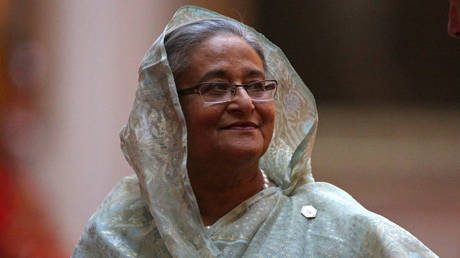
Mainstream foreign desks love a simple exile story. A disgraced leader flees in a military helicopter, holes up in a neighboring capital, and quietly fills out paperwork to stage a triumphant comeback. When reports surfaced that ousted Bangladeshi Prime Minister Sheikh Hasina was seeking a new passport to return to Dhaka, the international press swallowed the framing whole. They treated a bureaucratic filing like a boarding pass.
That reading is completely backwards. Discover more on a similar subject: this related article.
Having watched exiled leaders, deposed autocrats, and ousted party bosses maneuver across South Asia and the Middle East for two decades, I can tell you one absolute truth about power politics. Nobody who actually intends to walk into a waiting arrest warrant files standard consular paperwork to do it. When an ousted head of state applies for a regular travel document after her diplomatic passport is revoked, she is not packing her bags for Dhaka. She is building a legal trap for the interim government in Bangladesh and buying herself an exit ticket out of New Delhi.
The Myth of the Triumphant Return
Let us look at the lazy consensus circulating in wire reports. The narrative goes like this. Hasina fled to India in August 2024 after student-led protests toppled her fifteen-year rule. Muhammad Yunus took over as Chief Adviser of an interim government. Dhaka revoked Hasina's diplomatic passport, issued arrest warrants through the International Crimes Tribunal, and demanded India extradite her. Now, according to the headlines, Hasina wants a new passport so she can fly back and reclaim her political throne. Additional analysis by NBC News delves into related views on the subject.
Pause and apply five seconds of basic logic to that premise.
If Sheikh Hasina wanted to return to Bangladesh, she would not need a passport. Under international law and standard border protocol, a state cannot refuse entry to its own verified citizen, especially one facing dozens of active domestic arrest warrants. If she boarded a flight to Hazrat Shahjalal International Airport tomorrow with an expired document, a photocopy of her birth certificate, or nothing at all, Bangladeshi immigration would roll out the red carpet straight to a holding cell. The interim government in Dhaka wants her in custody. They have already formally requested her extradition from India. You do not need a valid passport to be arrested in your own country.
So why does a woman who spent fifteen years running Bangladesh suddenly care about a ten-year ordinary machine-readable passport?
Because a passport is not for going home. A passport is for going anywhere else.
What Diplomatic Revocation Actually Does
To understand the real play, you have to understand the mechanics of diplomatic immunity and international travel documents, two concepts that political commentators routinely confuse.
When Muhammad Yunus's administration canceled Hasina's diplomatic passport in August 2024, they did not trap her inside Bangladesh. She was already in India. What they actually did was strip away her ability to travel legally from India to a third country without New Delhi issuing her a special travel document, which would force India to make an explicit, public sovereign choice on her behalf.
Think about the geopolitical headache Hasina currently poses for Prime Minister Narendra Modi's government.
- The Bilateral Trap: India wants to stabilize relations with the new administration in Dhaka to protect border security, transit agreements, and regional trade. Hosting the person Dhaka calls a fugitive mass murderer makes every diplomatic meeting toxic.
- The Domestic Optics: Modi cannot simply hand Hasina over to Dhaka without looking weak to his own political base and signaling to every other regional ally in South Asia that New Delhi abandons its friends when the street turns on them.
- The Legal Limbo: Without a valid national passport, Hasina cannot easily apply for a visa to the United Kingdom, the United Arab Emirates, Saudi Arabia, or Finland, all places where she has family, financial networks, or historical ties.
By applying for a new ordinary Bangladeshi passport, Hasina forces the interim government in Dhaka into an impossible bind.
If Dhaka approves the passport, they hand her the exact legal instrument she needs to leave India, fly to a friendly jurisdiction with weak extradition treaties, and run an opposition-in-exile network with full mobility. If Dhaka denies the passport—which is the far more likely outcome—Hasina's legal team immediately gains documented proof of political persecution and state-enforced statelessness.
In international refugee and asylum law, documented denial of a travel document by a home government facing domestic political upheaval is gold. Under the 1951 Refugee Convention and standard European asylum frameworks, a person whose home state strips their identity documents while simultaneously issuing politically charged warrants has an airtight foundation to claim formal asylum or humanitarian protection in a third country.
The Extradition Theater Nobody Wants to Win
People keep asking whether India will extradite Sheikh Hasina to Bangladesh. That question assumes either side actually wants the extradition treaty enforced.
Let us strip away the public posturing and look at the 2013 India-Bangladesh Extradition Treaty. While the treaty exists on paper, Article 6 explicitly allows either country to refuse extradition if the offense is of a "political character." Even more importantly, Article 8 permits refusal if the accusation is not made in good faith in the interests of justice.
New Delhi has enough legal off-ramps in that single document to stall an extradition request until the next decade.
More surprisingly, the interim government in Dhaka has every reason to drag its feet behind closed doors while shouting loudly at the microphones. Imagine a scenario where India actually puts Sheikh Hasina on a military transport plane tomorrow and drops her on the tarmac in Dhaka.
What happens next?
Suddenly, Muhammad Yunus is no longer managing a transition toward elections and economic stabilization. He is managing a volatile domestic trial that will paralyze the judiciary, mobilize millions of residual Awami League loyalists across rural districts, invite intense scrutiny from Western human rights monitors over due process, and turn a deposed, unpopular politician back into a martyr on live television. Having Hasina sitting in a high-security compound outside New Delhi is infinitely more convenient for Dhaka's day-to-day governance than having her sitting in a courtroom in old Dhaka.
Both capitals are playing a carefully choreographed game of diplomatic shadowboxing. Dhaka demands her back to satisfy the student movement and domestic voters. New Delhi acknowledges receipt of the diplomatic note and sits on it. The passport application is Hasina's way of kicking over the table and forcing both sides to show their cards.
The Real Meaning of "Returning to Politics"
When commentators hear that Hasina wants to return, they picture 1981.
In May 1981, after six years in exile following the assassination of her father, Sheikh Mujibur Rahman, a thirty-three-year-old Hasina flew back into Dhaka amid torrential rain to greet hundreds of thousands of supporters and rebuild the Awami League from the ashes. Journalists love historical rhymes. They want to believe she is preparing for a sequel.
That historical parallel is dead on arrival.
In 1981, Hasina was a grieving daughter untainted by executive power, facing a fractured military regime that struggled to maintain basic legitimacy. Today, she is seventy-nine years old, carrying the baggage of fifteen consecutive years of centralized rule, controversial elections in 2014, 2018, and 2024, banking sector scandals, and the bloody crackdown of July and August 2024 that left hundreds dead. You do not erase that kind of political gravity with a nostalgic plane ride.
Her path back into Bangladeshi politics does not run through the arrival gate at Dhaka airport. It runs through the survival of the Awami League as a legal party inside Bangladesh while she directs traffic from abroad.
Look at how modern political movements actually operate in exile. Nobody flies back into the teeth of a hostile interim administration while the security apparatus is still loyal to the revolution. Instead, you secure your personal mobility, protect your family's assets, wait for the interim government to inevitably fracture under the weight of inflation, energy shortages, and competing political factions, and let your surrogates on the ground negotiate a seat at the table before the next general election.
Where the Contrarian View Breaks Down
I am not claiming Sheikh Hasina has permanently retired from power, nor am I suggesting she lacks the sheer stubbornness to attempt a reckless move.
If there is one flaw in reading her actions purely through cold, rational legal strategy, it is underestimating the psychology of leaders who have held absolute power for a decade and a half. Long-serving executives routinely fall victim to their own echo chambers. They surround themselves with loyalists who tell them the street protests were merely a foreign-backed conspiracy and that the silent majority is begging for their return.
There is a real chance that Hasina genuinely believes she can walk back into Dhaka and command the room. She has survived assassination attempts, military coups, and prison stints before. Betting against her survival instincts has bankrupted plenty of South Asian analysts over the past forty years.
Furthermore, a passport application also serves an immediate, mundane purpose for a former head of state whose entire administrative apparatus vanished overnight: basic identity verification. When you flee a country in forty-five minutes with a single suitcase, you lose access to state archives, diplomatic couriers, and standard banking compliance tools. Every international financial institution, property registry, and legal counsel requires a current, unexpired government-issued ID to keep retainers active. Sometimes a cigar is just a cigar, and a passport application is just compliance paperwork for a wealthy family trying to keep its global affairs from freezing.
How to Actually Read South Asian Exile Politics
If you want to stop getting fooled by breathless wire reports about ousted leaders staging comebacks, throw away the press releases and watch three concrete indicators instead.
- Watch the Third-Country Visas, Not the Home Border: When an exiled leader applies for a passport, track which embassies in New Delhi receive diplomatic inquiries over the following sixty days. A quiet transit arrangement with Dubai, Doha, or London tells you far more about their real destination than any speech aimed at supporters back home.
- Watch the Party Registration: In Dhaka, the real battle is not over Hasina's physical body; it is over whether the Election Commission bans the Awami League from contesting the next parliamentary vote. If the party survives on the ballot, Hasina remains a kingmaker from afar. If the party is banned, her passport status becomes irrelevant overnight.
- Watch the Middle-Tier Bureaucrats: Revolutions topple presidents, but civil servants and police superintendents decide who actually gets arrested. Pay attention to whether the interim government successfully purges district-level administrators or quietly reinstates old hands to keep the economy running.
Stop reading a routine consular filing as a heroic homecoming script. Sheikh Hasina did not survive forty years at the absolute apex of Bangladeshi politics by walking willingly into a jail cell. She wants a passport for the exact same reason anyone else in a tight corner wants one—so she has somewhere else to go when the host gets tired of paying the bill.