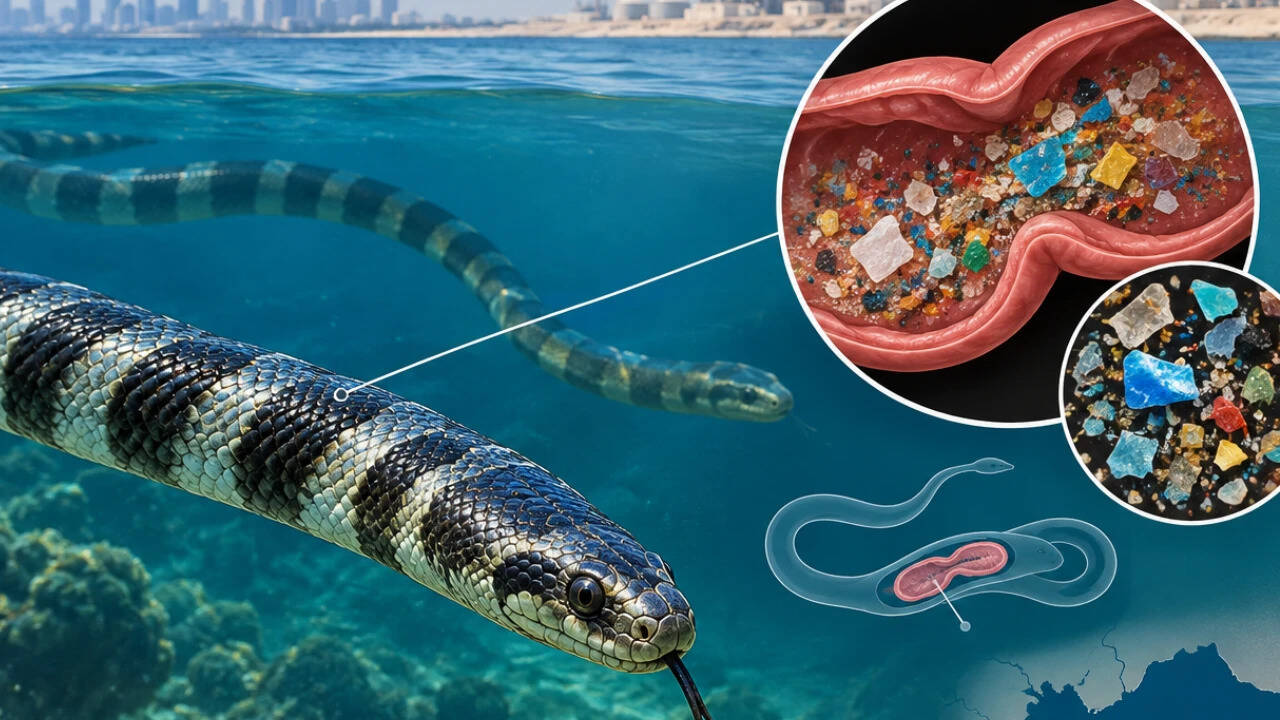
Detecting microplastics in roughly 95 percent of sampled sea snakes across six species along Sharjah's coasts establishes widespread exposure in a previously neglected marine predator, yet prevalence alone does not prove population collapse or pinpoint a single discharge pipe. To turn a headline percentage into an operational decision model, analysts must separate four elements: empirical detection, mechanistic pathways, statistical limits, and mitigation trade-offs. Standard coverage treats a high incidence rate as a self-contained verdict on ecosystem doom. A rigorous reading treats it as an early-stage baseline where exposure is documented, trophic routes are plausible, and causal attribution remains incomplete.
Deconstructing Competitor Logic and Core Findings
Surface-level reporting on marine plastic studies typically follows a compressed arc: a high percentage is cited, a single household culprit is named, and a broad warning is issued. In the case of the Sharjah coastal investigation—which examined the gastrointestinal tracts of 63 stranded sea snakes across six species spanning the Arabian Gulf and the Gulf of Oman—microplastics were found in 60 specimens (95.3 percent), totaling 390 particles at an average concentration of 9.15 plus or minus 1.47 particles per gram of tissue.
The first analytical flaw in casual summaries is conflating occurrence with dose-response harm. Presence in the gastrointestinal tract confirms contact and ingestion, not mortality or reproductive failure. Researchers tested for correlations between microplastic concentrations and co-occurring chemical contaminants—specifically polycyclic aromatic hydrocarbons, organochlorine pesticides, and heavy metals—across sea snake tissues and found no statistically significant correlations. That null result does not mean chemical co-transport never happens in nature; it means this dataset did not show a clean linear link between gut particle counts and measured tissue burdens.
The second analytical flaw is treating stranded specimens as an unbiased cross-section of healthy wild populations. Stranding introduces selection bias. Animals that wash ashore dead or moribund may differ in health status, foraging behavior, or local drift trajectories from snakes actively hunting offshore. Furthermore, sampling 63 animals across six species and two distinct basins—39 from the Arabian Gulf and 24 from the Gulf of Oman—means per-species and per-basin subsamples are small. Observed differences between younger and older snakes, or between the two water bodies, were not statistically significant and could stem from random variation rather than true ecological divergence.
Four Structural Pillars of Coastal Microplastic Exposure
Rather than viewing plastic ingestion as a single event, an operational analyst maps the system across four interacting pillars:
- Source Generation: Synthetic textiles, industrial activities, tire-wear particles, personal care products, and degraded macro-debris feed polymers into terrestrial, atmospheric, and marine reservoirs. In the Sharjah study, fibrous particles dominated, with nylon prominent, pointing toward textile washing and garment shedding as a prime candidate.
- Transport and Phase Partitioning: Once released, particles move via wastewater effluents, urban runoff, coastal currents, and airborne deposition. Polymer density and biofouling—the colonization of particles by microbes, algae, and organic matter—govern vertical distribution. Lighter polymers can float initially, while denser plastics or biofouled fibers sink toward the water column and seafloor sediments.
- Trophic Transfer: Sea snakes are carnivorous marine reptiles that feed largely on fish. Ingestion rarely requires a snake to mistake a fiber for prey; particles move up the food web when pelagic or benthic fish consume contaminated prey, suspended particles, or sediment-associated debris, transferring the load to predatory snakes.
- Retention and Clearance: A particle's residence time inside a snake depends on gut transit rates, particle geometry, and physical entanglement. Long, flexible fibers behave differently in a narrow digestive tract than rigid fragments, potentially slowing passage or interacting with mucosal surfaces even when outright gut blockage does not occur.
Cause and Effect Across Basins and Life Stages
A major blind spot in shallow commentary is ignoring hydrodynamics and habitat partitioning when comparing the Arabian Gulf and the Gulf of Oman. The Arabian Gulf is a semi-enclosed, relatively shallow marginal sea with restricted water exchange compared with the more open connectivity of the Gulf of Oman. In semi-enclosed basins with dense coastal populations, maritime activity, and desalination or industrial infrastructure, retention times for waterborne and sediment-bound pollutants can be higher, while seasonal weather events and coastal currents reshape local distributions. Even when raw counts appear higher in one basin or age class, small sample sizes prevent declaring a settled law without wider replication.
Age-related exposure involves competing mechanisms rather than a single upward line:
- Cumulative exposure over time: Older animals live longer and encounter more prey items across more seasons, creating greater opportunity for cumulative contact if retention or repeated uptake occurs.
- Ontogenetic diet shifts: Younger and older sea snakes do not always occupy identical microhabitats or consume identical prey sizes, altering which trophic compartments—surface, midwater, or benthic—dominate their intake.
- Survivorship and sampling noise: If higher exposure interacts with physiological stress in vulnerable life stages, or if sample counts per cohort are small, raw averages can swing sharply from study to study.
Equally important is separating established physics and chemistry from educated hypotheses:
- Known fact: Microplastics were detected in 60 of 63 stranded sea snakes across six species along Sharjah's coasts, with fibers—especially nylon—forming a major share of identified particles.
- Known fact: No statistically significant correlation emerged in this study between microplastic concentrations and measured levels of PAHs, organochlorine pesticides, or heavy metals in sea snake tissues.
- Educated hypothesis: Domestic laundry wastewater is a plausible contributor to the nylon and fibrous load, given how synthetic textiles shed fibers during washing and enter effluent streams.
- Educated hypothesis: Trophic transfer through fish prey links water-column and benthic microplastics to sea snakes, though direct field proof of every step in a given snake's meal history requires paired prey-and-predator sampling.
Why Standard Metrics Mislead Decision Makers
Public debates around microplastics often rely on two blunt metrics: percent prevalence and gross particle count. Both have clear failure modes when used to guide policy or research budgets.
Percent prevalence—such as 95 percent—is sensitive to detection thresholds and sample handling. If laboratory filtration captures very fine fibers and ambient air is tightly controlled, detection rates climb; if procedural blanks are not rigorously subtracted, false positives inflate counts. Moreover, a snake carrying one microscopic fiber and a snake carrying dozens both register as "positive" in a binary prevalence metric, flattening severity into a single boolean state.
Average concentration per gram of tissue improves on binary presence, yet mean values can be skewed by a few heavily loaded individuals when sample sizes are modest. In addition, reporting particle counts without polymer identification, size distribution, or shape categories hides whether the material consists of degradable-looking fragments, tire-wear-like rubbers, or persistent synthetic fibers. When researchers evaluate broader coastal waters—such as multi-site sampling across Abu Dhabi—finding microplastics across surveyed sites underscores how pervasive dispersion is and how difficult post-release removal becomes once particles enter marine circulation.
Operational Playbook for Researchers and Regulators
Turning this baseline into actionable intelligence requires a disciplined sequence rather than reactive bans or sweeping claims.
Step 1 Audit Contamination Controls and Polymer Spectra
Standardize necropsy and digestion protocols with strict procedural blanks, air-exposure controls, and spectroscopic polymer confirmation. Separate true synthetic polymers—such as nylon, polyethylene, or polypropylene—from natural cellulose fibers and non-plastic debris so reported loads reflect real polymer exposure.
Step 2 Stratify Sampling by Ecology and Basin
Expand sample sizes across defined species guilds—benthic foragers, reef associates, and pelagic drifters—across both the Arabian Gulf and the Gulf of Oman. Pair gastrointestinal analysis with stomach-content identification so trophic pathways are traced through actual consumed prey rather than assumed from species labels alone.
Step 3 Pair Exposure Metrics with Sublethal Biomarkers
Move beyond counts per gram by pairing particle characterization with tissue histology, oxidative stress markers, growth and body-condition indices, and chemical partitioning checks. Without physiological endpoints, managers cannot distinguish benign passage from chronic sublethal drag.
Step 4 Target Upstream Source Control Where Leverage Exists
Focus interventions on high-volume, controllable leakage points—such as wastewater filtration upgrades, washing-machine capture standards, stormwater traps, and single-use plastic reduction—while recognizing trade-offs. Retrofitting treatment plants carries capital and energy costs, filter maintenance burdens, and sludge-disposal questions because captured microplastics in biosolids can re-enter soil or runoff if not managed properly. No single intervention removes legacy microplastics already dispersed across marine basins.
Strategic Recommendation
Commission a coordinated, multi-year Gulf-wide sentinel monitoring program that pairs standardized fiber-and-polymer characterization in sea snakes and their primary fish prey with upstream wastewater and runoff sampling, using those empirical transfer ratios to prioritize targeted filtration and discharge controls before scaling costly interventions.