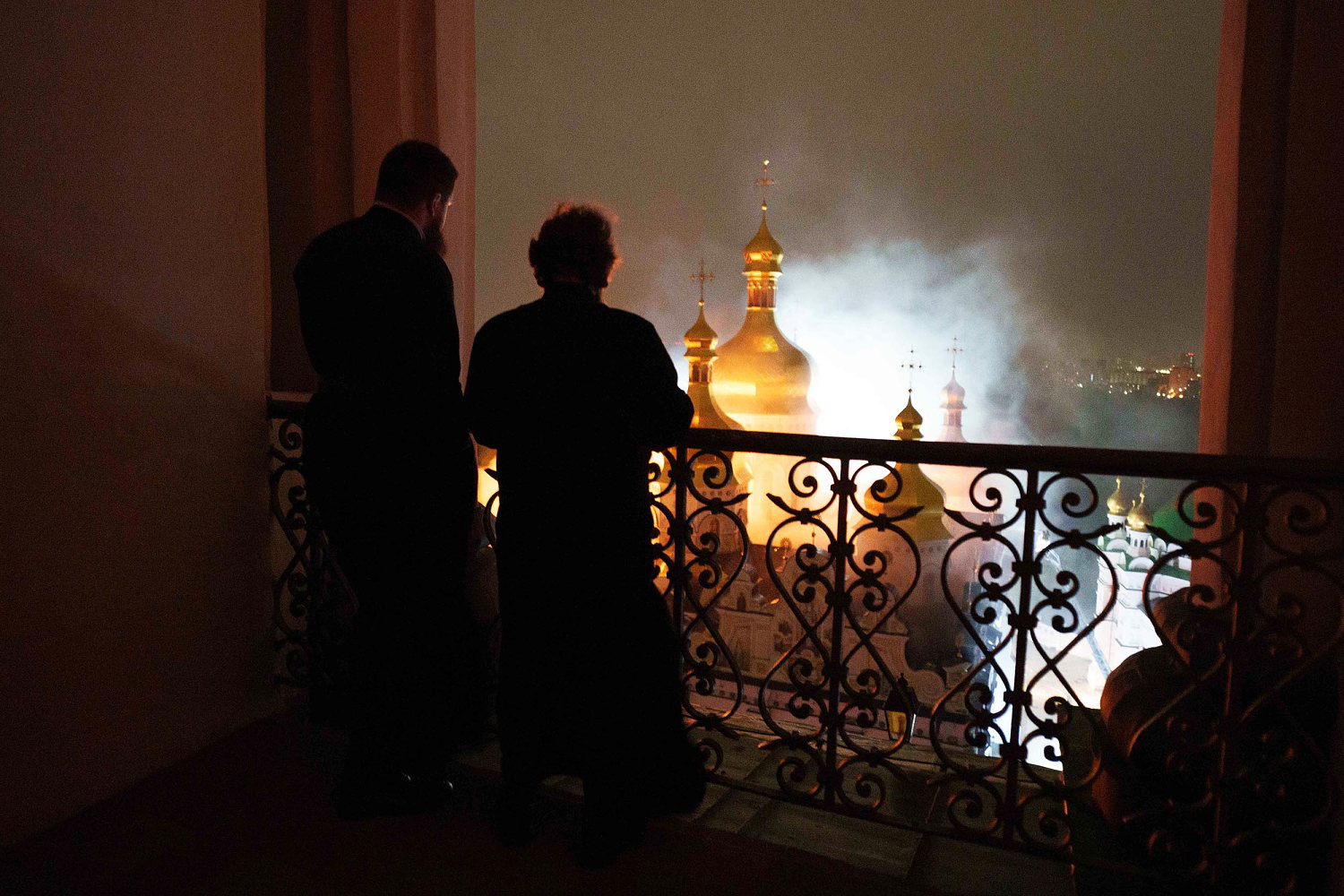
Military strikes have repeatedly targeted the Svyatohirsk Lavra, a historic Orthodox monastery located in the Donetsk region, reducing centuries-old wooden structures to ash and trapping hundreds of civilians who sought refuge within its limestone cliffs. While initial reports frequently misplace the monastery in Kyiv or treat the destruction as mere collateral damage, an investigation into the targeting patterns reveals a deeper, more systematic campaign against Ukrainian cultural and religious identity. The shelling of this historic site is not an accident of proximity to the front lines. It represents a deliberate erasure of a shared past, weaponized to enforce a specific geopolitical narrative.
The destruction at Svyatohirsk exposes a glaring contradiction in the Kremlin's stated war aims. Moscow has long claimed to protect the Ukrainian Orthodox Church of the Moscow Patriarchate, the very denomination that oversees the Svyatohirsk Lavra. Yet, when the artillery barrages began, the allegiance of the monks and the historical significance of the site offered no protection. This paradox demands a closer look at how religious infrastructure becomes a casualty of geopolitical ambition.
The Strategic Importance of the Holy Mountains
The Svyatohirsk Lavra, or the Monastery of the Holy Mountains, sits on the steep right bank of the Siverskyi Donets River. It is not just a collection of buildings. It is a massive complex carved into chalk cliffs, dating back to at least the 16th century, with some traditions tracing its origins even earlier to Byzantine monks.
From a purely military perspective, the high ground of the monastery offers a commanding view of the surrounding terrain. In the fluid combat environment of eastern Ukraine, any elevated structure becomes a potential observation post or defensive position. This reality has turned the holy site into a frontline fortress, regardless of the desires of its clergy.
The Geography of Destruction
During the heavy fighting in the Donetsk region, the monastery found itself directly in the crosshairs. The All Saints Skete, a magnificent wooden church built in the traditional Russian style of the 19th century, was completely destroyed by fire following a direct hit.
The loss was total. Timber that had survived revolutions and world wars burned to the ground in a matter of hours. The imagery of the burning skete quickly spread globally, but the structural loss was only part of the tragedy. Beneath the burning timber lay a network of caves where nearly 300 civilians, including monks, novices, and local refugees, were sheltering from the bombardment.
The Civilian Toll Underground
While artillery shells battered the surface, life inside the subterranean passages of the monastery turned into a psychological horror. The caves, designed for monastic isolation and prayer, became crowded bomb shelters.
- Lack of basic necessities: Power lines were severed early in the fighting, leaving the underground chambers in pitch darkness, lit only by candles.
- Water shortages: The filtration systems failed, forcing the occupants to ration water from the river.
- Medical emergencies: With no access to external hospitals, chronic illnesses went untreated, and injuries from shrapnel had to be managed with basic first-aid supplies.
Religious Alignment Offered No Protection
To understand the bitter irony of the Svyatohirsk attacks, one must examine the complex fractures within Ukrainian Orthodoxy. Before the full-scale invasion, Ukraine's religious sphere was deeply divided between the independent Orthodox Church of Ukraine and the Ukrainian Orthodox Church, which remained historically and canonically tied to the Moscow Patriarchate. Svyatohirsk belonged to the latter.
This affiliation was supposed to be a shield. Russian leadership had repeatedly justified its military actions by claiming to defend Orthodox believers of the Moscow Patriarchate from persecution by Kyiv. The shelling of Svyatohirsk completely shattered that rhetoric.
The Silence of the Moscow Patriarchate
As the shells fell on Svyatohirsk, the silence from the leadership of the Russian Orthodox Church in Moscow was deafening. Patriarch Kirill, who had openly blessed the military campaign, offered no public condemnation of the destruction of one of his church's most sacred sites in Ukraine.
This stance forced a profound ideological shift among the clergy inside Ukraine. Monks who had previously preached unity with the Russian church found themselves pulling the bodies of their brothers from the rubble of their own cells. The physical bombardment accelerated a canonical divorce that decades of political debate could not achieve. The Ukrainian Orthodox Church began distancing itself from Moscow, a direct consequence of the very bombs meant to enforce alignment.
The Broader Campaign Against Cultural Heritage
Svyatohirsk is not an isolated incident. It is part of a documented pattern of destruction targeting Ukrainian cultural heritage across the country. According to international observers and cultural experts, hundreds of religious sites, museums, and historical monuments have been damaged or destroyed since the conflict escalated.
+------------------------------------+-----------------------------------+
| Cultural Site Category             | Confirmed Damage/Destruction      |
+------------------------------------+-----------------------------------+
| Religious Sites (Churches/Mosques) | Over 250 locations verified       |
| Museums and Libraries              | Over 50 major institutions        |
| Historic Monuments                 | Dozens of urban landmarks         |
+------------------------------------+-----------------------------------+
This scale of destruction suggests that the targeting of cultural infrastructure is a feature, not a bug, of the military strategy. By flattening museums in Kharkiv, theaters in Mariupol, and monasteries in Donetsk, the campaign systematically erases the physical evidence of Ukraine's distinct cultural evolution.
The International Legal Framework
Under the 1954 Hague Convention for the Protection of Cultural Property in the Event of Armed Conflict, targeting historical and religious monuments is explicitly prohibited unless they are being used for military purposes. Both Russia and Ukraine are signatories to this treaty.
Proving a war crime in these circumstances requires demonstrating intent or reckless disregard for civilian and cultural infrastructure. In the case of Svyatohirsk, the repeated nature of the strikes over several weeks makes the argument of "accidental drift" difficult to sustain. The monastery complex is massive and clearly marked on every military map. The continued use of unguided heavy artillery against such a dense historical site constitutes at least a reckless disregard for international law, if not a coordinated effort to dismantle it.
Rebuilding Amid Ruins
The physical restoration of Svyatohirsk will take decades and cost millions of dollars, but the psychological and cultural reconstruction is an even greater challenge. The community that once maintained the monastery has been scattered, and the trust that bound the religious community together has been obliterated.
The Challenge of Authentic Restoration
Restoring a centuries-old wooden church is not a standard construction project. It requires specialized craftsmen who understand historical architectural techniques.
- Sourcing materials: The specific types of aged timber required to match the original structure are difficult to find in a war-torn economy.
- Artisanal skills: The intricate wood carving and traditional joinery methods are dying arts, preserved by only a handful of masters.
- Security risks: No meaningful reconstruction can begin while the region remains within range of long-range artillery and missile systems.
The immediate focus remains on stabilization. Tarps cover shattered roofs, and makeshift walls protect surviving icons from the elements. The priority is preserving what remains of the limestone foundations and preventing the cave systems from collapsing due to structural instability caused by the explosions.
The Ideological Shift
The most permanent casualty of the fire at Svyatohirsk is the concept of a shared spiritual space between Moscow and Kyiv. The smoke rising from the All Saints Skete signaled the end of an era. The monastery can be rebuilt, the wood can be replaced, and the icons can be repainted. The belief that shared faith would protect sacred ground, however, cannot be restored. The destruction of Svyatohirsk has permanently altered the religious geography of Eastern Europe, turning a symbol of monastic peace into an enduring monument to the brutality of the conflict.