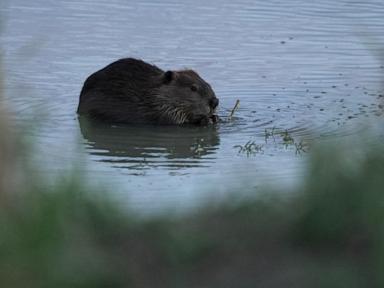
Water scarcity is no longer an abstract threat confined to meteorological projections or academic journals. Reservoirs are shrinking, snowpacks are disappearing months ahead of schedule, and agricultural sectors face severe rationing from California to the High Plains. Against this backdrop of creeping aridity, water managers and ecologists are looking past concrete dams and multi-billion-dollar desalination plants toward a remarkably low-tech solution: North American beavers.
Restoring beaver populations to degraded watersheds provides a natural mechanism for water retention, groundwater recharge, and drought mitigation. These semi-aquatic rodents alter hydrological cycles by constructing dams of mud, branches, and stone. These structures slow down high-velocity runoff during storm events, spread water across wider floodplains, and force moisture deep into the subterranean water table. When dry summer months arrive, that stored water slowly feeds the stream network, keeping channels flowing long after rain has stopped.
The Engineering of Water Storage
For over a century, federal wildlife policy treated beavers as agricultural pests or nuisances. State agencies dynamited dams, trapped colonies, and cleared riparian zones to maximize straight-line drainage. The objective was efficient water evacuation, moving spring runoff downstream as fast as possible to prevent localized flooding. That engineering philosophy created a vulnerability. Straightened channels act like drainage chutes, scouring out banks, lowering water tables, and rendering surrounding ecosystems brittle in the face of prolonged dry spells.
Beavers reverse this hydraulic degradation through decentralized engineering. A single dam creates a complex of ponds, side channels, and wetlands. This sponge-like network acts as a buffer against both extremes of the water cycle. During torrential downpours, floodwaters spill out onto adjacent floodplains, dropping sediment and dropping velocity. During droughts, those same saturated soils and elevated water tables sustain base flows in streams that would otherwise run completely dry.
Hydrologists studying restoration projects in the Intermountain West have documented measurable increases in late-summer streamflow downstream of active colonies. Subsurface storage compensates for diminished surface water. Water that infiltrates the streambed moves slowly through underground aquifers, emerging weeks or months later to maintain aquatic habitats and agricultural supplies when precipitation is zero.
Overcoming Institutional Inertia
Implementing this natural infrastructure strategy requires confronting entrenched bureaucratic habits. Traditional civil engineering relies on predictable inputs and controlled concrete outputs. Working with live animals introduces biological variables that do not fit neatly into standard infrastructure procurement cycles. Landowners often worry about flooded pastures, blocked culverts, and compromised timber.
Mitigating these conflicts requires active management rather than passive non-intervention. Flow devices, commonly known as beaver deceivers or pond levelers, allow managers to regulate maximum water heights behind dams, protecting infrastructure while preserving the ecological benefits of the wetland. Ranchers and farmers who once viewed the animals as threats are increasingly utilizing coexistence tools, recognizing that a restored water table secures their stock water and sub-irrigates forage crops through scorching July afternoons.
Financial models are shifting as well. State and federal agencies are beginning to allocate restoration grants specifically for process-based river repair, which frequently means relocating nuisance beavers to public lands or headwater streams where their engineering talent can benefit the entire watershed.
Economic Realities of Natural Infrastructure
Building traditional grey infrastructure requires massive capital investments and continuous maintenance funds. Reservoirs silt up, concrete cracks, and canals require lining. Beaver-mediated restoration scales organically. A pair of beavers establishes a colony, builds a primary dam, and proceeds to maintain it daily using locally sourced materials.
The economic calculus favors decentralized resilience. Restoring a mile of incised stream by reintroducing beavers costs a fraction of constructing an artificial recharge basin. More importantly, the ecological gains compound over time. As wetlands expand, riparian vegetation flourishes. Willows and cottonwoods stabilize banks, shade the water to reduce evaporation rates, and filter agricultural runoff before it reaches primary municipal water supplies.
Critics note that beavers cannot solve every arid-land water deficit. In deeply carved, bedrock-dominated canyons, dam construction is physically impossible. In heavily urbanized corridors, rising water tables can threaten basements and underground utilities. These limitations mean the strategy must be deployed strategically, targeting headwaters, public rangelands, and rural conservation easements where landscape-scale absorption provides maximum return on investment.
A Return to Baseline Function
The push to return beavers to depleted watersheds is ultimately an acknowledgment of ecological debt. For generations, land management assumed that human intervention could improve upon natural systems through sheer force and heavy machinery. The resulting water crises demonstrate the limits of that assumption. By allowing a native rodent to resume its historical role as a keystone ecosystem engineer, land managers are recovering lost resilience, proving that the most effective drought response involves stepping back and letting nature do the heavy lifting.