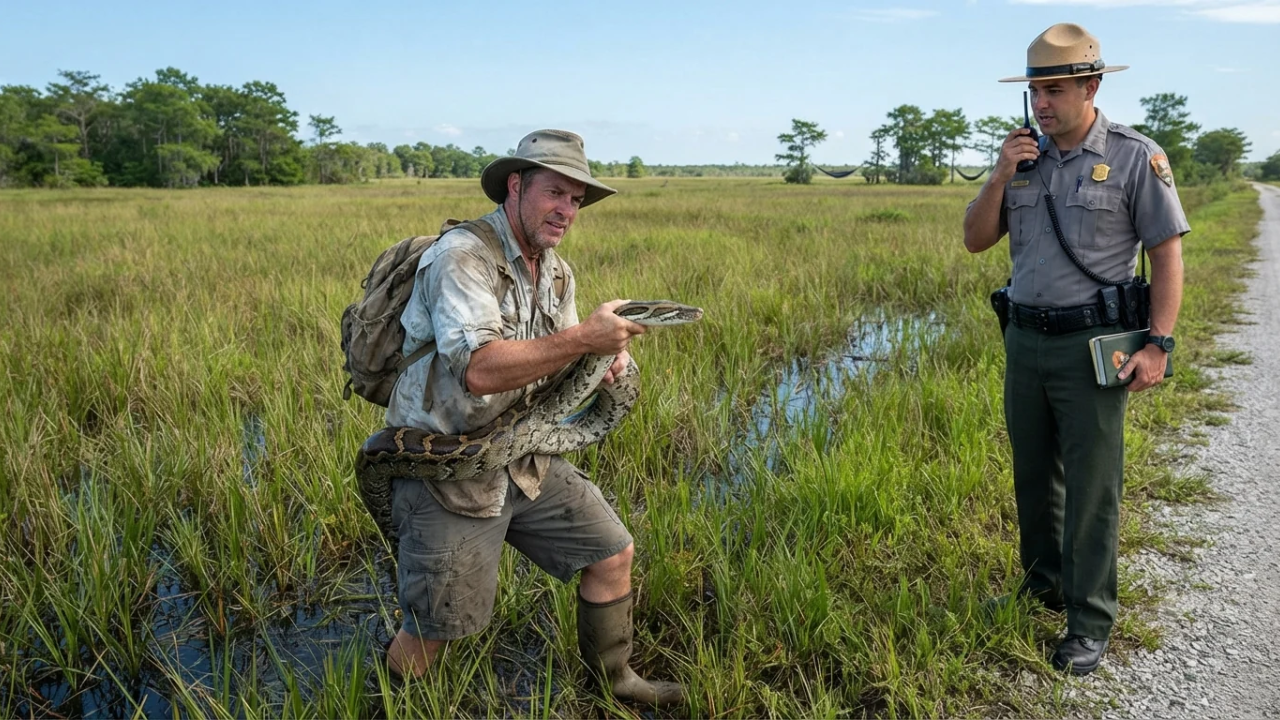
Enforcement mechanisms designed to protect native wildlife frequently collide with invasive species eradication initiatives, creating operational bottlenecks in conservation management. When a civilian in the Florida Everglades is cited with a $180 fine for physically capturing an invasive Burmese python—only for the citation to be subsequently dismissed—the incident exposes a structural misalignment between statutory wildlife protections, field-level enforcement protocols, and state-sponsored ecological mitigation goals. Understanding this friction requires decomposing the incident into its legal, ecological, and administrative components rather than treating it as an isolated viral anomaly.
The Structural Conflict Between Protection Statutes and Eradication Mandates
Wildlife management frameworks in South Florida operate under dual, often competing mandates. The first mandate focuses on preservation: preventing the harassment, capture, or removal of native flora and fauna within protected boundaries such as Everglades National Park and adjacent state-managed conservation areas. The second mandate focuses on eradication: aggressively reducing the population of Python bivittatus (the Burmese python), an apex invasive predator that has decimated native mammal populations across the region. Don't miss our earlier post on this related article.
The issuance of a $180 citation for grabbing a python illustrates the friction generated when these two mandates intersect on the ground. In protected zones, baseline regulatory rules prohibit visitors from interfering with wildlife or stepping off designated corridors to engage animals. Field officers tasked with enforcing park or wildlife management area (WMA) rules often rely on broad statutory language regarding wildlife harassment or unauthorized handling. When an individual physically seizes a snake, the immediate observable action triggers a standard enforcement protocol before the taxonomic status of the animal or the specific authorization of the handler is fully adjudicated.
The subsequent dismissal of the citation demonstrates an administrative correction rather than a policy shift. Once the incident moves from field enforcement to administrative or judicial review, the ecological status of the Burmese python overrides general anti-harassment statutes. Under Florida Fish and Wildlife Conservation Commission (FWC) regulations, Burmese pythons are classified as an invasive, non-native species with no state-level protection. They can be humanely killed on private land at any time with landowner permission and without a permit, and they are actively targeted across 32 FWC-managed lands. However, the jurisdictional boundary between state-managed WMAs and federally managed National Park Service (NPS) lands introduces distinct legal thresholds. If you want more about the history of this, Al Jazeera provides an informative summary.
Jurisdictional Boundaries and Authorization Thresholds
A primary driver of enforcement inconsistency in the Everglades is the patchwork of overlapping jurisdictions. The Greater Everglades ecosystem is not a single regulatory monolith; it is divided among federal, state, and local authorities, each enforcing different statutory codes.
- Federal Lands (Everglades National Park): Managed by the National Park Service under Title 36 of the Code of Federal Regulations. Within park boundaries, the taking, possessing, or disturbing of any wildlife—native or non-native—is strictly prohibited unless the individual is a specifically authorized agent or contractor operating under a federal research or eradication permit. A civilian grabbing a python inside the park violates federal code regardless of the species' invasive status.
- State Wildlife Management Areas (WMAs): Managed by the FWC under Florida Administrative Code. In designated WMAs, the state actively encourages public participation in python removal to supplement contracted hunters. No hunting license or permit is required to remove pythons in many of these zones, provided the methods used adhere to state humane-killing guidelines and general area regulations (such as prohibitions against discharging firearms in certain sectors or obstructing roadways).
- Public Right-of-Ways and Levees: Managed by entities such as the South Florida Water Management District (SFWMD). Roadways like Tamiami Trail (U.S. Route 41) or remote levee roads present distinct safety hazards. Law enforcement officers patrolling these corridors must balance invasive species removal against traffic safety, trespassing laws, and public endangerment.
When a citation is issued for grabbing a python, the underlying infraction is rarely tied to the welfare of the snake. Instead, the citation typically stems from secondary regulatory violations: operating in a restricted zone, creating a roadside hazard, lacking specific federal authorization within NPS boundaries, or violating local park ordinances regarding the physical handling of wildlife by unvetted members of the public. The dismissal of the $180 fine indicates that upon review, prosecutors or agency administrators determined either that the individual operated within an FWC-authorized zone where public removal is permitted, or that penalizing a civilian for removing an apex invasive predator ran counter to the broader public interest and state conservation objectives.
The Economics of Civilian Crowdsourcing Versus Contracted Eradication
To evaluate why administrative bodies routinely drop citations against civilians removing pythons, one must examine the cost function of invasive species management. Eradicating a cryptic, semi-aquatic predator across 1.5 million acres of sawgrass marsh and cypress swamp presents a severe detection problem.
Burmese pythons possess exceptionally low detection probabilities. Research conducted by the U.S. Geological Survey (USGS) and academic institutions consistently demonstrates that visual survey detection rates for Burmese pythons in the Everglades are frequently below 1% to 5%. Because the snakes are ambush predators with effective camouflage and spend substantial time submerged or hidden in dense vegetation, traditional wildlife management techniques—such as trapping or systematic grid searches—yield diminishing returns per labor hour.
State agencies address this low detection probability through two primary labor models:
- Contracted Specialist Programs: Programs operated by the FWC and SFWMD pay vetted contractors an hourly wage plus performance bounties based on the length of the captured snake and the discovery of active nests. While contractors provide high operational reliability, guaranteed humane euthanasia, and accurate GPS data collection, their geographic coverage is constrained by budget allocations and personnel limits.
- Civilian Crowdsourcing and Annual Challenges: Events like the Florida Python Challenge and year-round public removal initiatives leverage thousands of unpaid participants to increase search effort across accessible corridors, particularly levees and roadways during nocturnal hours when pythons move across warm asphalt.
The economic value of civilian removal lies in zero-cost search effort. Every reproductive female python removed by a civilian eliminates a clutch of 30 to 100 eggs at no direct payroll expense to the state. If law enforcement agencies strictly penalize opportunistic civilian captures with $180 fines, they introduce a financial disincentive that suppresses unpaid search effort. The dismissal of the fine reflects an implicit cost-benefit calculation: enforcing a minor regulatory infraction yields negligible revenue while actively undermining a high-leverage ecological mitigation strategy.
Operational Risks of Unregulated Civilian Engagement
While the dismissal of the citation aligns with eradication economics, the initial issuance of the fine highlights genuine operational hazards that agencies cannot ignore. Encouraging untrained civilians to physically capture large constrictors introduces distinct liability and ecological risks.
The first risk is physical injury and public safety. Adult Burmese pythons in the Everglades routinely exceed 10 to 15 feet in length and weigh over 100 pounds. While non-venomous, a constrictor of this size possesses substantial muscular force and rows of recurved teeth designed to secure prey. An untrained individual attempting to grab a large python by hand—particularly near open water or at night along active highways—faces risks of severe lacerations, constriction injuries, or vehicular collisions. Law enforcement officers issue citations in part to deter reckless behavior that could necessitate emergency medical evacuations in remote terrain.
The second risk is misidentification of native fauna. South Florida is home to several large native snakes that superficial observers frequently confuse with juvenile or sub-adult Burmese pythons. These include the eastern indigo snake (Drymarchon couperi), a federally threatened species protected under the Endangered Species Act, as well as native water snakes (Nerodia species) and rat snakes (Pantherophis species). Unregulated civilian handling increases the probability that protected native species are harassed, injured, or killed under the mistaken assumption that they are invasive pythons.
The third risk involves animal welfare and euthanasia compliance. State regulations mandate that captured invasive species be killed humanely—typically via a captive bolt gun or a firearm applied directly to the brain—to prevent unnecessary suffering. Capturing a python alive without the tools or training to execute immediate, humane euthanasia often results in prolonged stress for the animal or illegal transport of live Class III wildlife, as Florida law strictly prohibits transporting live wild-caught pythons without specific permits.
Strategic Alignment of Enforcement and Conservation Policy
The cycle of issuing and subsequently dismissing citations for python capture indicates a communication and policy gap between field enforcement officers and wildlife management administrators. Relying on post-hoc judicial dismissals to resolve regulatory ambiguity is an inefficient administrative mechanism that wastes court resources and creates confusion among both visitors and law enforcement personnel.
To eliminate this friction, conservation agencies and law enforcement divisions must implement clearer operational boundaries and standardized field protocols:
- Geofenced Regulatory Clarity: Signage and digital mapping tools along major Everglades corridors—such as U.S. Route 41, Card Sound Road, and levee access points—must explicitly delineate where federal National Park rules apply versus where state FWC public removal rules govern. Ambiguity at jurisdictional borders is the primary catalyst for erroneous citations.
- Standardized Field Triage Protocols: Law enforcement officers patrolling multi-use corridors require clear decision trees for civilian python encounters. Rather than defaulting to general wildlife harassment citations, officers should evaluate three variables: species verification, location safety (e.g., off the active roadway), and compliance with live-transport prohibitions. If an individual has safely secured a verified Burmese python on state-managed land without obstructing traffic, the protocol should favor confiscation and proper disposal over punitive citation.
- Integration of Opportunistic Captures into Data Pipelines: Every python removed from the ecosystem carries valuable biological data, including snout-vent length, sex, reproductive status, and stomach contents. Rather than penalizing civilians who capture pythons opportunistically, agencies should establish streamlined drop-off stations or mobile reporting protocols at ranger stations and WMA check-ins. Converting an unpermitted capture into a logged biological data point maximizes the scientific return of the event while ensuring the animal is humanely euthanized by trained personnel.
The dismissal of a $180 fine for grabbing a python demonstrates that ecological priorities ultimately supersede minor procedural infractions in the Everglades. However, until field-level enforcement protocols are formally synchronized with state eradication incentives, frontline officers and the public will continue to navigate an inconsistent regulatory environment.