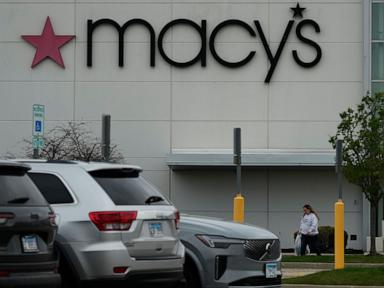
The floorboards of an old department store have a specific cadence. If you stand near the cosmetics counter at Herald Square on a rainy Tuesday morning, you can hear it beneath the hum of the escalators—a low, rhythmic creaking of joists that have held up the weight of millions of human ambitions since 1902.
For a long time, the smart money said those floorboards were rotting.
Every retail analyst with a spreadsheet and a Wi-Fi connection had already written the obituary. The narrative was clean, clinical, and seemingly inevitable: ecommerce was the new god, and the traditional department store was a crumbling monument to a forgotten century. Brick-and-mortar retail wasn't just dying; it was considered an embarrassing relic.
Then the numbers came in.
Four consecutive quarters of sales growth. An elevated annual outlook that caught Wall Street entirely off guard. While the tech giants bled market value and digital-native brands scrambled to figure out how to survive without cheap venture capital, the old guard with the red star logo quietly posted a win.
This isn't a story about supply chain optimization or digital transformation, though those words exist in the earnings report. This is a story about what happens when an institution stops trying to be a website and remembers how to be a destination.
The Ghost in the Aisles
To understand how Macy's pulled off a fourth straight quarter of growth, you have to look past the spreadsheets and look at a hypothetical shopper named Sarah.
Sarah is thirty-four. For the past few years, her relationship with clothing had become entirely transactional. She clicked a button on her phone, a plastic bag arrived on her porch two days later, and three times out of five, she sent it back because the fabric felt like sandpaper or the waist didn't sit right. It was efficient. It was also utterly joyless.
Consider what happens when Sarah decides she needs a dress for a Saturday wedding. She doesn't want an algorithm to guess her size based on her past purchases of sweatpants. She wants to feel the weight of the crepe. She wants to see how the color shifts under different lights.
When Macy's reported its recent surge, the financial commentators pointed to "inventory discipline" and "pricing power." But the real shift happened in the physical reality of the store. Macy's succeeded because they realized their biggest asset wasn't their website; it was the fact that they occupied physical space in a world that had grown suffocatingly digital.
They cleaned up the clutter. They realized that when a customer walks into a store and sees a mountain of discounted sweaters piled like a clearance graveyard, their brain registers stress. By cutting down on the noise and curating the floor, the store stopped feeling like a warehouse and started feeling like a service.
The Math Behind the Magic
The cold metrics are necessary to anchor the sentiment. Macy's didn't just stumble into these gains. They raised their adjusted earnings per share guidance to a range of $4.13 to $4.52, up from a previous estimate of $3.95 to $4.33. That is not a rounding error. That is a deliberate, calculated trajectory.
But how do you extract that kind of cash from an economy where everyone is complaining about inflation?
You do it by capturing both ends of the economic spectrum. While the core Macy's stores focused on offering recognizable brands that felt worth the money, their luxury holdings—specifically Bloomingdale's and Bluemercury—acted as financial shock absorbers.
High-end consumers didn't stop spending; they just changed what they spent money on. They wanted luxury denim, premium skincare, and the kind of high-touch service that requires an actual human being to look you in the eye and say, "That looks incredible on you."
Bloomingdale's turned in a comparable-store sales increase of 5.8%. Bluemercury, the beauty boutique arm, saw an 11.1% jump. When you see numbers like that in a volatile market, it tells you that people aren't just buying products. They are buying an experience to cure their isolation.
The Danger of the Digital Mirage
We were told that physical retail was a liability. The overhead was too high. The property taxes were too steep. The staff required healthcare and living wages.
But the digital purists forgot to calculate the hidden tax of the internet: customer acquisition cost. In the digital world, you don't pay rent to a landlord; you pay it to Meta and Google. Every year, those digital billboards get more expensive and less effective.
Macy's looked at its real estate and realized something profound. A store on a street corner isn't just a place where transactions happen. It is a giant, three-dimensional advertisement that people walk past every single day.
When a company manages its inventory correctly—meaning they don't buy ten thousand extra winter coats that they have to mark down by 70% in February—those stores become incredibly efficient cash machines. Macy's cut its inventory by 7% compared to last year. They didn't have to resort to the desperate, margin-killing clearance sales that make a brand look cheap. They held their ground.
The Human Geometry of the Store
Walk through the doors of a revitalized department store today and you will notice a change in the geometry. The counters are wider. The lighting is softer. There is an emphasis on categories that require human touch: fine fragrances, fine jewelry, tailored suits.
These are things you cannot reliably buy at 2:00 AM while scrolling in bed. They require a ceremony.
The turnaround isn't a guarantee of permanent immunity. The economic headwinds are real. Credit card delinquencies are ticking up across the industry, and consumer confidence feels as fragile as a teacup. Macy's executives admitted that they are watching the consumer closely, noting that the shopper is being highly selective about where their dollars go.
They aren't winning because the economy is great. They are winning because they are giving people a reason to choose them over the infinite, numbing scroll of the internet marketplace.
The Star Still Burns
As the sun sets over Thirty-Fourth Street, the giant red star on the side of the building begins to glow against the darkening New York sky. Inside, a cashier wraps a silk scarf in tissue paper, places it in a heavy paper bag, and hands it over the counter with a brief, genuine smile.
It is a small interaction. It happens thousands of times a day across the country.
For years, the experts looked at that interaction and saw an inefficiency that needed to be optimized out of existence by a line of code. They were wrong. That interaction is the entire point. The quarterly reports and the raised outlooks are simply the mathematical proof of a timeless human truth: we still want to go outside, we still want to touch things, and we still want to meet each other in the marketplace.