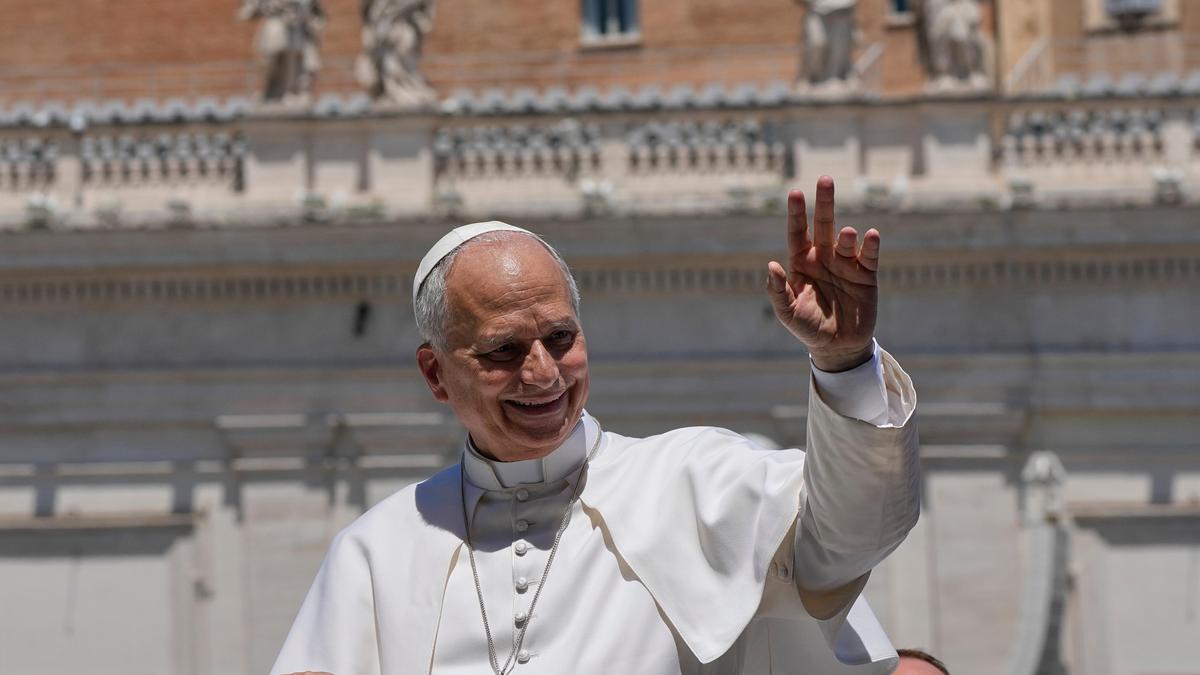
The Vatican’s traditional role as a geopolitical mediator is facing a historic crisis of relevance. On Wednesday, during his weekly audience in St. Peter's Square, Pope Leo XIV issued a blunt condemnation of the recent "sharp intensification" of the war in Ukraine, highlighting the civilian deaths, shattered homes, and destroyed places of worship caused by escalating missile and drone strikes. Yet, while the first American pontiff warns that these attacks multiply suffering and destroy any hope of security, his words are meeting a wall of strategic indifference. The brutal reality is that the Holy See's conventional diplomatic toolkit is entirely unsuited for a conflict driven by technological escalation and absolute zero-sum political goals.
Since assuming the papacy, Leo has consistently pushed for an immediate ceasefire, famously declaring that "war does not solve problems, but aggravates them." He has actively engaged both sides, conducting multiple face-to-face meetings with Ukrainian President Volodymyr Zelensky and attempting direct phone diplomacy with Russian President Vladimir Putin. The Vatican has even repeatedly offered its territory as a neutral venue for peace talks.
Every single one of these overtures has been flatly rejected or ignored by the Kremlin.
To understand why the Vatican is failing to move the needle, one must look past the moral rhetoric and examine the structural shifts in modern warfare. The Holy See is treating the Ukraine conflict as a 20th-century political dispute that can be settled via diplomatic compromise. It is not. The current escalation is defined by an irreversible attrition dynamic, fueled by rapid advancements in autonomous weaponry, industrial manufacturing gaps, and deeply entrenched geopolitical red lines.
The Broken Machinery of Papal Diplomacy
For centuries, the Vatican wielded immense leverage because it operated as a state above states, possessing an unmatched intelligence network through its global clergy and holding a unique moral monopoly. In the modern arena, that moral capital has been severely diluted.
When Pope Leo decries the "sharp intensification" of the conflict, he speaks to a global audience of faithful, but his voice carries zero weight with the military planners in Moscow or the defense ministers in Kyiv. The structural flaws in the Vatican's current approach are glaringly obvious when analyzed across three major fronts.
- The Rejection of Secular Neutrality: A peace mediator must be viewed as entirely neutral, yet both combatants view the Holy See with deep suspicion. Kyiv demands absolute solidarity against an unprovoked invasion, frequently viewing calls for a ceasefire as a tacit endorsement of territorial loss. Conversely, Moscow views the first American pope through a lens of deep-seated anti-Western skepticism, treating any Vatican initiative as a soft-power extension of NATO interests.
- The Failure of Parallel Backchannels: The Vatican has achieved minor, commendable successes in humanitarian efforts, such as coordinating prisoner-of-war exchanges and attempting to facilitate the return of deported Ukrainian children through figures like Cardinal Matteo Zuppi. However, these human-centric victories have completely failed to translate into high-level political leverage. The backchannels are open for logistics, but completely dead for peace.
- An Outdated Just War Framework: In his recent theological messaging, Pope Leo has signaled that the traditional concept of a "just war" is fundamentally obsolete in the era of modern technology. While this makes for compelling theology, it strips the Vatican of the vocabulary needed to engage with states that still view military force as a legitimate and necessary tool of national survival or imperial expansion.
The Technology Chasm
The primary reason moral appeals fall flat is that the war is currently dictated by an accelerating technological loop. As President Zelensky noted during a recent exchange with the pontiff, Russian strikes involving hundreds of Shahed drones and cruise missiles continue to batter Ukrainian infrastructure without a single hour of rest.
The battlefield has evolved into a hyper-automated environment where algorithms and industrial capacity matter far more than diplomatic sentiment.
Consider the raw logistics of the current attrition cycle. Russia has aggressively expanded its domestic manufacturing, producing artillery shells and long-range strike assets at a pace that consistently outstrips Western donation schedules. When the Vatican calls for weapons to fall silent, it ignores the industrial momentum behind the hardware. A factory line in the Urals or a drone assembly plant cannot be deterred by an encyclical on human dignity.
Furthermore, the rise of AI-directed warfare—a trend Pope Leo heavily criticized in his first major encyclical, Magnifica Humanitas—has created a faster, more detached command structure. When military decisions are increasingly optimized by data streams and predictive models, the human element that papal diplomacy traditionally targeted is systematically removed from the equation. The "spiral of annihilation" the pope warns against is not just a moral descent; it is a literal, automated loop of targeting and execution that operates independently of ethical constraints.
The Illusion of the Easter Ceasefire
The depth of the Vatican’s diplomatic isolation was laid bare during recent attempts to broker a humanitarian truce. Pope Leo pushed heavily for a ceasefire to coincide with the Easter holidays, hoping a temporary pause would open a window for broader dialogue.
The response was a massive, coordinated aerial assault across five Ukrainian regions.
This stark rejection highlights a fundamental misunderstanding of the Kremlin’s strategic calculus. For Moscow, a ceasefire is not a stepping stone to peace; it is a tactical liability or a restructuring window. Western intelligence estimates have repeatedly shown that Russia views any pause in hostilities through a purely transactional lens—an opportunity to resupply frontline units, fortify occupied territories, and recalibrate logistics.
Kyiv holds a similarly rigid view, recognizing that a premature ceasefire without ironclad international security guarantees would simply freeze the front lines, legitimizing the occupation of its sovereign territory and leaving the nation vulnerable to a renewed assault down the road. By advocating for a ceasefire in a vacuum, the Vatican inadvertently asks both sides to compromise on what they perceive as existential imperatives.
A Hard Reality for the Holy See
If the Vatican wishes to regain its status as a consequential global mediator, it must abandon the naive assumption that moral persuasion can halt an industrial war. The Holy See cannot sharm or lecture two deeply dug-in adversaries into submission.
Instead of issuing repetitive statements decrying escalation from the safety of the Apostolic Palace, papal diplomacy must pivot to a framework grounded in observable geopolitical realities. The Vatican needs to leverage its remaining assets where they actually matter. It should double down on its role as a hard-nosed logistical facilitator for specific humanitarian crises, rather than pretending it can negotiate a comprehensive post-war border settlement.
Peace will not be achieved by wishing away the weapons. It will only come when the material costs of continuing the conflict outweigh the strategic benefits for the parties involved. Until the Vatican aligns its diplomatic strategies with that brutal truth, its public pronouncements will remain nothing more than white noise in a sky filled with missiles.