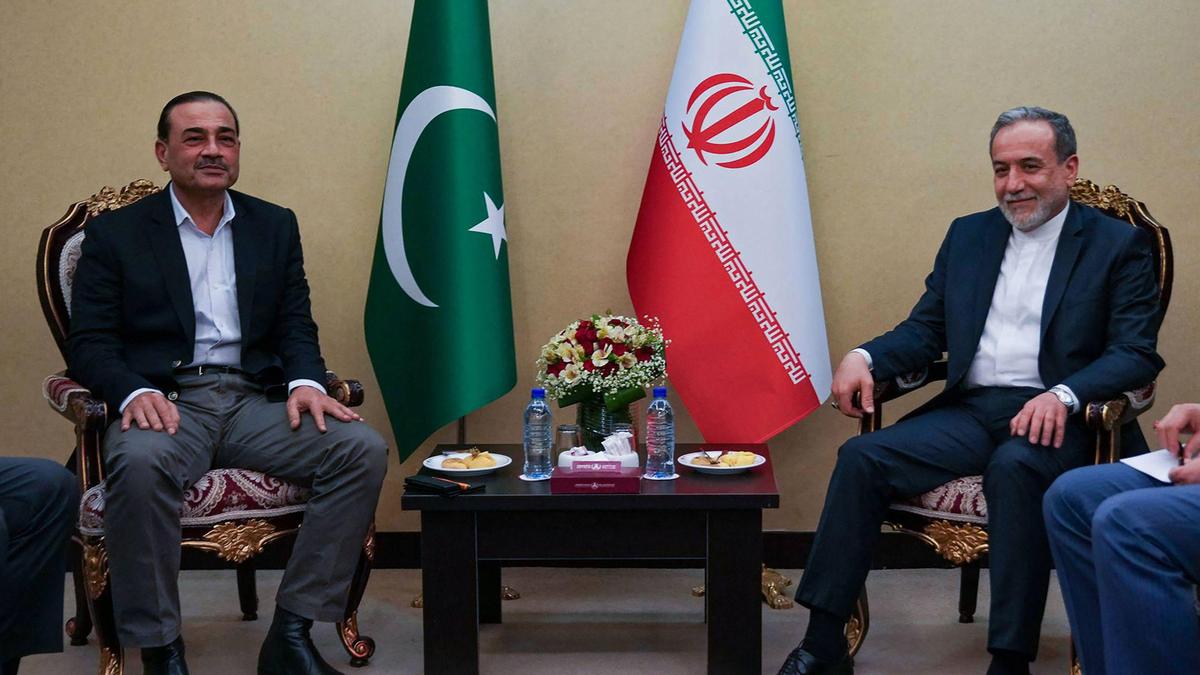
General Asim Munir did not travel to Tehran to talk about peace in the abstract sense. When Pakistan’s Army Chief meets with Iranian Foreign Minister Abbas Araghchi, the agenda is rarely about regional harmony and almost always about the cold, hard mechanics of survival. While official press releases describe a shared vision for Middle Eastern stability, the underlying truth is far more transactional. Pakistan is currently caught between its long-standing reliance on Gulf capital and the physical reality of a 900-kilometer border with an increasingly assertive Iran.
The meeting between Munir and Araghchi serves as a high-stakes recalibration of a relationship that nearly collapsed in early 2024 following cross-border missile strikes. For Islamabad, the primary objective is to prevent a two-front security nightmare. With the Taliban-led government in Kabul increasingly hostile and the domestic insurgency in Balochistan gaining ground, Munir cannot afford a hot border with Iran. Araghchi, representing a Tehran squeezed by Western sanctions and bracing for potential escalation with Israel, needs a neutral, if not friendly, eastern flank. This isn't diplomacy; it's a mutual insurance policy.
The Balochistan Powder Keg
The most urgent driver of this high-level meeting is the escalating violence in the Balochistan region, which straddles both nations. The Baloch Liberation Army (BLA) and other separatist groups have become more sophisticated, frequently launching attacks that disrupt Chinese-funded infrastructure projects.
For the Pakistan Army, these insurgents are a direct threat to the country’s economic lifeline. Islamabad has long suspected that Tehran turns a blind eye to militant hideouts on the Iranian side of the border. Conversely, Tehran accuses Pakistan of allowing Sunni extremist groups like Jaish al-Adl to operate within its territory.
Munir’s visit is an attempt to formalize intelligence sharing that actually works. We have seen these agreements before, but they usually fail because the two intelligence agencies—Pakistan’s ISI and Iran’s IRGC—do not trust each other. The current desperation, however, might change the math. Both states are facing internal economic crises that make prolonged border instability unaffordable.
Breaking the Cycle of Proxy Suspicion
The traditional playbook involves both sides using proxy groups to maintain leverage. This strategy has reached a point of diminishing returns.
- The Pakistani Perspective: Stability in Sistan-Baluchestan province reduces the flow of weapons to domestic insurgents.
- The Iranian Perspective: A cooperative Pakistan prevents the U.S. or its allies from using Pakistani soil as a launchpad for covert operations against Tehran.
The Saudi Factor and the Neutrality Trap
One cannot analyze Pakistani-Iranian relations without looking at Riyadh. General Munir has spent the better part of his tenure securing billions in investment and loans from Saudi Arabia and the United Arab Emirates. Historically, this financial dependence meant Pakistan had to keep Iran at arm's length.
However, the geopolitical board has shifted. Following the China-brokered detente between Iran and Saudi Arabia, Islamabad has slightly more breathing room. Munir is attempting a delicate balancing act. He is signaling to Tehran that Pakistan will not be part of any anti-Iran military coalition, while simultaneously reassuring his Gulf benefactors that Pakistan remains their primary security partner in South Asia.
This is a dangerous game. If the conflict between Iran and Israel expands into a full-scale regional war, Pakistan’s "neutrality" will be tested. Araghchi’s visit to Islamabad earlier this month, followed by Munir’s trip to Tehran, suggests that Iran is actively lobbying Pakistan to remain on the sidelines of any U.S.-led maritime or air initiatives.
Energy Dreams and Economic Deadlocks
While security dominates the headlines, the elephant in the room is the Iran-Pakistan (IP) gas pipeline. This project has been a ghost for decades.
Iran has completed its side of the pipeline and is now threatening to take Pakistan to international arbitration, demanding billions in penalties for Islamabad’s failure to finish its section. Pakistan is stuck. If they build it, they face crippling U.S. sanctions. If they don’t, they face a massive legal bill they cannot pay.
Munir’s role here is unconventional for a military chief, but typical for a Pakistani leader who currently oversees the Special Investment Facilitation Council (SIFC). He is looking for a "security-first" workaround. There is talk of technical waivers or barter trade to bypass the dollar-dominated financial system, but these are band-aids. The pipeline is no longer just an energy project; it is a diplomatic cudgel that Tehran uses to ensure Islamabad doesn’t drift too far into the Western orbit.
The Afghan Dimension
The chaos in Afghanistan provides the third pillar of this meeting. Since the U.S. withdrawal, both Iran and Pakistan have found themselves dealing with an unpredictable Taliban government.
Both nations are struggling with a massive influx of Afghan refugees and the threat of ISIS-K. There is a shared realization that if the Afghan economy completely bottoms out, the resulting surge in migration and militancy will overwhelm both Tehran and Islamabad. Munir and Araghchi are essentially trying to coordinate a regional "containment" strategy for Afghanistan.
They want to ensure that the Taliban does not export its brand of radicalism, but their methods differ. Iran has cultivated ties with various ethnic factions within Afghanistan, while Pakistan has historically focused on the Pashtun core of the Taliban. This meeting is an attempt to align those interests before the situation in Kabul deteriorates further.
The Mechanics of Border Management
To understand the "how" of this cooperation, look at the physical border.
- Joint Border Markets: A plan to legalize trade and reduce the power of smuggling cartels.
- Fencing Projects: Pakistan is aggressively fencing the border, a move Iran initially viewed with suspicion but now increasingly accepts as a tool to control Sunni militants.
- Communication Hotlines: Establishing direct links between local commanders to prevent small skirmishes from escalating into national crises.
The Shadow of the United States
Washington remains the silent participant in every room General Munir enters. The U.S. is Pakistan’s largest export market and a key source of military hardware.
The Biden administration—and any subsequent administration—views Iranian influence in South Asia as a net negative. Munir’s challenge is to convince Washington that his engagement with Tehran is purely for "conflict de-escalation" rather than a strategic pivot.
If the U.S. perceives that Pakistan is helping Iran bypass sanctions or providing it with a strategic "back door," the IMF bailouts that keep Pakistan’s economy afloat could suddenly vanish. This is why the rhetoric coming out of Tehran and Islamabad is so carefully scripted. They must say enough to satisfy each other without saying so much that they trigger a response from the Treasury Department in D.C.
The Cost of Failure
If Munir and Araghchi fail to find a working arrangement, the consequences will be felt far beyond their borders. A hostile Iran-Pakistan relationship would likely lead to:
- A surge in sectarian violence within Pakistan’s own borders.
- The total collapse of the CPEC (China-Pakistan Economic Corridor) projects in Balochistan.
- Increased Indian influence in the Iranian port of Chabahar, which competes directly with Pakistan’s Gwadar.
The military leadership in Rawalpindi knows that the "West Asia conflict" mentioned in the press releases is a wildfire that could easily jump the fence. Their goal isn't to put out the fire in Gaza or Lebanon; it is to build a firebreak at the Pakistani border.
The current engagement is a recognition that the old ways of managing this relationship—through denial and proxy warfare—are no longer sustainable in a world where the old alliances are fracturing. Pakistan is trying to navigate a path that keeps the lights on and the borders quiet, even if it means shaking hands with a regime that much of the world wants to isolate.
This isn't a new era of friendship. It is the beginning of a cold, calculated partnership between two neighbors who have realized they are far too vulnerable to remain enemies. The true measure of this meeting won't be found in the joint statements, but in whether the guns on the border stay silent for the next six months. If the BLA launches another major strike from across the border next week, we will know that Munir’s trip was a failure, regardless of the smiles in Tehran.