Silence.
That is the first thing you notice when you step into a room where someone is actually drawing, not merely doodling to pass the time during a tedious afternoon lecture, but truly seeing the world in front of them and wrestling it onto flat paper. Your breathing slows down. The peripheral noise of expectations, schedules, and heavy, inherited duties fades until nothing exists except the scratch of graphite against toothy cotton rag and the sudden, electric flash of blue along a riverbank.
Consider what happens when the person holding that pencil happens to be thirteen years old, and the weight resting on his narrow shoulders is not a middle-school backpack, but an entire constitutional monarchy.
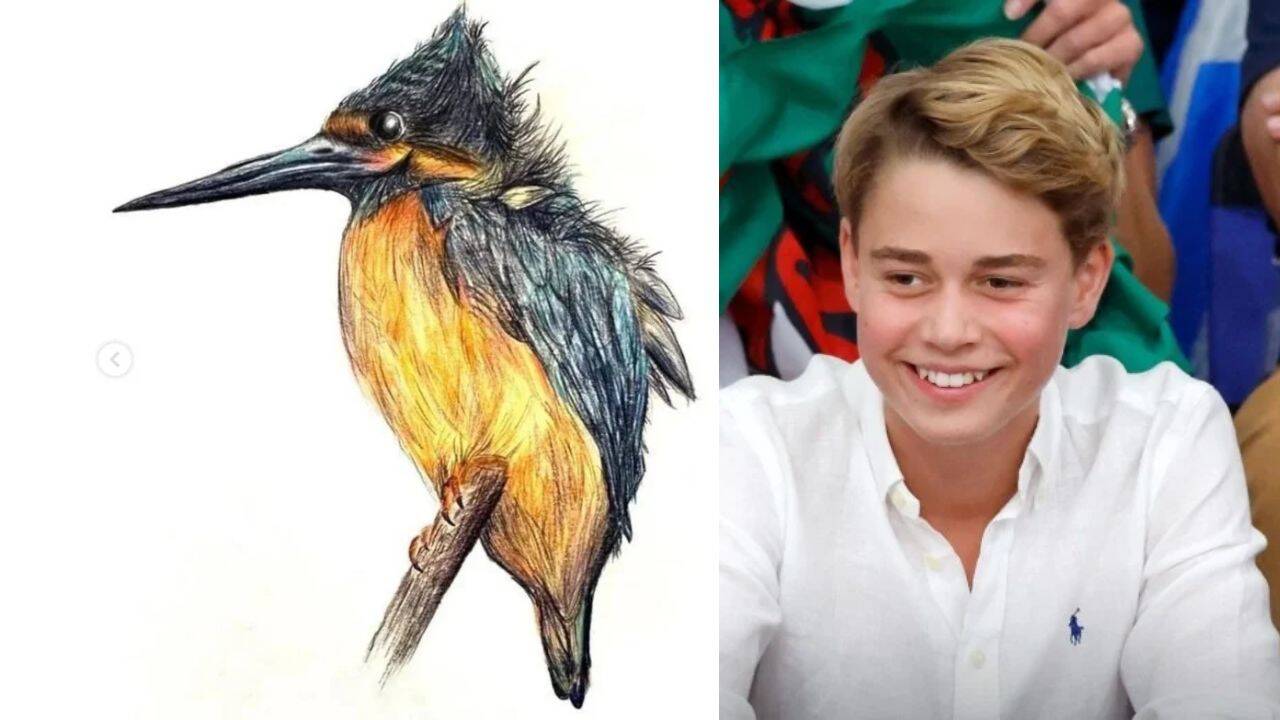
When Prince George’s drawing of a kingfisher appeared inside the pages of a magazine curated by his father, Prince William, the standard media machinery reacted with predictable, polite applause. Cute. Charming. A nice bit of royal trivia to sandwich between updates on charity galas and diplomatic tours. Most observers glanced at the illustration, noted that the heir to the British throne had inherited a steady hand, and scrolled onward.
They missed the entire story.
Because a thirteen-year-old boy choosing to sit still long enough to capture the exact posture of a shy, hyper-vigilant river bird is not a trivial footnote. It is a quiet act of survival. And if you understand what it actually takes to draw a kingfisher—or what it takes to grow up inside a gilded fishbowl where every blink is archived for posterity—you realize that single sheet of paper tells us more about the future of the British crown than a dozen carefully scripted speeches ever could.
The Architecture of Being Watched
To understand why this sketch matters, put yourself in the shoes of a boy whose entire existence was mapped out before he took his first breath. Let us imagine a hypothetical afternoon—not as a literal transcript of palace life, which remains fiercely guarded behind high walls and privacy agreements, but as a mirror to the psychological reality any teenager in his position faces.
Picture a Tuesday afternoon in late autumn. Rain streaks the tall mullioned windows of a stone house in Windsor or Norfolk. Outside, the world wants a symbol. It wants a future king who stands straight during national anthems, shakes hands with practiced warmth, wears miniature suits that echo his father’s wardrobe, and smiles on balconies while hundreds of telephoto lenses click like mechanical locusts.
Nobody asks a symbol what he thinks about the light hitting wet reeds at four in the afternoon. Nobody asks an institution how it feels when it makes a mistake.
When you grow up under that kind of ambient pressure, your nervous system learns to stay on high alert. Psychologists who study children raised in extreme public scrutiny—from child actors to political heirs—describe a specific kind of armor that forms early. You become hyper-aware of how you are perceived from the outside. You begin to edit yourself before you even speak. Your inner life risks shrinking down to a cramped, locked room while your public persona expands to fill every hallway.
I remember the first time I tried to teach a teenager under immense academic and familial pressure how to draw from life. He sat at the table with his shoulders hunched up toward his ears, gripping his pencil like a weapon, erasing every third line before the graphite had even settled into the grain of the paper. He wasn't trying to see the bowl of fruit in front of him; he was trying to guess what I wanted the drawing to look like so he wouldn't fail. It took forty minutes of silence and a strict rule—no erasers allowed—before his shoulders finally dropped two inches and he actually looked at the shadow under an apple.
Drawing refuses to let you perform. You cannot fake observation. If you rush, the proportions collapse. If you are thinking about how you look while holding the pencil, the line goes stiff and dead.
To draw well, you have to disappear from your own ego and become completely absorbed in something else.
Why a Kingfisher Is the Hardest Bird to Know
Look closely at the subject Prince George chose for his father’s publication. He did not draw a crown, a castle, a lion, or a majestic stag—the traditional, heavy-handed heraldry of British royalty that screams authority and conquest.
He drew a kingfisher.
If you have ever walked along a quiet stretch of English chalk stream or a marshy creek in Norfolk, you know that seeing a kingfisher is less like birdwatching and more like witnessing a minor hallucination. They are tiny—barely larger than a sparrow—yet engineered like miniature torpedoes. For hours, they can sit motionless on an overhanging willow branch, camouflaged against the dappled bark despite their outrageously bright plumage. Then, in the space of a heartbeat, they drop like a stone into the water, snatch a minnow with a dagger-like beak, and vanish upstream in a streak of iridescent turquoise and burnt orange.
You do not spot a kingfisher while checking your phone. You do not see one while walking in a noisy crowd surrounded by security details and chatter.
To know what a kingfisher looks like—to understand the specific tilt of its oversized head, the fierce concentration in its dark eye, the way its short tail balances the weight of that heavy bill—you have to practice radical stillness. You have to learn how to wait without fidgeting. You have to become invisible enough that nature forgets you are there.
Think about that contrast for a moment.
In his public role, Prince George is the most visible thirteen-year-old on the planet. When he steps out at Wimbledon or stands beside his parents at Trooping the Colour, millions of strangers dissect his posture, his expressions, his tailored navy suits. Yet the art he produces in private reveals a boy who knows how to disappear into quiet places and pay close attention to small, fleeting things.
There is an unmistakable lineage running through those lines, too, though not the stiff, formal lineage found in history books. King Charles III has spent decades painting watercolors of Scottish hillsides and architectural ruins, often retreating into the landscape with a sketchbook when the noise of public life became unbearable. Kate, the Princess of Wales, studied art history at St Andrews, captures candid, sunlit photographs of her children that strip away royal formality, and has spoken openly about the grounding power of nature and creative focus. Even Prince Philip painted oils in his spare time, finding in the technical problem of mixing light and shadow a rare domain where rank meant nothing and only skill mattered.
When Prince William included his son’s kingfisher illustration in a magazine project tied to his environmental and community work, it was far more than a proud father showing off refrigerator art on a global stage. It was an intentional glimpse into how the next generation is being raised differently.
The Invisible Stakes of the Next Monarchy
Let us be candid about something that royal commentators rarely admit out loud: the British monarchy is navigating one of the trickiest generational transitions in its modern history.
For seventy years, Queen Elizabeth II embodied an almost mythic stoicism—a philosophy of "never complain, never explain" that worked brilliantly in the twentieth century, when deference was woven into the social fabric and mystery preserved majesty. That world is gone. Today, the crown survives in an era of relentless digital transparency, fractured attention spans, and deep public skepticism toward inherited privilege.
If the institution feels cold, distant, or robotic, it loses the public’s emotional consent. Yet if it overshares, chasing celebrity relevance like an influencer account, it destroys the very mystique that justifies its existence.
Prince William and Catherine have spent the last decade trying to thread that needle. Watch how they manage their children’s public appearances. Unlike previous generations of royal heirs—who were either paraded constantly before the press or shipped off to harsh, emotionally distant boarding schools where sensitivity was beaten out of them—William and Catherine have guarded their children’s ordinary moments with fierce discipline.
At thirteen, Prince George stands right at the threshold where childhood ends and institutional duty begins to cast a much longer shadow. Thirteen is the age when self-consciousness hits like a freight train for any kid. Your voice changes, your limbs feel awkward, and suddenly you realize the world is judging you. Now multiply that normal adolescent vulnerability by a billion viewers.
In that context, nurturing a serious artistic practice isn't a cute hobby. It is psychological armor.
When a teenager learns to translate a three-dimensional living creature onto a two-dimensional page, something fundamental shifts in how their brain processes the world. Art teaches agency. In almost every other corner of George’s life, the script is already written—the protocols, the succession, the expectations of millions of people he will never meet. On a blank sheet of paper, however, he is the sole authority. Nobody can inherit talent. Nobody can delegate the patience required to shade the feathers along a bird’s wing or capture the tension in its perched feet. Every mark is earned through personal focus.
What We Get Backward About Talent and Privilege
It is easy to look at a young royal’s artwork with a touch of cynicism. People naturally wonder: Well, of course he can draw—he probably has access to the finest tutors, the best archival paper, and private estates teeming with wildlife.
There is truth in that observation, and pretending otherwise would be dishonest. Privilege buys quiet gardens, high-grade pencils, and uninterrupted afternoons that millions of equally talented kids in crowded city apartments never get. Ignoring that reality insults the reader’s intelligence.
And yet, anyone who has ever held a piece of charcoal or sat in front of a blank canvas knows the great, stubborn democracy of art: money cannot hold the pencil for you.
You can buy a thousand-dollar sable brush, and it will still make a clumsy, hesitant smudge if your eye is lazy. You can hire the greatest living draftsman in London to sit beside you, and the drawing will still look dead if you haven't done the quiet, internal work of actually looking at your subject without preconceptions.
Most people draw what they think a bird looks like—a generic oval body, a triangle beak, two stick legs—because our brains are wired to take shortcuts. We label things and move on. Truly drawing a kingfisher requires overriding that mental shortcut. You have to forget the word "bird" and see only angles, negative spaces, the subtle curve where the cobalt plumage of the back meets the warm rust of the chest, and the sharp glint of light on a dark pupil.
That capacity for deep, unhurried attention is becoming an endangered species in our culture, regardless of wealth or status. We live in an economy designed to shred human focus into three-second fragments. Thirteen-year-olds everywhere—from council estates in Birmingham to royal residences in Berkshire—are growing up inside algorithms engineered to keep them anxious, distracted, and performing for invisible audiences.
Seeing a boy of thirteen resist that current long enough to study a wild river bird and render it with genuine sensitivity strikes a nerve because we recognize how rare that stillness has become.
A Different Kind of Leadership
There is a second layer to this story that connects directly to why the drawing appeared in Prince William’s magazine in the first place.
Over the past several years, William has staked his public legacy on two massive, interconnected themes: protecting the natural world through initiatives like the Earthshot Prize, and tackling the human isolation that drives homelessness and mental distress. Both causes share a single root conviction—that modern society has become dangerously disconnected from the living environment and from one another.
You cannot care deeply about preserving habitats you have never noticed. You cannot protect a chalk stream or a wetland if a kingfisher is just an abstract name on a conservation spreadsheet rather than a living, breathing miracle you have watched dart beneath an alder branch.
By placing his son’s artwork inside a publication dedicated to environmental stewardship and human connection, William quietly linked personal craft to public purpose. He didn't issue a grand proclamation about the future of the crown. He didn't need to. The image did the work. It showed a boy who is learning to pay attention to the fragile things his father is trying to protect.
Think about the emotional mechanics of that collaboration between father and son.
History is littered with royal fathers and sons locked in bitter, suffocating power struggles—monarchs who viewed their heirs as impatient rivals, and heirs who grew resentful waiting in the wings while their fathers clung to relevance. Queen Victoria famously distrusted Edward VII so deeply she barred him from state papers well into middle age. Even in healthier eras, the sheer machinery of the crown often turned family relationships into formal negotiations.
Against that heavy historical backdrop, a father creating space in his own public project for his thirteen-year-old son’s quiet, creative voice feels remarkably grounded. It honors the boy as an individual with his own eyes and his own sensibility, rather than merely an understudy waiting to step into a costume.
The Marks That Remain
We often measure public figures by their loudest moments—the balcony waves, the televised coronations, the sweeping policy speeches delivered under chandeliers. Those are the scenes that fill history textbooks and documentary montages.
Yet human character is almost always forged in the margins, far away from the cameras. It takes shape in the things we choose to do when nobody is grading us, when no protocol dictates our posture, and when the only audience is a sheet of paper waiting to see if we were paying attention.
Somewhere in a drawer or a portfolio, beneath layers of tissue paper, sits the original sketch of that kingfisher. Long after the headlines move on to the next royal tour, the next diplomatic handshake, or the next ceremonial milestone, those pencil strokes will remain exactly as a thirteen-year-old boy left them: unhurried, observant, and fiercely alive—a small blue flash of wildness captured on a quiet afternoon before the noise of the world rushed back in.